
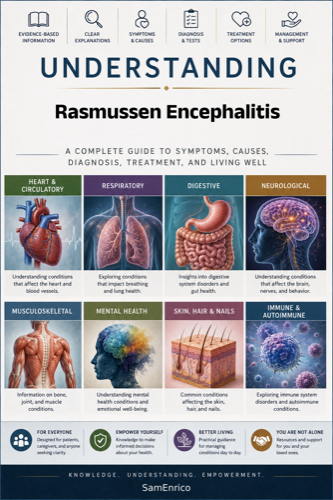
Non-FictionInformativeEducational
Understanding Rasmussen Encephalitis eBook
This condition publication, published by SamEnrico
This condition publication, published by SamEnrico, covers Understanding Rasmussen Encephalitis
Formats
Free sample
Chapter 1: The Silent War...–- When three-year-old Maya began dragging her right foot, her parents assumed she had simply tripped on the living room rug. When she started stumbling during her morning walk to preschool, they bought new sneakers. When her right hand began trembling during breakfast—just a subtle flutter, like a leaf caught in a gentle breeze—they scheduled an appointment with their pediatrician. "Toddlers are clumsy," they were told. "It will pass." It did not pass.
Within six months, Maya's right side had weakened to the point where she could no longer hold a crayon. Her seizures began as brief episodes of staring, then progressed to rhythmic jerking of her right arm that lasted for hours. By the time a neurologist finally ordered a brain MRI, half of Maya's left hemisphere had already begun to wither—a process that should have taken decades but had unfolded in less than a year. The diagnosis, when it came, sounded like a sentence: Rasmussen Encephalitis. Her parents had never heard of it.
Neither had their family doctor. Neither, as they would soon discover, had most of the specialists they consulted. This chapter opens the door to understanding that diagnosis—not as a collection of medical terms, but as a story about a war being waged inside a single hemisphere of the brain, a war that medicine is only beginning to understand how to stop.What This Chapter Will Do for You This chapter serves as the foundation for everything that follows. By the time you finish reading, you will understand what Rasmussen Encephalitis (RE) fundamentally is and—equally important—what it is not. You will learn why RE is classified as an immune-mediated disease rather than an infection, why standard seizure medications fail to control its symptoms, and how to distinguish it from other conditions that share similar features.
Most importantly, this chapter will give you a conceptual framework for the disease as a progressive, one-sided neurological catastrophe that follows its own unique logic. Whether you are a parent who has just received a devastating diagnosis, a clinician encountering RE for the first time, or a student seeking to understand one of neurology's most fascinating and frightening conditions, the information here will orient you to the terrain ahead. Let us begin with a single, crucial distinction: RE is not what most people think of when they hear the word "encephalitis."Defining the Enemy: What Rasmussen Encephalitis Actually Is The term "encephalitis" strikes fear into the hearts of most parents and clinicians alike, and for good reason. In common medical parlance, encephalitis refers to inflammation of the brain parenchyma—the functional tissue of the brain—typically caused by a viral infection. Herpes simplex virus, West Nile virus, and enteroviruses are among the usual suspects.
This form of encephalitis often presents as a medical emergency: high fever, altered mental status, seizures, and rapid neurological decline. Treatment focuses on antiviral medications, supportive care, and sometimes immunomodulation to calm the immune system's overreaction to the infection.Rasmussen Encephalitis shares only the name, not the mechanism.Unlike infectious encephalitides, RE is not caused by an active viral infection. Decades of research have failed to isolate a consistent viral pathogen from brain tissue of affected patients, although some studies have detected fragments of cytomegalovirus (CMV) or Epstein-Barr virus (EBV) in a subset of cases. Even if these viral elements prove relevant—a question we will explore in Chapter 8—RE is fundamentally an immune-mediated disorder. The immune system, for reasons that remain incompletely understood, declares war on one hemisphere of the brain and one hemisphere only.
It attacks neurons and supporting cells (astrocytes) as though they were foreign invaders. The attack is relentless, progressive, and almost entirely unilateral.Let that word sink in: unilateral. One side. One hemisphere. The left or the right, but never both.This distinguishing feature sets RE apart from nearly every other neurological disease.
Multiple sclerosis affects both hemispheres in a scattered, relapsing-remitting pattern. Viral encephalitis often affects both hemispheres symmetrically or with variable asymmetry. Autoimmune encephalitides such as anti-NMDA receptor encephalitis typically involve widespread bilateral inflammation. Even focal epilepsies, which may originate from a single region, do not progressively consume an entire hemisphere while leaving the other pristine. RE does exactly that.
As one neuroscientist put it, "RE is the disease that behaves like a hemispherectomy in reverse—instead of removing half the brain, it destroys it slowly, piece by piece, while the other half watches from the sidelines."The Hallmark: Unihemispheric Inflammation Understanding unihemispheric inflammation is essential to grasping every other aspect of RE. The disease process begins insidiously in a single region of one hemisphere—often the frontoinsular cortex, the perisylvian region, or the motor cortex—and then spreads like a slow-moving wildfire across the rest of that hemisphere. The inflammatory infiltrate consists primarily of cytotoxic CD8+ T lymphocytes, which directly kill neurons by releasing perforin and granzymes (proteins that punch holes in target cells and trigger programmed cell death). Microglia, the brain's resident immune cells, become activated and amplify the inflammatory response by secreting cytokines such as interleukin-1 (IL-1) and tumor necrosis factor-alpha (TNF-α). Over months to years, the affected hemisphere undergoes progressive atrophy—shrinkage—as neurons die and are replaced by glial scar tissue (astrogliosis).The contralateral hemisphere, meanwhile, remains entirely normal.
Not partially affected. Not mildly inflamed. Completely untouched.This remarkable selectivity has profound implications for both treatment and prognosis. Because the disease is confined to one hemisphere, surgical removal or disconnection of that hemisphere (hemispherectomy, discussed in depth in Chapter 7) can halt the disease entirely. Seizures stop.
Progression stops. The patient is left with the neurological deficits caused by the destruction of the affected hemisphere—typically hemiparesis (weakness on the opposite side of the body), hemianopia (blindness in half the visual field), and variable cognitive impairments—but the disease itself is cured. No other form of progressive encephalitis offers such a clean surgical solution, precisely because no other form respects the hemispheric boundary.Distinguishing RE from Other Encephalitides and Epilepsy Syndromes For families and clinicians navigating the diagnostic odyssey that almost always accompanies RE, distinguishing it from other conditions is a matter of urgent practical importance. Misdiagnosis delays treatment, allows disease progression to continue unchecked, and exposes patients to ineffective or even harmful therapies. This section provides a practical guide to the differential diagnosis.Viral Encephalitis As noted above, viral encephalitis typically presents with fever, altered mental status, and often bilateral or diffuse abnormalities on MRI and EEG.
Herpes simplex encephalitis, the most common cause of sporadic viral encephalitis in developed countries, has a predilection for the temporal lobes and may be unilateral in its early stages—but it progresses rapidly over days, responds to acyclovir, and does not follow the chronic, progressive course of RE. A patient who has been ill for months or years with progressive unilateral symptoms almost certainly does not have viral encephalitis.Anti-NMDA Receptor Encephalitis This autoimmune encephalitis, first described in 2007, has become increasingly recognized as a cause of severe neuropsychiatric symptoms, seizures, and movement disorders. It often presents with psychiatric symptoms (anxiety, psychosis, catatonia), followed by speech dysfunction, dyskinesias, and autonomic instability. Unlike RE, anti-NMDA receptor encephalitis is mediated by antibodies…
This is the end of the free sample. Get the eBook to keep going. Buy now
About this book
Details
- Author
- Faulkner Deandra
- Publisher
- SamEnrico
- Language
- English
- Genre
- Non-Fiction, Informative, Educational
- Released
- 2026-05-18
- Pages (approx.)
- 148
- Available as
- eBook, Audiobook

Read better in the ZLOADR app
Your eBooks on your phone or tablet. Sign in with your SamEnrico account and start reading.
More by Faulkner Deandra
 Anger De escalation for Social WorkersFaulkner Deandra$11.99
 Gambling in SeniorsFaulkner Deandra$11.99
 Baby Boomer vs Gen Z HobbiesFaulkner Deandra$11.99
 Alphabet Peg System WorkbookFaulkner Deandra$11.99
 Fear of Failure Breakthrough GuideFaulkner Deandra$11.99
 Quit Smoking for DiabetesFaulkner Deandra$11.99
 Payroll Deduction Giving GuideFaulkner Deandra$11.99
 Biotin Hair Skin GuideFaulkner Deandra$11.99
 Gilgamesh and the Lost Tablet of UrukFaulkner Deandra$11.99
 The Vanishing Heiress: The Hunt for the Missing Duchess of WindsorFaulkner Deandra$11.99
 How to Produce Sorting and Stacking ToysFaulkner Deandra$11.99
 A Collector's Handbook to the Cord 812Faulkner Deandra$11.99
You may also like
 Hong Kong Handover 1997Dunn Johnnie$11.99
 Zumba For Postnatal Recovery CourseNeal Christian$11.99
 Zumba for BeginnersLadner Nikia$11.99
 YouTube Comment Mining GuideHumes Pandora$12.99
 Worry Box MeditationCarlin Rudy$11.99
 Workplace Stress MeditationNguyen Lynn$11.99
 Workplace Stress and Sleep RepairHawley Ivory$11.99
 Workplace Perfectionism CureDelaney Jeffry$11.99
 Workplace Injustice Anger GuideWallen Isabelle$11.99
 Work Addiction and Burnout LinkGreenwood Ester$11.99
 Women in Yoga and WellnessBeattie Galina$11.99
 Women in Stand Up ComedyChun Evangeline$11.99