
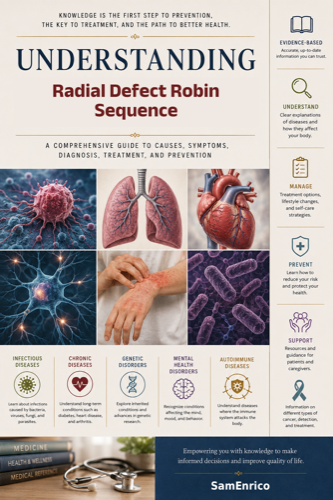
Non-FictionInformativeEducational
Understanding Radial Defect Robin Sequence eBook
This disease publication, published by SamEnrico,
This disease publication, published by SamEnrico, covers Understanding Radial Defect Robin Sequence
Formats
Free sample
Chapter 1: The Cascade Begins...--It begins not with a scream, but with a silence. In the delivery room, where the first cry is a currency of health, the infant with Robin Sequence often arrives quietly—not from lack of effort, but from an anatomical betrayal that began weeks before the mother even felt the first flutter of movement. The jaw, small and recessed, holds the tongue against the back of the throat. The palate, once meant to close, remains open like a question. And somewhere along the upper limb, the radius—that sturdy pillar of the forearm—may be thin, curved, or absent entirely.
This is Radial Defect Robin Sequence (RDRS), a condition that sits at the crossroads of craniofacial and limb development, and one that challenges nearly every system in the growing child.To understand RDRS is to understand a cascade—a series of events where one initial anomaly triggers another, and then another, until the clinical picture becomes far more than the sum of its parts. This chapter establishes the foundational terminology, historical context, epidemiological landscape, and the often-overlooked psychosocial burden that families carry from the moment of diagnosis. It is the first step in a journey that will take us from embryology to adulthood, from the operating room to the classroom, and from medical management to the art of compassionate care.The Historical Thread: From Pierre Robin to Bruce Winship Every medical condition carries the weight of its naming. In 1923, French stomatologist Pierre Robin described a triad of features: micrognathia (a small lower jaw), glossoptosis (downward displacement of the tongue), and respiratory obstruction. He recognized that these were not three separate problems but a sequence—a chain of cause and effect.
What he did not know was why the jaw failed to grow or why some of these patients also had limb anomalies.Decades later, the pieces began to fit together. In 1974, the term "Robin Sequence" was proposed to distinguish the mechanical cascade from syndromes with similar appearances but different etiologies. The word "sequence" mattered. It signaled that the cleft palate, for instance, was not a primary malformation but a secondary consequence of the tongue blocking palatal fusion. This distinction, as we will see throughout this book, has profound implications for surgical timing, genetic counseling, and parental expectations.The radial defect component entered the literature through scattered case reports until Bruce Winship and colleagues characterized a distinct phenotype combining Robin Sequence with upper limb radial ray deficiencies.
The National Institutes of Health (NIH) now recognizes "Radial defect robin sequence" as a specific entity, sometimes referred to as Bruce Winship syndrome (NIH, 2023). Yet despite this recognition, RDRS remains poorly understood compared to isolated Robin Sequence. Most textbooks treat the two conditions separately, leaving clinicians to bridge the gap themselves. This book is that bridge.Why Terminology Matters: Sequence vs. Syndrome vs.
Association One of the most common sources of confusion for both clinicians and families is the language used to describe congenital anomalies. Are these conditions syndromes? Sequences? Associations? The distinctions are not merely academic—they guide prognosis, recurrence risk, and genetic testing strategies.A sequence begins with a single structural anomaly that sets off a cascade.
In Robin Sequence, the initiating event is mandibular hypoplasia. That small jaw displaces the tongue backward (glossoptosis), which then prevents the palatal shelves from fusing normally, resulting in a U-shaped cleft palate. The airway obstruction is the final common pathway. Importantly, once the cascade is triggered, the sequence unfolds regardless of the underlying cause. This is why children with Stickler syndrome (a genetic condition) and children with Treacher Collins (another genetic condition) can both exhibit the exact same Robin Sequence phenotype.
The sequence is the final common pathway, not the root diagnosis.A syndrome, by contrast, is a collection of anomalies that occur together because of a single underlying cause—usually a genetic mutation, chromosomal abnormality, or teratogenic exposure. In a syndrome, the anomalies are not mechanically linked; they arise independently from the same root insult. For example, Stickler syndrome includes ocular, articular, and craniofacial features that do not cause one another but all result from collagen gene mutations.An association lies somewhere in between. It describes a non-random co-occurrence of anomalies that appear together more often than expected by chance, but without a known unifying cause. VACTERL association (vertebral, anal, cardiac, tracheoesophageal, renal, limb) is the classic example.
Some patients with RDRS fit into the VACTERL framework, while others have identifiable single-gene disorders.Why does this matter for Chapter 1? Because when a parent is told their child has "Robin Sequence with a radial defect," they need to know whether they are looking at a sequence superimposed on a syndrome, or a true association, or something else entirely. As we will explore in Chapter 3, most cases of RDRS are syndromic—meaning there is an underlying genetic diagnosis waiting to be found. But the sequence itself—the small jaw, the tongue displacement, the airway compromise—requires management regardless of the root cause.Defining the Dual Diagnosis: Isolated RS vs. Radial Defect Robin Sequence Isolated Robin Sequence refers to patients who have the classic triad (micrognathia, glossoptosis, airway obstruction) with or without a cleft palate, but no other systemic anomalies.
These patients generally have better outcomes, lower rates of associated medical complications, and a lower likelihood of an identifiable genetic syndrome. Their mandibles often show significant catch-up growth, and their airway obstruction typically resolves with conservative management or single-stage surgery.Radial Defect Robin Sequence is a different entity. These patients have all the features of Robin Sequence plus a radial ray deficiency—a spectrum of upper limb anomalies ranging from mild hypoplasia of the thumb to complete absence of the radius. The radial ray includes the thumb, the radius bone, the scaphoid, and the trapezium. Deficiencies can affect any or all of these structures, unilaterally or bilaterally, symmetrically or asymmetrically.The presence of a radial defect fundamentally alters the clinical picture.
First, it nearly guarantees that the condition is syndromic. Second, it introduces functional challenges—prehension, grasp, and activities of daily living—that require separate management from the craniofacial team. Third, it changes the risk profile for associated anomalies. Patients with RDRS have higher rates of cardiac, renal, and vertebral abnormalities than those with isolated RS. Fourth, it complicates basic care: positioning a child prone to relieve airway obstruction may be impossible if both upper limbs have significant deficiencies.
As we will see in Chapter 5, this seemingly simple intervention—turning the baby onto their stomach—may be contraindicated in RDRS, forcing clinicians to move more quickly to surgical airway management.Epidemiology: How Rare Is Rare?Numbers matter to families. They want to know: Is my child alone in this? How many others are walking this path?Isolated Robin Sequence occurs in approximately 1 in 8,500 to 1 in 14,000 live births (Seminars in Orthodontics, 2020; Seattle Children's, 2023). The wide range reflects differences in diagnostic criteria—some studies include only patients with cleft palate, while others include those with micrognathia and airway obstruction regardless of palatal status. Males and females are affected equally.Radial Defect Robin Sequence is significantly rarer.
No large-scale population studies exist exclusively for RDRS, but data from craniofacial and limb anomaly registries suggest an incidence perhaps…
This is the end of the free sample. Get the eBook to keep going. Buy now
About this book
Details
- Author
- Nance Jefferson
- Publisher
- SamEnrico
- Language
- English
- Genre
- Non-Fiction, Informative, Educational
- Released
- 2026-06-02
- Pages (approx.)
- 138
- Available as
- eBook, Audiobook

Read better in the ZLOADR app
Your eBooks on your phone or tablet. Sign in with your SamEnrico account and start reading.
More by Nance Jefferson
 Disability Financial CopingNance Jefferson$11.99
 Carson Daly TRL to TodayNance Jefferson$11.99
 Weekend Email Anger Management WorkbookNance Jefferson$11.99
 Nobel Laureates in Developmental BiologyNance Jefferson$11.99
 The Friend Betrayal ResentmentNance Jefferson$11.99
 The Oxford Plague Chronicles: How Medieval Scholars Defied the Black DeathNance Jefferson$11.99
 Graduate AnalystNance Jefferson$11.99
 Export Payment Fraud PreventionNance Jefferson$12.99
 Airtable PLG GuideNance Jefferson$12.99
 How to Start a Organo-sulphur Compounds Business (Beginners Guide)Nance Jefferson$11.99
You may also like
 Hong Kong Handover 1997Dunn Johnnie$11.99
 Zumba For Postnatal Recovery CourseNeal Christian$11.99
 Zumba for BeginnersLadner Nikia$11.99
 YouTube Comment Mining GuideHumes Pandora$12.99
 Worry Box MeditationCarlin Rudy$11.99
 Workplace Stress MeditationNguyen Lynn$11.99
 Workplace Stress and Sleep RepairHawley Ivory$11.99
 Workplace Perfectionism CureDelaney Jeffry$11.99
 Workplace Injustice Anger GuideWallen Isabelle$11.99
 Work Addiction and Burnout LinkGreenwood Ester$11.99
 Women in Yoga and WellnessBeattie Galina$11.99
 Women in Stand Up ComedyChun Evangeline$11.99