
Non-FictionInformativeEducational
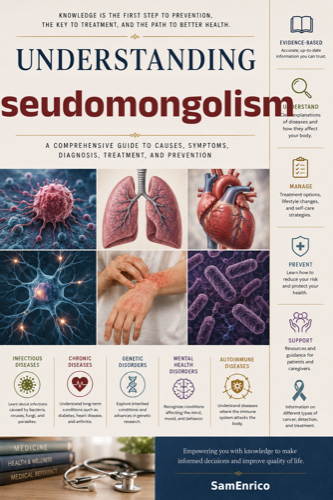
Understanding Pseudomongolism eBook
This disease publication, published by SamEnrico,
by Belt Sean
This disease publication, published by SamEnrico, covers Understanding Pseudomongolism
Formats
Free sample
Chapter 1: The Ghost Diagnosis...--In the summer of 1972, a three-month-old girl named Theresa was brought to a university genetics clinic in Chicago. Her parents had been told at birth that she had Down syndrome – the flat facial profile, the up-slanting eyes, the single crease across her palms, the profound hypotonia that made her feel like a rag doll when held. The delivering obstetrician had been certain. The pediatrician had agreed. The diagnosis seemed as obvious as any in medicine.But the karyotype came back normal.
Forty-six chromosomes, perfectly arranged. No extra chromosome 21. No translocation. No mosaicism.The parents were told something that would haunt them for years: "It looks like Down syndrome, but it isn't. We don't know what it is.
Let's call it Pseudomongolism and see how she develops."Theresa died fourteen months later. An autopsy revealed something the clinicians had missed: her liver was cirrhotic, her kidneys were cystic, and her brain showed profound abnormal myelination. She had Zellweger syndrome – a peroxisomal biogenesis disorder that is uniformly fatal in infancy. Had anyone recognized the signs – the striking hypotonia that was far more severe than typical Down syndrome, the seizures that began at two months, the hepatomegaly that her pediatrician had dismissed as "probably nothing" – Theresa might have received a correct diagnosis before her death. Her parents might have been spared the cruel experience of watching their child die from a condition they had been told was compatible with decades of life.The term "Pseudomongolism" did not help Theresa.
It harmed her. It was a diagnostic placeholder that satisfied no one, answered nothing, and delayed the pursuit of a real answer until it was too late.This book is about that term – its origins, its failures, and the dangerous legacy it represents. But more importantly, this book is about why diagnostic precision matters, how the habit of provisional labeling continues to harm patients under different names, and what clinicians can do to ensure that no child receives a ghost diagnosis when a real diagnosis is waiting to be found.The Definitional Core: What Pseudomongolism Actually Meant Before proceeding further, we must establish a definition that will remain consistent throughout this book. Pseudomongolism was a historical catch-all diagnosis applied exclusively to patients who exhibited the facial features, hypotonia, and intellectual disabilities reminiscent of Down syndrome (Trisomy 21) but whose karyotype tested negative for the extra chromosome. That is the definition.
It is narrow. It is specific. And it is essential to understanding everything that follows.Notice what this definition excludes. Pseudomongolism never included patients with mosaic Down syndrome, where only a fraction of cells carry the extra chromosome. Those patients have Down syndrome.
It never included patients with partial trisomy 21, where only a segment of chromosome 21 is duplicated. Those patients have Down syndrome. It never included patients with Robertsonian translocations involving chromosome 21. Those patients have Down syndrome. The term "pseudo" was meant to indicate false resemblance, not atypical presentation.
A child with mosaic Down syndrome does not have a false resemblance to Down syndrome – they have Down syndrome, albeit in a milder or less typical form.This distinction matters enormously, because earlier medical literature sometimes blurred the line. Some clinicians in the 1960s and 1970s, working with limited karyotyping technology that examined only a small number of cells, may have missed low-level mosaicism and erroneously labeled those patients as Pseudomongolism. That was a laboratory error, not a correct application of the term. This book treats Pseudomongolism as what it was intended to be: a diagnosis of exclusion for patients who truly lacked any form of Trisomy 21 but nonetheless resembled it.Why does this distinction matter for clinicians today? Because when you encounter a patient who looks like they have Down syndrome but has a normal karyotype, you must resist two temptations.
The first temptation is to assume that the karyotype is wrong and order a repeat of the same test. The second temptation is to accept "Pseudomongolism" as an answer. Neither response serves the patient. The correct response is to pursue the differential diagnosis aggressively, using the tools of modern molecular medicine – chromosomal microarray, metabolic screening, and whole exome sequencing – to find the real condition hiding beneath the superficial resemblance.The Diagnostic Void That Created the Term To understand why Pseudomongolism emerged as a concept, we must understand the diagnostic landscape of the mid-twentieth century. Before the 1970s, clinicians had no reliable way to confirm or rule out Down syndrome.
They had only their eyes and their experience. The diagnosis was made entirely on physical examination, using scoring systems like the Hall criteria that assigned points for characteristic features: up-slanting palpebral fissures, epicanthal folds, a flat nasal bridge, a protruding tongue, a single palmar crease, a gap between the first and second toes. A child who scored above a certain threshold was diagnosed with Down syndrome. That was it. No confirmatory test.
No second-layer investigation.This system worked reasonably well for the majority of patients. Most children who looked like they had Down syndrome did, in fact, have Trisomy 21. The physical gestalt was (and remains) remarkably consistent. But a minority of patients fell into a grey zone – they had the look, but subsequent testing (once it became available) revealed a normal karyotype. These were the patients who received the Pseudomongolism label.The discovery of Trisomy 21 by Jérôme Lejeune in 1959 should have ended the reliance on physical diagnosis alone.
But clinical karyotyping did not become widely available until the early 1970s, and even then, it was not universally accessible. Throughout the 1960s, a diagnostic gap existed: physicians knew that Down syndrome was caused by an extra chromosome, but they could not test for it routinely. During this gap, the term Pseudomongolism began appearing in the medical literature, used to describe patients who seemed to have Down syndrome but whose karyotypes (when finally performed) were normal.This gap created a peculiar diagnostic category: a condition defined not by what it was, but by what it was not. Pseudomongolism was not Down syndrome. But what was it?
The term offered no answer, only a placeholder. In some cases, the underlying condition was eventually identified – Zellweger syndrome, Smith-Lemli-Opitz syndrome, Fetal Alcohol Syndrome, and others that we will explore in subsequent chapters. In other cases, the underlying condition remained unknown, and Pseudomongolism functioned as a confession of ignorance disguised as a diagnosis.Why the Term Was Always Problematic Even at its peak usage in the late 1960s and early 1970s, Pseudomongolism was recognized as a problematic term. It suffered from three fundamental flaws that made it unsuitable as a clinical diagnosis.First, it was purely descriptive with no etiological anchor. A good diagnosis tells you something about the underlying cause of a patient's condition.
"Trisomy 21" tells you there is an extra chromosome. "Zellweger syndrome" tells you there is a peroxisomal biogenesis defect. "Pseudomongolism" tells you nothing except that the patient looks like they have Down syndrome but doesn't. It is the diagnostic equivalent of saying "it's not nothing" – technically accurate but utterly uninformative.Second, it obscured rather than illuminated the truth. A parent told that their child has Pseudomongolism might reasonably ask: "What is the prognosis?
What treatments are available? What should we expect?" The clinician had no answers, because Pseudomongolism was not a single condition…
This is the end of the free sample. Get the eBook to keep going. Buy now
About this book
Details
- Author
- Belt Sean
- Publisher
- SamEnrico
- Language
- English
- Genre
- Non-Fiction, Informative, Educational
- Released
- 2026-05-11
- Pages (approx.)
- 153
- Available as
- eBook, Audiobook

Read better in the ZLOADR app
Your eBooks on your phone or tablet. Sign in with your SamEnrico account and start reading.
More by Belt Sean
 Body Scan For Autoimmune ConditionsBelt Sean$11.99
 Partner Ex Contact JealousyBelt Sean$11.99
 Fish Mercury Buying GuideBelt Sean$11.99
 The Family Estrangement TalkBelt Sean$11.99
 Kigali SAFE Note GuideBelt Sean$11.99
 The Children of God: The Cult That Trafficked Across EuropeBelt Sean$11.99
 Electrical Instrumentation and Controls TechnicianBelt Sean$11.99
 Multi State Employment TrapBelt Sean$12.99
 Grubhub GuideBelt Sean$12.99
 How to Start a Pension Fund Management Business (Beginners Guide)Belt Sean$11.99
You may also like
 Hong Kong Handover 1997Dunn Johnnie$11.99
 Zumba For Postnatal Recovery CourseNeal Christian$11.99
 Zumba for BeginnersLadner Nikia$11.99
 YouTube Comment Mining GuideHumes Pandora$12.99
 Worry Box MeditationCarlin Rudy$11.99
 Workplace Stress MeditationNguyen Lynn$11.99
 Workplace Stress and Sleep RepairHawley Ivory$11.99
 Workplace Perfectionism CureDelaney Jeffry$11.99
 Workplace Injustice Anger GuideWallen Isabelle$11.99
 Work Addiction and Burnout LinkGreenwood Ester$11.99
 Women in Yoga and WellnessBeattie Galina$11.99
 Women in Stand Up ComedyChun Evangeline$11.99