
Non-FictionInformativeEducational
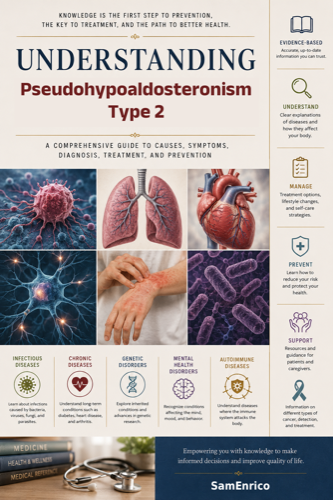
Understanding Pseudohypoaldosteronism Type 2
This disease publication, published by SamEnrico,
by Larue Venita
This disease publication, published by SamEnrico, covers Understanding Pseudohypoaldosteronism Type 2
Formats
About this book
Free sample
Chapter 1: The Misleading Label–- Imagine receiving a laboratory report that makes no sense. A 32-year-old woman with well-controlled blood pressure comes to your clinic for a routine physical. She feels fine, exercises regularly, and takes no medications. Her basic metabolic panel shows a potassium of 5.8 m Eq/L – dangerously high by most standards – yet her kidney function is completely normal. Her creatinine is 0.7 mg/d L.
Her blood urea nitrogen is 12 mg/d L. By every measure, her kidneys should be excreting potassium without difficulty. But they are not.You repeat the test, thinking perhaps the blood was hemolyzed or the tourniquet left on too long. The result comes back the same: potassium 5.7 m Eq/L. You check her medications again – none.
You ask about diet – she eats bananas occasionally but nothing excessive. You order a basic metabolic panel on her brother, who accompanied her to the appointment, and his potassium is 5.9 m Eq/L. Now you have a family pattern. Now you have a mystery.This scene plays out in primary care offices and nephrology clinics around the world, often repeatedly, before someone finally recognizes the underlying condition. The patient may undergo adrenal imaging to rule out a tumor.
She may receive a referral to endocrinology for cortisol stimulation testing. She may be placed on a low-potassium diet that does nothing to normalize her levels. She may be told, incorrectly, that she has a benign variant of essential hypertension with an incidentally elevated potassium – two findings that should never coexist in benign form.The condition hiding behind these confusing laboratory results has a name, but the name itself is part of the problem. Pseudohypoaldosteronism Type 2. Say it aloud.
The word "pseudo" suggests false or fake. "Hypoaldosteronism" suggests too little aldosterone activity. Putting them together, the name implies a condition that mimics low aldosterone function without actually being low aldosterone. And in a sense, that is correct – but only in the most superficial sense. The deeper truth, the truth that matters for diagnosis and treatment, is almost the opposite of what the name suggests.The Burden of a Name…
This is the end of the free sample. Get the eBook to keep going. Buy now
Contents
- Chapter 1
- Chapter 2
- Chapter 3
- Chapter 4
- Chapter 5
- Chapter 6
- Chapter 7
- Chapter 8
- Chapter 9
- Chapter 10
- Chapter 11
- Chapter 12
Details
- Author
- Larue Venita
- Publisher
- SamEnrico
- Language
- English
- Genre
- Non-Fiction, Informative, Educational
- Released
- 2026-05-11
- Pages (approx.)
- 160
- Available as
- eBook, Audiobook

Read better in the ZLOADR app
Your eBooks on your phone or tablet. Sign in with your SamEnrico account and start reading.
More by Larue Venita
 Yoga Nidra Body Scan IntegrationLarue Venita$11.99
 Cape Town Customer DiscoveryLarue Venita$11.99
 Partner Weight Change EsteemLarue Venita$11.99
 Parks Arrest RecordsLarue Venita$11.99
 The Shopping Addiction and DepressionLarue Venita$11.99
 The Cosmic Alchemist: Ernest Everett Just and the Symphony of LifeLarue Venita$11.99
 Edge AI Applications and SystemsLarue Venita$11.99
 National Origin Trap GuideLarue Venita$12.99
 Economic Interaction Terms ExcelLarue Venita$12.99
 How to Become a OpenerLarue Venita$11.99
You may also like
 Hong Kong Handover 1997Dunn Johnnie$11.99
 Zumba For Postnatal Recovery CourseNeal Christian$11.99
 Zumba for BeginnersLadner Nikia$11.99
 YouTube Comment Mining GuideHumes Pandora$12.99
 Worry Box MeditationCarlin Rudy$11.99
 Workplace Stress MeditationNguyen Lynn$11.99
 Workplace Stress and Sleep RepairHawley Ivory$11.99
 Workplace Perfectionism CureDelaney Jeffry$11.99
 Workplace Injustice Anger GuideWallen Isabelle$11.99
 Work Addiction and Burnout LinkGreenwood Ester$11.99
 Women in Yoga and WellnessBeattie Galina$11.99
 Women in Stand Up ComedyChun Evangeline$11.99