
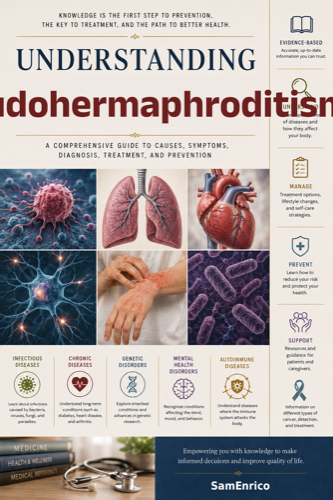
Non-FictionInformativeEducational
Understanding Pseudohermaphroditism eBook
This disease publication, published by SamEnrico,
This disease publication, published by SamEnrico, covers Understanding Pseudohermaphroditism
Formats
Free sample
Chapter 1: The Ghost Diagnosis...--The medical file arrived in a plain cardboard box, tied with the indifferent bureaucracy of a hospital records department. Sarah Jenkins had requested her childhood charts out of idle curiosity—she was thirty-four now, healthy, successful, and trying to piece together a few gaps in her medical history. Three unexplained abdominal surgeries before age twelve. A prescription for estrogen she had taken for years without ever fully understanding why. A childhood spent shuttling between specialists who spoke in hushed tones and looked at her with something she later learned to recognize as medical anxiety.She sat on her living room floor, boxes of old photographs spread around her, and opened the file.
Page after page of indecipherable doctor handwriting, lab results with numbers that meant nothing to her, referral letters to endocrinologists and urologists. She was about to close the box when she turned to the final page—a summary sheet from her pediatric endocrinologist, dated the year she turned twelve.And there it was. Typed in all capital letters, as if the doctor had wanted to be absolutely certain no one could misread it: "DIAGNOSIS: MALE PSEUDOHERMAPHRODITISM, SECONDARY TO PARTIAL ANDROGEN INSENSITIVITY SYNDROME."Sarah read the line three times. Then she put the paper down, walked to her bathroom, and sat on the edge of the tub, her hands trembling."I didn't know what it meant," she would tell me years later, when I interviewed her for this book. "But I knew it was something they had hidden from me.
Something about my body that my parents and my doctors had decided I should never know."She called her mother that evening. There was a long silence on the other end of the line. Then her mother said, quietly, "We were told it would only confuse you. We were told it was better if you never knew."This book exists because of that silence. Because of the thousands of Sarahs—and Davids, and Marias, and Alexes—who grew up with a diagnosis written in their charts but never spoken to their faces.
Because of the medical system that told parents that secrecy was kindness, that a hidden diagnosis was a protected child. Because of the surgeons who operated on infants too young to consent, altering bodies in the name of "normalization," while leaving those same children to discover the truth decades later, alone and ashamed and furious.This is a book about what happens when the binary breaks down.The Three Missions of This Book Before we dive into the science—and there is fascinating, paradigm-shifting science ahead—I need to be clear about what this book is trying to accomplish. It has three missions, and every chapter will return to one or more of them.Mission One: To demystify the complex science of sex development into clear, accessible language.The biology of how we become male or female—or something in between—is one of the most intricate and beautiful processes in all of human development. But it has been hidden behind a wall of medical jargon that serves to exclude rather than educate. This book will tear down that wall.
I promise you that by the end of Chapter 3, you will understand the difference between a bipotential gonad and a Müllerian duct, between SRY and DHT, between determination and differentiation. And you will understand it without a medical degree.Mission Two: To honor the often-silenced lived experiences of individuals with DSD.This is not a dry textbook. It is a work of narrative nonfiction that places human stories at its center. Every chapter from here forward opens with a vignette from a real person—named with their consent, telling their own story in their own words. You will meet Elena, who learned she had Complete Androgen Insensitivity Syndrome at sixteen because she hadn't started her period.
You will meet Johnny, who was raised as a girl in the Dominican Republic and grew a penis at twelve. You will meet Maria, who nearly died from an adrenal crisis before doctors realized she had Congenital Adrenal Hyperplasia. You will meet Alex, who found peace as a non-binary adult after a lifetime of feeling they didn't fit anywhere.These stories are not illustrations of the science. They are the reason the science matters.Mission Three: To explain the critical, compassionate shift in terminology that has occurred over the past two decades.Words matter. They matter because they shape how we see people.
They matter because they carry the weight of history. They matter because they can heal or they can wound. The term "pseudohermaphroditism"—the term that sat in Sarah Jenkins's medical file, hidden and unspoken—is a wounding term. It is a term that belongs in a museum of outdated medical thinking, not in a modern examination room. This book will explain why that term was abandoned, what replaced it, and why the shift from "pseudohermaphrodite" to "Differences of Sexual Development" (DSD) is not just a matter of political correctness but of basic human dignity.The Statistic That Changes Everything Before we go any further, I want to give you a number.
It is the single most important statistic in this book, and I want you to hold it in your mind as you read every chapter that follows.1.7 percent.That is the estimated prevalence of Disorders (or Differences) of Sexual Development in live births. To put that number in perspective: 1.7 percent means that DSDs are roughly as common as having natural red hair. It means that in a typical American high school of two thousand students, approximately thirty-four of them have a DSD. That is more than the number of students with cystic fibrosis, muscular dystrophy, or most other genetic conditions that receive far more public attention and research funding.Let me say that again, because it is so counter to what most people believe: DSDs are not rare. They are not anomalies.
They are not freakish medical curiosities that happen to one in a million. They are common, natural variations on the human developmental spectrum.This statistic comes from a landmark 2002 review by medical geneticist Melanie Blackless and her colleagues, who analyzed decades of birth data to arrive at the 1.7 percent figure. The number includes conditions ranging from Klinefelter syndrome (47,XXY) and Turner syndrome (45,XO) to Congenital Adrenal Hyperplasia and Androgen Insensitivity Syndrome to hypospadias (a condition in which the urethral opening is located on the underside of the penis rather than at the tip). Some of these conditions are visible at birth. Others are invisible until puberty or later.
Some affect fertility. Others do not. Some are associated with other health issues. Others are isolated variations.But all of them share one thing in common: they represent a departure from the expected binary of male and female. And that departure, for centuries, has been treated as a problem to be solved, a defect to be corrected, a shame to be hidden.This book argues for a different approach.
Not "problem." Variation. Not "defect." Diversity. Not "shame." Human.A Note on Language: Why Words Matter Before we can talk about the science of sex development, we have to talk about the words we…
This is the end of the free sample. Get the eBook to keep going. Buy now
About this book
Details
- Author
- Givens Sharen
- Publisher
- SamEnrico
- Language
- English
- Genre
- Non-Fiction, Informative, Educational
- Released
- 2026-05-11
- Pages (approx.)
- 153
- Available as
- eBook, Audiobook

Read better in the ZLOADR app
Your eBooks on your phone or tablet. Sign in with your SamEnrico account and start reading.
More by Givens Sharen
 Rosa Parks Detroit YearsGivens Sharen$11.99
 Past Relationship Trauma GuideGivens Sharen$11.99
 Parking Anger TriggersGivens Sharen$11.99
 Cape Town Design Talent GuideGivens Sharen$11.99
 The Afterpay and BNPL Trap GuideGivens Sharen$11.99
 The Golden Spear: The Rise of the Nubian Warrior QueensGivens Sharen$11.99
 How to Become a Spring Coiling Machine SetterGivens Sharen$11.99
 Document Control ManagerGivens Sharen$11.99
 Constructive Discharge TrapGivens Sharen$12.99
 Log Linear Models Excel GuideGivens Sharen$12.99
You may also like
 Hong Kong Handover 1997Dunn Johnnie$11.99
 Zumba For Postnatal Recovery CourseNeal Christian$11.99
 Zumba for BeginnersLadner Nikia$11.99
 YouTube Comment Mining GuideHumes Pandora$12.99
 Worry Box MeditationCarlin Rudy$11.99
 Workplace Stress MeditationNguyen Lynn$11.99
 Workplace Stress and Sleep RepairHawley Ivory$11.99
 Workplace Perfectionism CureDelaney Jeffry$11.99
 Workplace Injustice Anger GuideWallen Isabelle$11.99
 Work Addiction and Burnout LinkGreenwood Ester$11.99
 Women in Yoga and WellnessBeattie Galina$11.99
 Women in Stand Up ComedyChun Evangeline$11.99