
Non-FictionInformativeEducational
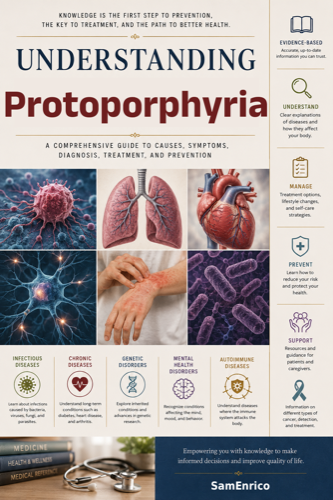
Understanding Protoporphyria eBook
This disease publication, published by SamEnrico,
by Fierro Jamar
This disease publication, published by SamEnrico, covers Understanding Protoporphyria
Formats
Free sample
Chapter 1: The Body's Engine...--–- Imagine for a moment that your body is a factory. Not just any factory, but the most sophisticated manufacturing facility in the known universe. This factory runs twenty-four hours a day, seven days a week, from the moment you are conceived until the moment you die. It produces tens of thousands of different molecules, each with a specific job, each essential to keeping you alive. Among all of these products, one stands out as perhaps the most critical and least understood: a small, iron-containing ring of atoms called heme.If you have picked up this book, chances are that somewhere inside your body, this factory has developed a problem.
The assembly line that produces heme has a bottleneck, a traffic jam, a glitch in the machinery. And like any manufacturing problem, the symptoms show up where the product is needed most—in your skin when sunlight hits it, in your liver when toxins build up, and in your nerves when the pain becomes unbearable.This chapter is about understanding that factory. Not because you need to become a biochemist—you don't. But because the single most empowering thing a patient can do is understand, at a basic level, what has gone wrong inside their own body. When you understand the machinery, you stop feeling like a victim of random misfortune and start feeling like someone who can make informed decisions.
When you understand why sunlight causes pain, you can stop blaming yourself for being "too sensitive." When you understand why your liver needs monitoring, you can advocate for the right tests. Knowledge, in this case, is not just power. It is relief.So let us walk through the factory together. Let us meet the workers, understand their jobs, and see exactly where the breakdown occurs. By the end of this chapter, you will know more about heme biosynthesis than most medical students.
More importantly, you will understand your own body in a way that no doctor can take away from you.The Most Important Molecule You Have Never Heard Of Heme is not a household name. Ask someone on the street what heme is, and you will likely get a blank stare. But without heme, you would be dead in seconds.Heme is a molecule composed of a large ring-shaped structure called a porphyrin ring, with a single iron atom nestled in its center like a jewel in a crown. This simple structure—carbon, hydrogen, nitrogen, and one atom of iron—is responsible for some of the most fundamental processes of life.First and most famously, heme is the business end of hemoglobin, the protein in your red blood cells that carries oxygen from your lungs to every tissue in your body. When you breathe in, oxygen molecules bind to the iron in heme, turning your blood bright red.
When that oxygen is released to your muscles and organs, the heme darkens. This is why arterial blood is bright red and venous blood is dark crimson—it is all about whether heme is holding oxygen.But hemoglobin is just the beginning. Heme is also essential for myoglobin, the protein that stores oxygen in your muscles so you can sprint, lift, or even just stand up from a chair without passing out. Heme is a critical component of the cytochrome P450 family of enzymes, which live in your liver and detoxify everything from medications to environmental pollutants to the waste products of your own metabolism. Without these heme-containing enzymes, the drugs you take would never be cleared from your system, and toxins would accumulate to fatal levels.Heme is also part of the electron transport chain, the molecular machinery inside your mitochondria that generates adenosine triphosphate (ATP), the energy currency of every cell in your body.
Every heartbeat, every thought, every movement, every breath is powered by ATP. And ATP is made possible by heme-containing proteins that shuttle electrons like relay runners passing a baton.Finally, heme is involved in cell signaling, gene regulation, and even the circadian rhythms that tell you when to sleep and wake. In short, heme is everywhere. It is in your blood, your muscles, your liver, your brain, your heart. It is so essential that your body has developed multiple redundant systems to ensure a steady supply.And yet, for reasons you will soon understand, your body has also developed a dangerous vulnerability in the way it makes heme.
That vulnerability is the subject of this book.The Assembly Line: Eight Steps to a Critical Product Your body does not make heme from scratch in one simple reaction. Instead, it uses an eight-step enzymatic pathway, each step performed by a specific enzyme that takes the product of the previous step and transforms it into the next molecule in line. This is called a biosynthetic pathway, and it is best understood as an assembly line.Imagine a factory floor with eight workstations. At the first workstation, raw materials enter. At the second, those materials are shaped into a partial product.
At the third, more pieces are added. And so on, down the line, until at the eighth workstation, a finished heme molecule rolls off the end.The raw materials are simple: glycine, an amino acid; succinyl-Co A, a molecule produced when your body breaks down carbohydrates and fats; and iron, which you absorb from food. These are combined, transformed, rearranged, and oxidized through a series of chemical reactions until the final product emerges.The first step is controlled by an enzyme called ALAS (aminolevulinic acid synthase). There are actually two versions of this enzyme: ALAS1, which works in the liver, and ALAS2, which works in the bone marrow. This distinction will become critically important later when we discuss the difference between EPP and X-linked protoporphyria, so file it away for now.The pathway proceeds through several intermediate molecules with complicated names: porphobilinogen, hydroxymethylbilane, uroporphyrinogen III, coproporphyrinogen III, protoporphyrinogen IX, and finally, protoporphyrin IX.
At each step, an enzyme performs a specific chemical transformation. For our purposes, you do not need to memorize these names. What matters is the final step.At the eighth workstation, an enzyme called ferrochelatase (FECH) takes the molecule protoporphyrin IX and inserts an iron atom into its center. That single act—inserting iron—turns protoporphyrin IX into heme. It is the final, critical, non-negotiable step.
Without it, protoporphyrin IX accumulates. With it, heme is complete.Think of it like baking a cake. You mix the flour, sugar, eggs, and butter. You pour the batter into a pan. You bake it.
The final step—baking—transforms the batter into a cake. Without baking, you just have raw batter. In heme synthesis, ferrochelatase is the oven. And in protoporphyria, the oven is broken.Where the Assembly Line Breaks Now we arrive at the heart of the matter. In a healthy person, the heme assembly line runs smoothly.
Each enzyme does its job. Protoporphyrin IX is produced in exactly the right amounts, and ferrochelatase promptly inserts iron, converting it to heme. Nothing accumulates. Nothing spills over. The factory is clean and efficient.But in a person with protoporphyria, something has gone wrong at the final workstation.
The enzyme ferrochelatase is not working at full capacity. It might be partially defective due to a genetic mutation, as…
This is the end of the free sample. Get the eBook to keep going. Buy now
About this book
Details
- Author
- Fierro Jamar
- Publisher
- SamEnrico
- Language
- English
- Genre
- Non-Fiction, Informative, Educational
- Released
- 2026-06-02
- Pages (approx.)
- 158
- Available as
- eBook, Audiobook

Read better in the ZLOADR app
Your eBooks on your phone or tablet. Sign in with your SamEnrico account and start reading.
More by Fierro Jamar
 Nightmare Rescripting For Dental Phobia CourseFierro Jamar$11.99
 Home Repair Anger TriggersFierro Jamar$11.99
 Plastic Chemical Leaching PreventionFierro Jamar$11.99
 The Alcohol Calorie Tracking GuideFierro Jamar$11.99
 Cape Town SaaS Customer AcquisitionFierro Jamar$11.99
 The Invisible Thread: How a Forgotten Patent Changed the WorldFierro Jamar$11.99
 How to Start a Ball Valves Business (Beginners Guide)Fierro Jamar$11.99
 Public Economics Excel Exam PrepFierro Jamar$12.99
 Workers Comp First Hire GuideFierro Jamar$12.99
 Digital Marketing Account ManagerFierro Jamar$11.99
You may also like
 Hong Kong Handover 1997Dunn Johnnie$11.99
 Zumba For Postnatal Recovery CourseNeal Christian$11.99
 Zumba for BeginnersLadner Nikia$11.99
 YouTube Comment Mining GuideHumes Pandora$12.99
 Worry Box MeditationCarlin Rudy$11.99
 Workplace Stress MeditationNguyen Lynn$11.99
 Workplace Stress and Sleep RepairHawley Ivory$11.99
 Workplace Perfectionism CureDelaney Jeffry$11.99
 Workplace Injustice Anger GuideWallen Isabelle$11.99
 Work Addiction and Burnout LinkGreenwood Ester$11.99
 Women in Yoga and WellnessBeattie Galina$11.99
 Women in Stand Up ComedyChun Evangeline$11.99