
Non-FictionInformativeEducational
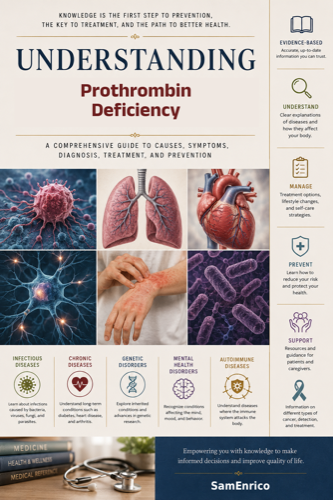
Understanding Prothrombin Deficiency eBook
This disease publication, published by SamEnrico,
This disease publication, published by SamEnrico, covers Understanding Prothrombin Deficiency
Formats
Free sample
Chapter 1: The Domino's Secret...–- Every time you accidentally bite your tongue, scrape your knee, or undergo a surgical procedure, your body performs a miracle that you never see. Within seconds, a complex cascade of proteins activates in precise sequence, forming a clot that stops the bleeding and begins the healing process. For most people, this happens so seamlessly that they never give it a second thought. But for those with prothrombin deficiency, this elegant system has a critical flaw—a missing or malfunctioning domino in the chain that can turn a minor injury into a medical emergency.This chapter demystifies the clotting process in plain language, using analogies and illustrations that will stick with you long after you close this book. Whether you are a newly diagnosed patient, a concerned parent, or a caregiver trying to understand a loved one's condition, mastering the basics of how blood clots—and specifically what prothrombin does—will empower you to make informed decisions about treatment, recognize warning signs, and communicate effectively with your healthcare team.The Three Stages of Hemostasis: Your Body's Emergency Response Team Think of hemostasis—the technical term for stopping bleeding—as a three-alarm fire response.
Each stage builds upon the last, and if any stage fails, the bleeding continues. Understanding these stages is like learning the rules of the road before you drive: essential knowledge that keeps you safe.Stage One: Vasoconstriction – The Immediate Shutdown Imagine a garden hose that springs a leak. The first thing you would do is turn down the water pressure at the main valve. Your body does exactly this when a blood vessel is injured. Within milliseconds of a cut or tear, the smooth muscle in the blood vessel wall contracts violently.
This vasoconstriction reduces blood flow to the injured area, buying precious seconds for the next stages to kick in.This response is reflexive—you do not control it, and it happens whether you are awake or asleep. However, in people with certain connective tissue disorders or severe inflammation, this vasoconstriction may be less effective. For most people with prothrombin deficiency, this stage works normally. The problem comes later.Stage Two: Platelet Plug Formation – The Temporary Patch The second stage involves tiny, disc-shaped cells called platelets (thrombocytes). These cells circulate in your blood by the billions, always on patrol for signs of injury.
When a blood vessel is damaged, the inner lining (endothelium) peels back, revealing a sticky protein called collagen that is normally hidden beneath.Platelets are attracted to this exposed collagen like bees to nectar. They change shape from smooth discs to spiky, star-shaped structures with tentacle-like extensions. These extensions allow them to grab onto the injured vessel wall and, just as importantly, to grab onto each other. Within seconds, a growing mass of activated platelets forms a loose, temporary plug.This platelet plug is like a quick patch on a tire—it might hold for a few minutes, but it is not strong enough to withstand normal blood pressure for long. The plug needs reinforcement.
That reinforcement comes from the third stage, where prothrombin plays its starring role.Stage Three: The Coagulation Cascade – The Permanent Reinforcement The coagulation cascade is the most complex part of hemostasis, involving over a dozen different proteins called clotting factors. They are numbered with Roman numerals (I through XIII) in the order they were discovered, not the order they work. This numbering system can be confusing, but do not worry—you only need to remember a few key players.The cascade is often compared to a row of dominoes. When the first domino falls, it knocks over the second, which knocks over the third, and so on until the final domino falls. In the clotting cascade, each factor activates the next factor in a carefully choreographed sequence.
This domino effect serves an important purpose: amplification. A single trigger can ultimately produce millions of fibrin strands because each step activates many molecules in the next step.Here is where prothrombin enters the story. Prothrombin is Factor II. It is produced by your liver and circulates in your blood in an inactive form. Think of it as a sleeping giant.
The giant awakens when it is converted into its active form, called thrombin. This conversion is the single most important step in the entire cascade.Once activated, thrombin goes to work immediately. Its primary job is to convert another protein, fibrinogen (Factor I), into fibrin. Fibrin is a sticky, thread-like protein that weaves itself through and around the platelet plug, creating a mesh that traps more platelets and red blood cells. This fibrin mesh is the reinforced concrete of the clot—strong, elastic, and durable enough to withstand the pressure of flowing blood until the blood vessel heals.Thrombin also activates Factor XIII, which cross-links the fibrin strands, making the clot even stronger.
Additionally, thrombin activates more platelets and amplifies its own production through a positive feedback loop. This is why the conversion of prothrombin to thrombin is often called the "burst" of the coagulation cascade.The Difference Between a Bleeding Disorder and a Clotting Disorder One of the most common sources of confusion among patients—and even some doctors—is the difference between a bleeding disorder and a clotting disorder. These two categories are opposites, yet they are often lumped together under the vague umbrella of "blood disorders." Mistaking one for the other can have dangerous consequences because treatments that help one condition can cause catastrophic harm in the other.Bleeding Disorders: When the Dominoes Won't Fall A bleeding disorder means your body has difficulty forming stable clots. You bleed longer than normal after injuries, surgeries, or even spontaneously without any apparent trigger. The most common bleeding disorders include hemophilia A (Factor VIII deficiency), hemophilia B (Factor IX deficiency), von Willebrand disease, and the focus of this book: prothrombin deficiency (Factor II deficiency).In bleeding disorders, the coagulation cascade is interrupted at some point.
One or more clotting factors are either missing entirely, present in insufficient quantity, or structurally abnormal so they cannot function properly. The result is that the dominoes stop falling before they reach the end. Fibrin is not produced in adequate amounts, or it is produced too slowly to stop bleeding in a timely manner.Patients with bleeding disorders may experience easy bruising, prolonged nosebleeds, heavy menstrual bleeding, bleeding into joints (hemarthrosis), and excessive bleeding after dental work or surgery. In severe cases, spontaneous bleeding into the brain or digestive tract can be fatal.Clotting Disorders: When the Dominoes Won't Stop Falling A clotting disorder (thrombophilia) is the opposite problem. In these conditions, the body forms clots too easily or fails to break down clots when they are no longer needed.
These inappropriate clots—called thrombi—can block blood vessels and cause heart attacks, strokes, pulmonary embolisms (clots in the lungs), and deep vein thrombosis (clots in the legs).Common clotting disorders include Factor V Leiden (a mutation that makes Factor V resistant to inactivation), prothrombin gene mutation (a different mutation than prothrombin deficiency—confusing, yes, but we will clarify this distinction), antiphospholipid syndrome, and protein C or protein S deficiency.Here is a point of critical importance: Prothrombin deficiency (low or dysfunctional Factor II) is a…
This is the end of the free sample. Get the eBook to keep going. Buy now
About this book
Details
- Author
- Rankin Delicia
- Publisher
- SamEnrico
- Language
- English
- Genre
- Non-Fiction, Informative, Educational
- Released
- 2026-05-18
- Pages (approx.)
- 123
- Available as
- eBook, Audiobook

Read better in the ZLOADR app
Your eBooks on your phone or tablet. Sign in with your SamEnrico account and start reading.
More by Rankin Delicia
 Nightmare Processing For Claustrophobia WorkbookRankin Delicia$11.99
 Rosa Parks Seat StoryRankin Delicia$11.99
 Nairobi E commerce LogisticsRankin Delicia$11.99
 Cooking Anger TriggersRankin Delicia$11.99
 The Meal Prep Calorie Counting GuideRankin Delicia$11.99
 The Damascus Jury: A Trial That Shook the Ottoman EmpireRankin Delicia$11.99
 Meal Break Legal TrapsRankin Delicia$12.99
 HubSpot RetentionRankin Delicia$12.99
 Digital CopywriterRankin Delicia$11.99
 How to Start a Training Racehorses BusinessRankin Delicia$11.99
You may also like
 Hong Kong Handover 1997Dunn Johnnie$11.99
 Zumba For Postnatal Recovery CourseNeal Christian$11.99
 Zumba for BeginnersLadner Nikia$11.99
 YouTube Comment Mining GuideHumes Pandora$12.99
 Worry Box MeditationCarlin Rudy$11.99
 Workplace Stress MeditationNguyen Lynn$11.99
 Workplace Stress and Sleep RepairHawley Ivory$11.99
 Workplace Perfectionism CureDelaney Jeffry$11.99
 Workplace Injustice Anger GuideWallen Isabelle$11.99
 Work Addiction and Burnout LinkGreenwood Ester$11.99
 Women in Yoga and WellnessBeattie Galina$11.99
 Women in Stand Up ComedyChun Evangeline$11.99