
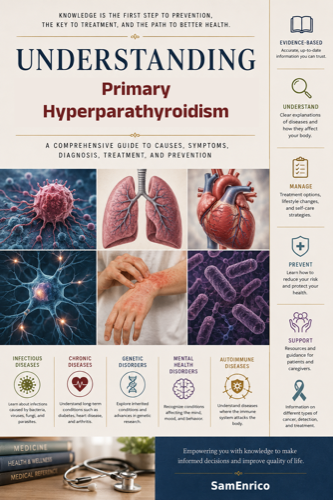
Non-FictionInformativeEducational
Understanding Primary Hyperparathyroidism eBook
This disease publication, published by SamEnrico,
by Caudle Keven
This disease publication, published by SamEnrico, covers Understanding Primary Hyperparathyroidism
Formats
Free sample
Chapter 1: The Hidden Invader--Imagine waking up one morning and realizing that the strange collection of complaints you have been accumulating for years—your relentless fatigue, the brain fog that makes you forget your own phone number, the irritability that has strained your closest relationships, the mysterious bone pain in your shins, the heartburn that no antacid can touch—are not separate problems. They are not “just aging.” They are not menopause, fibromyalgia, depression, or anxiety. They are not in your head.They are, in fact, the calling cards of a tiny, hidden invader: a benign tumor on a gland you have probably never heard of, located in a part of your body you rarely think about, causing a biochemical chaos that medicine has only recently begun to fully appreciate.This book is about that invader. Its name is primary hyperparathyroidism. And for the estimated 100,000 Americans diagnosed each year—and the hundreds of thousands more who remain undiagnosed—it is a disease shrouded in misunderstanding, missed opportunities, and unnecessary suffering.But here is the good news: primary hyperparathyroidism is not only treatable.
It is curable. And the cure is surprisingly simple, remarkably safe, and often life-changing.This chapter is your first step toward understanding what has been happening to your body, why so many doctors have missed it, and why the answer may be right in front of you—hidden, like the glands themselves, but waiting to be found.The Disease Nobody Talks About Let me tell you about Sarah. She is 54 years old, though she feels 74. For the past six years, she has been to her primary care doctor repeatedly. She has seen a rheumatologist for her bone pain.
A gastroenterologist for her reflux and chronic constipation. A neurologist for her headaches and memory lapses. A psychiatrist for her depression and anxiety. A sleep specialist for her fatigue. She has been prescribed antidepressants, acid blockers, muscle relaxants, sleeping pills, and pain medication.What she has not been told is that her routine blood work has shown slightly elevated calcium levels for eight years.
Not dramatically high—just a few decimal points above the normal range. Her doctors noted it. Some muttered something about “maybe dehydration.” Others ignored it entirely. Not one of them thought to check her parathyroid hormone level.Sarah has primary hyperparathyroidism. And her story is not unusual.
It is, in fact, the rule.Primary hyperparathyroidism is the third most common endocrine disorder, behind only diabetes and thyroid disease. It affects approximately one in 500 women over 50, and one in 1,000 men of the same age. The incidence rises sharply after age 60, and postmenopausal women are disproportionately affected—by a factor of three to one compared to men.Despite its prevalence, primary hyperparathyroidism remains widely misunderstood. Why? Because its symptoms are subtle, gradual, and easily attributed to other causes.
Because the disease has traditionally been called “asymptomatic” in the medical literature—a term we will vigorously challenge throughout this book. And because the diagnostic test—a simple blood test for calcium and parathyroid hormone—is not automatically ordered when patients present with the vague complaints that characterize this condition.You are about to learn what your doctors may have missed. And you are about to discover that you do not have to live this way.The Discovery That Took a Century To understand where we are today, we need to go back to where it all began. The story of the parathyroid glands is a tale of anatomical serendipity, surgical catastrophe, and scientific persistence—a reminder that even the most essential parts of our bodies can remain hidden in plain sight for centuries.In 1880, a young Swedish medical student named Ivar Sandström was conducting routine dissections of cadavers at the University of Uppsala. He was not looking for anything unusual.
He was simply examining the thyroid glands of various animals, including a rhinoceros—a detail that seems almost absurd until you realize that medical education in the 19th century relied heavily on comparative anatomy.Inside that rhinoceros, Sandström noticed something peculiar: four tiny, rice-sized glands embedded in the fatty tissue surrounding the thyroid. He had never seen them before. He checked his anatomy textbooks. They were not mentioned. He examined other specimens—dogs, cats, rabbits, humans—and found the same four glands in every single one.Sandström named them “glandulae parathyreoideae” and published his findings in 1880.
Then, remarkably, he moved on. He did not understand what these glands did. He did not realize their importance. And for nearly a decade, the medical world largely ignored his discovery.The lesson here is worth pausing over: even trained observers can miss what is right in front of them when they are not looking for it. This same principle applies to your diagnosis today.The Deadly Clue The true significance of the parathyroid glands was not recognized until surgeons began performing thyroidectomies—removal of the thyroid gland—to treat goiters and thyroid cancer.
In the 1890s, a disturbing pattern emerged. A significant number of patients who underwent thyroid surgery died within days or weeks of the operation. The cause was not bleeding or infection. It was something far stranger.These patients developed uncontrollable muscle spasms, starting in their hands and feet, then spreading to their arms and legs, finally affecting their larynx and diaphragm. They could not breathe.
They could not speak. They died in a state of tetanic rigidity, their muscles locked in permanent contraction.The condition was called tetany. No one knew what caused it.Then, in 1891, a French physiologist named Eugène Gley made the connection. Gley was studying the effects of thyroid removal in dogs when he noticed that some of his animals developed tetany and died—but only when he inadvertently removed the tiny glands adjacent to the thyroid. If he carefully preserved those glands, the dogs survived.Gley had discovered the function of the parathyroids by accident—or, more accurately, by noticing what others had overlooked.
The parathyroid glands, he realized, produce a substance essential for life. Without it, the nervous system becomes hyperexcitable, muscles spasm uncontrollably, and death follows.That substance, we now know, is parathyroid hormone (PTH). And its primary job is to regulate calcium levels in the blood.Why Calcium Matters Before we go further, we need to understand why calcium is so important. Most people think of calcium only in the context of bones and teeth. But calcium is far more versatile—and far more essential—than that.Calcium is the most abundant mineral in the human body, but only about 1% of it circulates in the blood and soft tissues.
The other 99% is stored in the skeleton, where it provides structural integrity and serves as a reservoir for the body’s calcium needs.That 1% in the blood, however, is where the action happens. Calcium ions are critical for:Nerve transmission. Every time you think, feel, sense, or move, it is because calcium ions are flowing into neurons, triggering the release of neurotransmitters. Without calcium, your brain would be silent.Muscle contraction. From your heartbeat to your diaphragm to your biceps, every muscle contraction depends on calcium.
When calcium levels drop too low, muscles cramp. When they rise too high, muscles become sluggish.Blood clotting. The cascade of…
This is the end of the free sample. Get the eBook to keep going. Buy now
About this book
Details
- Author
- Caudle Keven
- Publisher
- SamEnrico
- Language
- English
- Genre
- Non-Fiction, Informative, Educational
- Released
- 2026-05-11
- Pages (approx.)
- 146
- Available as
- eBook, Audiobook

Read better in the ZLOADR app
Your eBooks on your phone or tablet. Sign in with your SamEnrico account and start reading.
More by Caudle Keven
 SBOM Adoption TrendsCaudle Keven$11.99
 Creator Email List BuildingCaudle Keven$11.99
 The Post Binge Self Care GuideCaudle Keven$11.99
 Alcohol Detox Medications ListCaudle Keven$11.99
 Imposter Syndrome CoachingCaudle Keven$11.99
 The Vanished Heir: The Untold Story of King Edward VIII’s Secret ExileCaudle Keven$11.99
 A Beginners Guide to Football (Volume 1)Caudle Keven$11.99
 Canada Export Eco Logo GuideCaudle Keven$12.99
 One Page Executive Summary GuideCaudle Keven$12.99
 Contract AnalystCaudle Keven$11.99
You may also like
 Hong Kong Handover 1997Dunn Johnnie$11.99
 Zumba For Postnatal Recovery CourseNeal Christian$11.99
 Zumba for BeginnersLadner Nikia$11.99
 YouTube Comment Mining GuideHumes Pandora$12.99
 Worry Box MeditationCarlin Rudy$11.99
 Workplace Stress MeditationNguyen Lynn$11.99
 Workplace Stress and Sleep RepairHawley Ivory$11.99
 Workplace Perfectionism CureDelaney Jeffry$11.99
 Workplace Injustice Anger GuideWallen Isabelle$11.99
 Work Addiction and Burnout LinkGreenwood Ester$11.99
 Women in Yoga and WellnessBeattie Galina$11.99
 Women in Stand Up ComedyChun Evangeline$11.99