
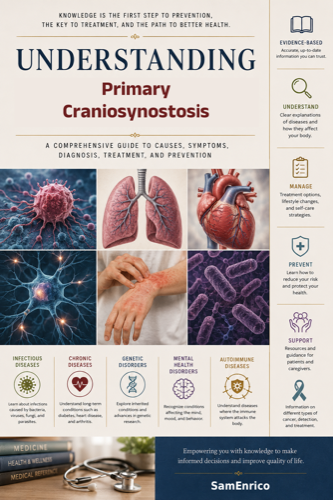
Understanding Primary Craniosynostosis
This disease publication, published by SamEnrico,
This disease publication, published by SamEnrico, covers Understanding Primary Craniosynostosis
Formats
About this book
Free sample
Chapter 1: The Living Puzzle...–- When Julia first held her newborn son Leo, she counted ten fingers, ten toes, and felt an overwhelming rush of relief. He was perfect. But at the two-month well-child visit, her pediatrician ran a gentle finger along the top of Leo’s head and paused. “I feel a ridge here,” she said, “right along this line. Has anyone mentioned his head shape before?” Julia looked down at Leo, who was peacefully asleep, and saw what she had somehow missed for weeks: his head was not round like her older daughter’s had been.
It was long and narrow, almost boat-shaped. In that single moment, a word she had never heard entered her life forever. Craniosynostosis.The Most Common Thing You Have Never Heard Of Craniosynostosis—from the Greek kranion (skull) and synostosis (bone fusion)—affects approximately one in every 2,000 to 2,500 live births. To put that number in perspective, it is roughly as common as cleft lip with cleft palate, and significantly more common than childhood cancers like neuroblastoma or Wilms’ tumor. Every day in the United States alone, about four babies are born with some form of craniosynostosis.
Every week, that number approaches thirty. Yet ask ten people on the street what it means, and nine will likely guess it has something to do with dinosaurs or ancient fossils.Why is such a common condition so poorly understood? Partly because the word itself sounds intimidating. Partly because the physical signs—an odd head shape, a palpable ridge, a forehead that seems too pointed or too flat—are often subtle in the first weeks of life. And partly because pediatricians, despite their best intentions, receive shockingly little training in the diagnosis of craniosynostosis.
A 2016 survey of graduating pediatric residents found that nearly forty percent felt unprepared to distinguish between positional plagiocephaly (the common “flat head” from sleeping on the back) and true suture fusion. The consequences of this knowledge gap are profound: missed diagnoses lead to delayed surgery, which can mean prolonged helmet therapy, less optimal cosmetic outcomes, and in rare cases, irreversible neurocognitive damage…
This is the end of the free sample. Get the eBook to keep going. Buy now
Contents
- Chapter 1
- Chapter 2
- Chapter 3
- Chapter 4
- Chapter 5
- Chapter 6
- Chapter 7
- Chapter 8
- Chapter 9
- Chapter 10
- Chapter 11
- Chapter 12
Details
- Author
- Whaley Destiny
- Publisher
- SamEnrico
- Language
- English
- Genre
- Non-Fiction, Informative, Educational
- Released
- 2026-05-09
- Pages (approx.)
- 159
- Available as
- eBook, Audiobook

Read better in the ZLOADR app
Your eBooks on your phone or tablet. Sign in with your SamEnrico account and start reading.
More by Whaley Destiny
 The Twelve Step Food Addiction GuideWhaley Destiny$11.99
 DevOps Security Shift LeftWhaley Destiny$11.99
 Bipolar And Borderline OverlapWhaley Destiny$11.99
 Telehealth Alcohol DetoxWhaley Destiny$11.99
 Imposter Syndrome Success LogWhaley Destiny$11.99
 The Quantum Strategist: Clausewitz and the Birth of Modern WarfareWhaley Destiny$11.99
 Search Console Shopping FeedWhaley Destiny$12.99
 China Export Green Label GuideWhaley Destiny$12.99
 Construction TechnicianWhaley Destiny$11.99
 How to Become a Composition MixerWhaley Destiny$11.99