
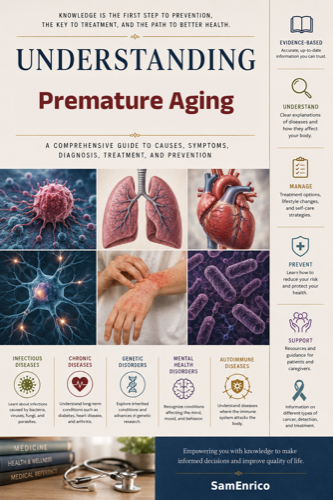
Non-FictionInformativeEducational
Understanding Premature Aging eBook
This disease publication, published by SamEnrico,
This disease publication, published by SamEnrico, covers Understanding Premature Aging
Formats
Free sample
Chapter 1: The Biological Mortgage...–- Lisa felt forty-three going on seventy. At thirty-eight, she had been a competitive amateur tennis player, agile and sharp. Now, at forty-three, she struggled to rise from a low couch without using her arms for leverage. Her knees cracked. Her memory had developed lag, like an old computer struggling to open a browser.
Her doctor ran standard blood work, declared everything “normal for your age,” and sent her home with a prescription for anti-inflammatories and a suggestion to “slow down a bit.” Lisa was not comforted. She could not accept that feeling two decades older than her chronological age was simply the way things had to be.Lisa’s story opens this book because it is not unusual. It is, in fact, becoming the new normal. Across the developed world, men and women in their thirties and forties are experiencing health markers—fatigue, joint stiffness, metabolic dysfunction, cognitive fog, loss of muscle mass—that were once the province of their parents’ generation at age sixty-five or seventy. The data is stark: early-onset Type 2 diabetes has risen by over forty percent in adults under forty-five in the last decade alone.
Non-alcoholic fatty liver disease, once a rarity before age fifty, now appears routinely in patients in their early thirties. Hypertension, sarcopenia (the age-related loss of muscle), and even early cognitive decline are all shifting left on the age axis.What is happening? Are we simply weaker than our ancestors? Are our genes failing us? Or is something more insidious at work—something that can be measured, understood, and reversed?This chapter answers those questions by introducing the central concept that will guide this entire book: the difference between your chronological age and your biological age, and the powerful, underappreciated phenomenon of the “aging cliff.” You will learn why forty feels like sixty for so many people, why the decline is often sudden rather than gradual, and most importantly, why this is not inevitable.
Premature aging is not a life sentence. It is a debt—a biological mortgage—that has come due.The Great Distinction: Chronological vs. Biological Age Before we can understand premature aging, we must abandon one of the most deeply ingrained assumptions in modern medicine: that age is simply the number of birthdays you have celebrated. That assumption is not merely simplistic; it is actively harmful because it normalizes preventable decline.Chronological age is simple. It is the time elapsed since your birth, measured in years, months, and days.
It is linear, inevitable, and identical for everyone born on the same date. You cannot change your chronological age. It marches forward whether you run marathons or sit on a couch.Biological age is something altogether different. Biological age is the physiological state of your cells, tissues, and organs relative to population norms. It is a measure of how well your body is functioning, how much damage has accumulated, and how much repair capacity remains.
Unlike chronological age, biological age is highly variable, highly modifiable, and often shockingly discordant from the number on your birth certificate.Consider two actual case studies from the medical literature. A fifty-five-year-old man who has spent decades smoking, eating a processed diet, sleeping poorly, and managing chronic stress may have a biological age of seventy-two. His arteries are stiff, his telomeres (the protective caps on his chromosomes, which we will explore in Chapter 4) are short, his inflammatory markers are elevated, and his muscle mass has declined to that of an average seventy-two-year-old. He feels old because he is old—biologically.Conversely, a sixty-eight-year-old woman who follows a Mediterranean diet, exercises regularly, maintains strong social connections, and sleeps seven to eight hours per night may have a biological age of fifty-four. Her mitochondria (the power plants of her cells, also in Chapter 4) are efficient, her inflammation is low, her cognitive function is sharp, and her mobility is excellent.
She does not feel her chronological age because her body does not match it.The gap between chronological and biological age is where this book lives. When that gap is negative—biological age higher than chronological—you are experiencing premature aging. When the gap is positive, you are experiencing successful aging or even biological age reversal (a concept we will revisit in Chapter 12).Lisa, our opening example, had a chronological age of forty-three but a biological age estimated at fifty-eight based on her inflammatory markers, grip strength, and metabolic profile. She was not imagining her decline. She was accurately perceiving her biological reality.The good news—and the entire premise of this book—is that biological age is not fixed.
It is not a destiny written into your DNA. It is a current status, and status can change.The Aging Cliff: Why Decline Feels Sudden If biological age can vary so dramatically, why do so many people experience the aging process as a relatively smooth, gradual slope? And why do others—like Lisa—experience it as a sudden cliff?The answer lies in the concept of physiological reserve. Throughout your twenties and early thirties, your body possesses an extraordinary capacity for compensation. If you damage your mitochondria with poor diet, your cells can produce more mitochondria to pick up the slack.
If you inflame your tissues with chronic stress, your anti-inflammatory systems can temporarily quench the fire. If you lose some muscle mass by sitting too much, your remaining muscle fibers can hypertrophy to compensate. This reserve is your body’s buffer zone.But this buffer is not infinite. And it does not decline linearly.The groundbreaking research of Dr. Michael Rose and other biogerontologists has demonstrated that aging is not a steady drumbeat of decline.
Instead, it is characterized by threshold effects. You can lose thirty percent of your mitochondrial function with no noticeable change in your energy levels because your remaining mitochondria work harder. You can lose forty percent of your muscle mass with no noticeable weakness because your nervous system recruits muscle fibers more efficiently. You can accumulate significant DNA damage with no visible consequences because your repair enzymes keep up.And then, one day, you cross a threshold. The compensation mechanisms can no longer keep pace.
The reserve is exhausted. And suddenly, what felt like a gentle slope becomes a vertical cliff.This is the aging cliff. It is why so many people report feeling fine—truly fine—at age thirty-eight, and then feel old, tired, stiff, and foggy at age forty-two. It is not that four years caused that much damage. It is that the damage accumulated silently over decades, and then the compensation mechanisms failed all at once.The aging cliff typically hits hardest between ages forty and forty-five for most people, but this timing is highly variable.
Those with poor lifestyle habits may hit the cliff at thirty-five. Those with exceptional habits may push it to fifty-five or beyond. The cliff is not a biological inevitability. It is the consequence of how well you have managed your biological mortgage.The Biological Mortgage: A Framework for Understanding To make these abstract concepts concrete, this book introduces the metaphor of the biological mortgage. This metaphor will appear throughout the coming chapters, so it is worth understanding thoroughly now.Imagine that…
This is the end of the free sample. Get the eBook to keep going. Buy now
About this book
Details
- Author
- Gallant Jammie
- Publisher
- SamEnrico
- Language
- English
- Genre
- Non-Fiction, Informative, Educational
- Released
- 2026-05-09
- Pages (approx.)
- 158
- Available as
- eBook, Audiobook

Read better in the ZLOADR app
Your eBooks on your phone or tablet. Sign in with your SamEnrico account and start reading.
More by Gallant Jammie
 Medical Imposter Syndrome GuideGallant Jammie$11.99
 Bipolar And Seasonal PatternsGallant Jammie$11.99
 SOAR Automation ReviewGallant Jammie$11.99
 The Teen Bullying Recovery GuideGallant Jammie$11.99
 The Night Eating Syndrome GuideGallant Jammie$11.99
 Silent Shadows: The Vanished Spy Who Never ExistedGallant Jammie$11.99
 Search Console Redirect ReportGallant Jammie$12.99
 ASC Aquaculture Export GuideGallant Jammie$12.99
 How to Start a Chicory Root Drying Business (Beginners Guide)Gallant Jammie$11.99
 Community Creator InternGallant Jammie$11.99
You may also like
 Hong Kong Handover 1997Dunn Johnnie$11.99
 Zumba For Postnatal Recovery CourseNeal Christian$11.99
 Zumba for BeginnersLadner Nikia$11.99
 YouTube Comment Mining GuideHumes Pandora$12.99
 Worry Box MeditationCarlin Rudy$11.99
 Workplace Stress MeditationNguyen Lynn$11.99
 Workplace Stress and Sleep RepairHawley Ivory$11.99
 Workplace Perfectionism CureDelaney Jeffry$11.99
 Workplace Injustice Anger GuideWallen Isabelle$11.99
 Work Addiction and Burnout LinkGreenwood Ester$11.99
 Women in Yoga and WellnessBeattie Galina$11.99
 Women in Stand Up ComedyChun Evangeline$11.99