
Non-FictionInformativeEducational
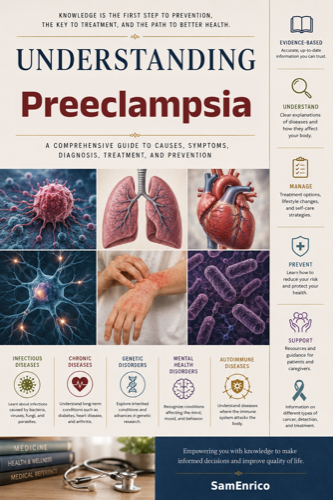
Understanding Preeclampsia eBook
This disease publication, published by SamEnrico,
This disease publication, published by SamEnrico, covers Understanding Preeclampsia
Formats
Free sample
Chapter 1: The Great Mimicker--Every year, millions of pregnant women around the world are told a version of the same four words: “You’re fine. Go home.”These words are spoken in bustling obstetric clinics, in rural birthing centers, and in crowded emergency departments. They are spoken to women whose ankles have swollen past the point of fitting into shoes, to women whose headaches have persisted for days, to women whose “heartburn” feels like a fist squeezing beneath their ribs. And sometimes—more often than anyone wants to admit—those four words are catastrophically wrong.Preeclampsia is known in medical literature as a hypertensive disorder of pregnancy. But among the survivors who have lived through its sudden, terrifying escalation, it has another name: the great mimicker.
It disguises itself as the mundane discomforts of pregnancy. It borrows the symptoms of heartburn, migraine, flu, and normal swelling. It whispers “this is normal” while, inside the body, a storm is gathering.This chapter exists because that whisper must be silenced.Here, you will learn to see what preeclampsia actually is—not merely “high blood pressure,” not “that thing they check your urine for,” but a multisystem disorder that originates in the placenta and can affect your liver, kidneys, blood, brain, and cardiovascular system simultaneously. You will walk through the clinical spectrum from mild gestational hypertension to the most severe forms of the disease. And most critically, you will learn to distinguish between the benign discomforts of a healthy pregnancy and the red flags that demand immediate medical attention.By the end of this chapter, you will never again dismiss a symptom simply because a well-meaning friend or a hurried nurse said “that’s just pregnancy.” You will have the language, the framework, and the confidence to advocate for yourself.
Let us begin.The Most Dangerous Misconception If you ask ten women on the street what preeclampsia is, nine of them will say some variation of: “It’s when your blood pressure gets too high during pregnancy.”They are not wrong. But they are dangerously incomplete.Hypertension is a feature of preeclampsia—often the first one measured, the easiest one tracked, the number that determines admission or discharge. But hypertension is not the disease. It is a smoke alarm. And focusing exclusively on the smoke alarm while ignoring the fire is how women die.Preeclampsia is, at its core, a multisystem disorder unique to pregnancy.
That means it does not stay in one organ. It does not politely restrict itself to your blood vessels. It spreads. It affects:The vascular system (widespread endothelial damage, vasospasm, leaky capillaries)The kidneys (protein leakage, decreased filtration, acute kidney injury)The liver (inflammation, hepatocellular damage, subcapsular hematoma)The hematologic system (platelet consumption, hemolysis, coagulopathy)The central nervous system (cerebral hyperperfusion, seizure risk, PRES syndrome)Understanding this systemic nature is not academic trivia. It is the difference between thinking “my blood pressure is a little high, but I feel fine” and recognizing that your feeling of “fine” may be the quiet before the storm.Let me say this as clearly as possible: You can have severe, life-threatening preeclampsia with a blood pressure that is only modestly elevated.
Conversely, you can have very high blood pressure (say, 160/100) with no other symptoms and be safely managed as an outpatient. The blood pressure number alone does not tell the whole story. The other symptoms—the ones that are so easily dismissed—are often the truest indicators of organ damage.This chapter will teach you to read the whole story.The Clinical Spectrum: From Mild to Catastrophic Preeclampsia is not a single condition. It is a spectrum that ranges from a mild, manageable elevation in blood pressure to a catastrophic, life-threatening cascade of organ failure. Understanding where you fall on this spectrum—and how the spectrum progresses—is essential for knowing what questions to ask your medical team.Let us walk through each stage.Gestational Hypertension: The Starting Point Gestational hypertension is defined as new-onset high blood pressure (sustained readings of 140/90 or higher, taken at least four hours apart) after 20 weeks of pregnancy, without evidence of protein in the urine or other organ dysfunction.This is the mildest form of the spectrum.
Many women with gestational hypertension go on to have uncomplicated deliveries and normal blood pressure within weeks postpartum. However—and this is critical—approximately 15-25% of women with gestational hypertension will progress to preeclampsia. This progression can happen slowly over weeks or abruptly within hours.What this means for you: If you are diagnosed with gestational hypertension, your provider should monitor you closely with serial blood pressure checks, urine protein assessments, and laboratory studies (platelets, liver enzymes, creatinine). You should not be dismissed with a “wait and see” approach without a clear monitoring plan.Preeclampsia: The Threshold Preeclampsia is diagnosed when gestational hypertension is accompanied by evidence of end-organ damage. The classic marker is proteinuria (protein in the urine), but current diagnostic criteria recognize that organ damage can occur without protein leakage.According to the American College of Obstetricians and Gynecologists (ACOG), the diagnosis of preeclampsia requires:New-onset hypertension (140/90 or higher after 20 weeks) plus one or more of the following:Proteinuria (300 mg or more in a 24-hour collection, or protein/creatinine ratio of 0.3 or higher, or a dipstick reading of 1+ or greater)Thrombocytopenia (platelets below 100,000/microliter)Renal insufficiency (creatinine above 1.1 mg/d L or doubling of baseline)Impaired liver function (elevated transaminases to twice the upper limit of normal)Pulmonary edema (fluid in the lungs, causing shortness of breath)Cerebral or visual symptoms (new-onset headache unresponsive to medication, vision changes, altered mental status)Notice what is missing from this list?
“Feeling bad.” “Stress.” “Anxiety.” These are not diagnostic criteria because they are subjective and unreliable. The diagnosis rests on measurable, objective evidence of organ damage.Severe Preeclampsia: The Danger Zone Severe preeclampsia is not just “worse” preeclampsia. It is a distinct clinical category requiring different management—specifically, delivery is recommended regardless of gestational age once the maternal condition becomes unstable.Severe features include any of the following:Blood pressure of 160/110 or higher on two occasions at least four hours apart (or confirmed within minutes if the patient is symptomatic)Severe, persistent headache that does not respond to acetaminophen Visual disturbances (scotomata—blinking spots—blurred vision, photophobia, or transient blindness)Severe right upper quadrant or epigastric pain (liver involvement)Shortness of breath or evidence of pulmonary edema Platelet count below 100,000Liver enzymes elevated to twice the normal upper limit or higher Creatinine above 1.1 mg/d L or doubling of baseline New-onset cerebral or visual disturbances Here is the clinical reality: A woman with severe preeclampsia is at immediate risk of eclampsia (seizure), stroke, liver rupture, acute kidney injury, and placental abruption. Delivery is the only definitive treatment. In many cases, delivery will be recommended even if the baby is extremely premature—because the maternal risk of continuing the pregnancy outweighs the fetal risk of early delivery.HELLP Syndrome: The Triad HELLP syndrome (discussed in depth in Chapter 7) is a specific form of severe preeclampsia defined by:Hemolysis: breakdown of red blood cells Elevated Liver enzymes: hepatocellular damage Low Platelets: increased bleeding risk HELLP is often described as “silent” because its symptoms—fatigue, nausea, malaise, upper abdominal pain—are easily mistaken for flu, gallstones, or…
This is the end of the free sample. Get the eBook to keep going. Buy now
About this book
Details
- Author
- Ledbetter Luella
- Publisher
- SamEnrico
- Language
- English
- Genre
- Non-Fiction, Informative, Educational
- Released
- 2026-05-09
- Pages (approx.)
- 160
- Available as
- eBook, Audiobook

Read better in the ZLOADR app
Your eBooks on your phone or tablet. Sign in with your SamEnrico account and start reading.
More by Ledbetter Luella
 Creator Health Insurance GuideLedbetter Luella$11.99
 SaaS Security BreachesLedbetter Luella$11.99
 OUD Medications in PregnancyLedbetter Luella$11.99
 The Binge Eating Recovery WorkbookLedbetter Luella$11.99
 Executive Imposter SyndromeLedbetter Luella$11.99
 The Ghost of Pablo Escobar: Cursed Gold and Cartel Paranormal EncountersLedbetter Luella$11.99
 Fair Trade Export CertificationLedbetter Luella$12.99
 Search Console Breadcrumbs ReportLedbetter Luella$12.99
 Commercial Sales RepresentativeLedbetter Luella$11.99
 How to Become a Compo CasterLedbetter Luella$11.99
You may also like
 Hong Kong Handover 1997Dunn Johnnie$11.99
 Zumba For Postnatal Recovery CourseNeal Christian$11.99
 Zumba for BeginnersLadner Nikia$11.99
 YouTube Comment Mining GuideHumes Pandora$12.99
 Worry Box MeditationCarlin Rudy$11.99
 Workplace Stress MeditationNguyen Lynn$11.99
 Workplace Stress and Sleep RepairHawley Ivory$11.99
 Workplace Perfectionism CureDelaney Jeffry$11.99
 Workplace Injustice Anger GuideWallen Isabelle$11.99
 Work Addiction and Burnout LinkGreenwood Ester$11.99
 Women in Yoga and WellnessBeattie Galina$11.99
 Women in Stand Up ComedyChun Evangeline$11.99