
Non-FictionInformativeEducational
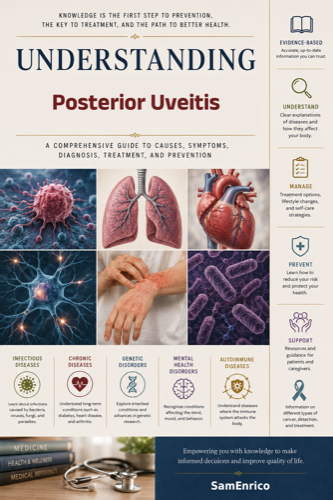
Understanding Posterior Uveitis
This disease publication, published by SamEnrico,
by Worley Elroy
This disease publication, published by SamEnrico, covers Understanding Posterior Uveitis
Formats
About this book
Free sample
Chapter 1: The Layered Battlefield...--–- The human eye is a masterpiece of biological engineering, but its posterior segment is not merely a passive structure awaiting insult. It is, instead, a layered battlefield where inflammation announces itself not through thunderous systemic alarms but through subtle, specific, and deeply instructive changes in anatomy. For the clinician who learns to read these changes, the retina, choroid, and vitreous become a diagnostic language more precise than any laboratory test. This chapter establishes the essential anatomical framework for understanding posterior uveitis, moving beyond traditional descriptions to explain how the unique architecture of the retina, choroid, and vitreous dictates specific inflammatory responses. The premise is simple yet profound: the layer in which inflammation begins determines the clinical appearance, the differential diagnosis, the imaging findings, and ultimately the treatment strategy.
A lesion that starts in the choroid behaves fundamentally differently from one that starts in the retina, and the clinician who understands why will never again look at a fundus exam the same way.The Anatomy of Vulnerability To understand posterior uveitis, one must first understand the blood-retinal barrier (BRB), the structural sentinel that separates the immune-privileged intraocular environment from the systemic circulation. The BRB is actually two barriers in one. The inner BRB consists of tight junctions between retinal capillary endothelial cells, analogous to the blood-brain barrier and regulated by similar molecular machinery including claudins, occludin, and junctional adhesion molecules. These tight junctions prevent circulating immune cells, complement proteins, and immunoglobulins from freely entering the retinal parenchyma. The outer BRB resides in the retinal pigment epithelium (RPE), where tight junctions between adjacent RPE cells create a second line of defense between the fenestrated choroidal capillaries and the neurosensory retina.
The choroid, in contrast, has no equivalent barrier; its capillaries are inherently leaky, allowing rapid diffusion of small molecules and even plasma proteins.The clinical implications of this dual-barrier system are immediate and actionable. When the inner BRB breaks down, typically due to retinal vasculitis or retinal vein occlusion, fluorescein angiography reveals leakage originating from retinal vessels, with dye accumulating in the retinal interstitium and eventually pooling…
This is the end of the free sample. Get the eBook to keep going. Buy now
Contents
- Chapter 1
- Chapter 2
- Chapter 3
- Chapter 4
- Chapter 5
- Chapter 6
- Chapter 7
- Chapter 8
- Chapter 9
- Chapter 10
- Chapter 11
- Chapter 12
Details
- Author
- Worley Elroy
- Publisher
- SamEnrico
- Language
- English
- Genre
- Non-Fiction, Informative, Educational
- Released
- 2026-05-09
- Pages (approx.)
- 148
- Available as
- eBook, Audiobook

Read better in the ZLOADR app
Your eBooks on your phone or tablet. Sign in with your SamEnrico account and start reading.
More by Worley Elroy
 Public Speaking Self Esteem GuideWorley Elroy$11.99
 Family Guide To Bipolar DisorderWorley Elroy$11.99
 Critical Infrastructure AttacksWorley Elroy$11.99
 Berber Silver Jewelry LoreWorley Elroy$11.99
 The Teen Goal Setting GuideWorley Elroy$11.99
 The Beast of Mount Taranaki: A Maori Warrior’s TrialWorley Elroy$11.99
 Clinical Informatics SpecialistWorley Elroy$11.99
 A Beginners Guide to Fujian White Crane (Volume 1)Worley Elroy$11.99
 HARO Fast Responder StrategyWorley Elroy$12.99
 Managed IT Services GuideWorley Elroy$12.99Managed IT Services GuideWorley Elroy$12.99
You may also like
 Hong Kong Handover 1997Dunn Johnnie$11.99
 Zumba For Postnatal Recovery CourseNeal Christian$11.99
 Zumba for BeginnersLadner Nikia$11.99
 YouTube Comment Mining GuideHumes Pandora$12.99
 Worry Box MeditationCarlin Rudy$11.99
 Workplace Stress MeditationNguyen Lynn$11.99
 Workplace Stress and Sleep RepairHawley Ivory$11.99
 Workplace Perfectionism CureDelaney Jeffry$11.99
 Workplace Injustice Anger GuideWallen Isabelle$11.99
 Work Addiction and Burnout LinkGreenwood Ester$11.99
 Women in Yoga and WellnessBeattie Galina$11.99
 Women in Stand Up ComedyChun Evangeline$11.99