
Non-FictionInformativeEducational
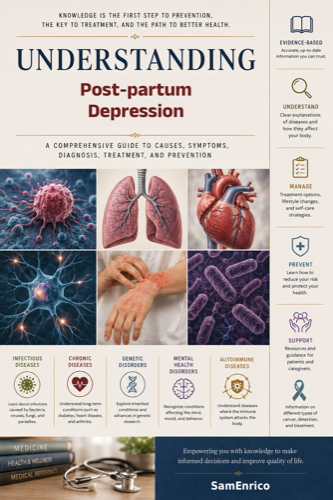
Understanding Post-partum Depression eBook
This disease publication, published by SamEnrico,
This disease publication, published by SamEnrico, covers Understanding Post-partum Depression
Formats
Free sample
Chapter 1: The Silent Crash...--The ceiling is white. Not a interesting white, not a warm white, but the flat, institutional white of a rental apartment you never wanted. You are staring at that ceiling at 3:47 AM. The baby cried forty-seven minutes ago. You fed her.
She is back asleep in the bassinet beside the bed. You can hear your partner breathing steadily—deep, unconscious, free. And you are awake. Not because the baby needs you. Not because you heard a noise.
Because your brain will not stop. Because there is a voice in your head—your own voice, but not your own voice—whispering, What if she stops breathing? What if you fall asleep and she stops breathing and you don't hear her because you were too tired? What if you are too tired to be a mother?You have not slept more than ninety minutes at a stretch in eleven days. Your body feels like it has been hit by a car.
You cannot remember the last time you ate a meal sitting down. You cannot remember your own phone number without pausing. And somewhere, beneath the exhaustion, beneath the stitches that pull when you move too fast, beneath the leaking breasts and the tangled hair and the pajamas you have worn for three days, there is a feeling you were not supposed to have.You were supposed to be happy.That is the lie. That is the first lie, and it is the most dangerous one. The lie says that motherhood is a destination, not a transition.
The lie says that the moment the baby is placed on your chest, a switch flips inside you—a biological, emotional, spiritual switch—and you become someone new. Someone patient. Someone glowing. Someone who does not fantasize about throwing the crying baby out the window because oh my God if she does not stop crying I will shatter into a thousand pieces. The lie says that if you are not happy, you are broken.
And if you are broken, you cannot tell anyone, because they will take the baby away, or they will whisper about you at family gatherings, or they will say I told you so because they thought you were too young, too old, too ambitious, too anxious, too something.This chapter is not about happiness. This chapter is about the space between what you expected and what you are living. That space is called the disconnect, and it is the most dangerous place in early motherhood—not because it hurts, but because it silences. When you cannot admit that you are not happy, you cannot ask for help. When you cannot ask for help, you drown alone.Welcome to the first chapter of Understanding Postpartum Depression.
If you are reading this because you are struggling, let me say what no one else has said: You are not broken. You are not dangerous. You are not alone. And the ceiling you are staring at right now? Thousands of other women are staring at the exact same ceiling at this exact same moment, feeling the exact same fear, believing the exact same lie.The first step out of the dark is naming the dark.
So let us name it together.The Halo Effect: Why Society Lied to You There is a phenomenon in cultural psychology called the "halo effect" —the tendency to assume that a person who is good in one area is good in all areas. A beautiful person must be kind. A successful person must be smart. And a new mother? A new mother must be radiant.
The halo effect around motherhood is so powerful, so pervasive, that it has become its own genre of fiction. Look at any birth announcement on social media. Look at any baby shower. Look at any advertisement for diapers or formula or strollers. The mother is always glowing.
Her hair is always brushed. Her home is always clean. Her baby is always smiling. And she is always, always happy.This is not malice. This is not a conspiracy.
This is a cultural script so deeply embedded that most people do not even know they are performing it. When a friend asks, "How are you feeling?" they do not actually want to know. They want you to say, "Tired but so blessed!" They want you to perform the script. And when you cannot perform it—when you say, "Actually, I am really struggling"—the silence that follows is deafening. Your friend does not know what to do with your honesty.
Your mother changes the subject. Your partner looks at you with fear in their eyes because if you are not okay, then we are not okay, and we cannot afford to not be okay.The halo effect does not just come from outside. It comes from inside. You believed it too. You believed that you would look at your baby and feel a love so powerful it would erase every other feeling.
You believed that you would intuitively know how to soothe her, how to feed her, how to be her mother. You believed that the hard parts—the sleepless nights, the recovery, the learning curve—would be temporary inconveniences on the otherwise blissful journey of motherhood.And then reality arrived.Reality arrived in the form of a baby who does not sleep. Reality arrived in the form of a third-degree tear that makes sitting down feel like glass. Reality arrived in the form of a partner who is also exhausted and also scared and also has no idea what they are doing. Reality arrived, and it did not look like the Instagram photo.
It looked like a battlefield.The gap between the halo and the battlefield is where postpartum depression lives. Not because difficult circumstances cause depression—they do not, not directly—but because the shame of the disconnect prevents you from seeking help. You do not say, "I think I have PPD." You say, "I must not be trying hard enough. I must not love my baby enough. I must be a bad mother." You blame yourself for not being happy, and self-blame is the lock on the door of recovery.The Baby Blues: When Normal Feels Terrifying Before we go any further, we need to talk about something that affects 80% of new mothers.
It is called the Baby Blues, and it is not postpartum depression—but it can feel exactly like it.The Baby Blues typically begin two to three days after birth. You have just come home from the hospital. Your milk is coming in. Your hormones are doing things that feel like a chemical war. And suddenly, you are crying.
Not sad-crying, exactly. Just crying. You cry because the baby is beautiful. You cry because the baby is crying. You cry because the sun is shining.
You cry because the sun is not shining. You cry because your partner looked at you with kindness, and for some reason, that broke something open inside you.The Baby Blues are caused by the most dramatic hormonal shift in the human lifespan. During pregnancy, your body produces massive amounts of estrogen and progesterone—so massive that your brain actually changes its receptor density…
This is the end of the free sample. Get the eBook to keep going. Buy now
About this book
Details
- Author
- Shipman Cheryll
- Publisher
- SamEnrico
- Language
- English
- Genre
- Non-Fiction, Informative, Educational
- Released
- 2026-05-08
- Pages (approx.)
- 156
- Available as
- eBook, Audiobook

Read better in the ZLOADR app
Your eBooks on your phone or tablet. Sign in with your SamEnrico account and start reading.
More by Shipman Cheryll
 The Praise Receiving GuideShipman Cheryll$11.99
 Bipolar Triggers IdentificationShipman Cheryll$11.99
 Financial Sector Cyber ReviewShipman Cheryll$11.99
 Shona Healing SculptureShipman Cheryll$11.99
 Vivitrol Induction ProtocolShipman Cheryll$11.99
 Blood on the Streets: The Dublin-Irish Mob and the Sicilian ConnectionShipman Cheryll$11.99
 Clinical SupervisorShipman Cheryll$11.99
 HARO Brand Mention StrategyShipman Cheryll$12.99
 App Store MonetizationShipman Cheryll$12.99
 How to Become a Drawstring KnotterShipman Cheryll$11.99
You may also like
 Hong Kong Handover 1997Dunn Johnnie$11.99
 Zumba For Postnatal Recovery CourseNeal Christian$11.99
 Zumba for BeginnersLadner Nikia$11.99
 YouTube Comment Mining GuideHumes Pandora$12.99
 Worry Box MeditationCarlin Rudy$11.99
 Workplace Stress MeditationNguyen Lynn$11.99
 Workplace Stress and Sleep RepairHawley Ivory$11.99
 Workplace Perfectionism CureDelaney Jeffry$11.99
 Workplace Injustice Anger GuideWallen Isabelle$11.99
 Work Addiction and Burnout LinkGreenwood Ester$11.99
 Women in Yoga and WellnessBeattie Galina$11.99
 Women in Stand Up ComedyChun Evangeline$11.99