
Non-FictionInformativeEducational
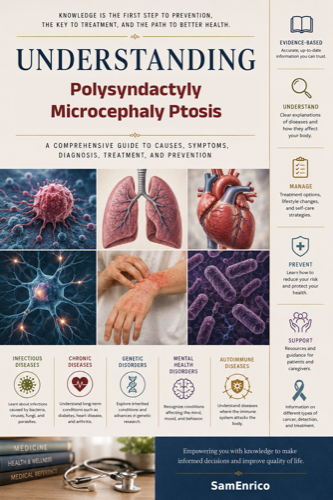
Understanding Polysyndactyly Microcephaly Ptosis
This disease publication, published by SamEnrico,
This disease publication, published by SamEnrico, covers Understanding Polysyndactyly Microcephaly Ptosis
Formats
About this book
Free sample
Chapter 1: The Sum of Parts...--– In the winter of 2018, a three-month-old girl named Amara was brought to a tertiary genetics clinic by her parents. Her chart listed three separate findings documented by three different specialists: a neonatologist noted postaxial polydactyly of both hands, a neurologist documented progressive microcephaly (head circumference falling from the 15th percentile at birth to below the 3rd percentile by week ten), and a pediatric ophthalmologist described bilateral congenital ptosis with the left eyelid covering more than half the pupil. Each specialist had addressed their own organ system. Each had assured the parents that their finding, in isolation, was “likely nothing serious.” And each had sent the family to the next consultation without connecting the dots. It was only when Amara’s parents, by their own desperation, compiled all three reports and searched the medical literature themselves that they found the word “syndromic.” The triad of findings—polysyndactyly, microcephaly, and ptosis—had been described together in exactly eleven peer-reviewed articles in the preceding thirty years.
Amara’s mother later wrote, “We didn’t have a rare disease. We had three rare diseases that happened to occur in the same child. And no one told us that was impossible.”That impossibility is the subject of this book.The Statistical Improbability That Demands Attention Isolated congenital anomalies occur with measurable frequencies in the general population. Polydactyly—extra digits—affects approximately 1 in 500 to 1 in 1,000 live births, depending on ancestry and whether the duplication is postaxial (ulnar side) or preaxial (thumb side). Isolated syndactyly—fused digits—affects approximately 1 in 2,000 to 1 in 3,000 live births.
Congenital microcephaly, defined as occipitofrontal circumference (OFC) more than two standard deviations below the mean for gestational age and sex, occurs in approximately 1 in 6,000 to 1 in 8,000 live births. Congenital ptosis—drooping of the upper eyelid present at birth—occurs in approximately 1 in 800 to 1 in 1,000 live births.If these four conditions were independent events—and in the absence of any biological connection, that assumption might hold—the probability of all three occurring in the same child would be the product of their individual frequencies. Multiplying…
This is the end of the free sample. Get the eBook to keep going. Buy now
Contents
- Chapter 1
- Chapter 2
- Chapter 3
- Chapter 4
- Chapter 5
- Chapter 6
- Chapter 7
- Chapter 8
- Chapter 9
- Chapter 10
- Chapter 11
- Chapter 12
Details
- Author
- Delacruz Gertha
- Publisher
- SamEnrico
- Language
- English
- Genre
- Non-Fiction, Informative, Educational
- Released
- 2026-05-09
- Pages (approx.)
- 156
- Available as
- eBook, Audiobook

Read better in the ZLOADR app
Your eBooks on your phone or tablet. Sign in with your SamEnrico account and start reading.
More by Delacruz Gertha
 Morning Of Presentation RoutineDelacruz Gertha$11.99
 The Tax Benefits of DownsizingDelacruz Gertha$11.99
 Divorce for WomenDelacruz Gertha$11.99
 Alcohol Detox Hydration ProtocolDelacruz Gertha$11.99
 Griot Epic Performance TraditionsDelacruz Gertha$11.99
 Virginia Woolf and the Bloomsbury Bookshop: A Literary Revolution in Tea and InkDelacruz Gertha$11.99
 Celery and Celariac HarvestingDelacruz Gertha$11.99
 HARO Follow Up EtiquetteDelacruz Gertha$12.99
 Private Aviation Spending RecoveryDelacruz Gertha$12.99
 How to Start a Chemical Process Machine Tool (metal Working) Business (Beginners Guide)Delacruz Gertha$11.99
You may also like
 Hong Kong Handover 1997Dunn Johnnie$11.99
 Zumba For Postnatal Recovery CourseNeal Christian$11.99
 Zumba for BeginnersLadner Nikia$11.99
 YouTube Comment Mining GuideHumes Pandora$12.99
 Worry Box MeditationCarlin Rudy$11.99
 Workplace Stress MeditationNguyen Lynn$11.99
 Workplace Stress and Sleep RepairHawley Ivory$11.99
 Workplace Perfectionism CureDelaney Jeffry$11.99
 Workplace Injustice Anger GuideWallen Isabelle$11.99
 Work Addiction and Burnout LinkGreenwood Ester$11.99
 Women in Yoga and WellnessBeattie Galina$11.99
 Women in Stand Up ComedyChun Evangeline$11.99