
Non-FictionInformativeEducational
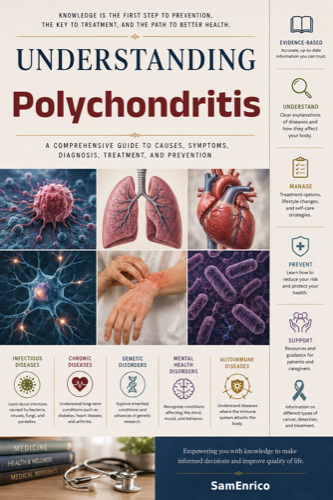
Understanding Polychondritis eBook
This disease publication, published by SamEnrico,
This disease publication, published by SamEnrico, covers Understanding Polychondritis
Formats
Free sample
Chapter 1: The Architecture of You...--–- Imagine waking up one morning to find your ear glowing like a hot coal. Not the soft, fleshy lobe at the bottom—that part remains pale and normal—but the curved, ridged upper half. It is red, swollen, painful to the touch, and warm in a way that feels wrong, like an infection without a cut. You check your temperature. Normal.
You wait a day. The redness fades. You forget about it. Three weeks later, your other ear does the same thing. Then your nose becomes tender.
Then your knee swells for no reason. Then a routine eye exam reveals inflammation deep inside your eye that your optometrist cannot explain.This is not a collection of random, unrelated events. This is your body attacking its own scaffolding. This is the hidden architecture of you—turning against itself.Before we can understand why this happens, before we can discuss treatments, medications, or the long road ahead, we must first understand what is under attack. You cannot fight an enemy you cannot see.
And the enemy in relapsing polychondritis is not your immune system alone—it is the very framework that holds your body together.This chapter is an architectural tour of the human body. We will map every structure that can become inflamed in RP. We will learn why cartilage behaves differently than bone, muscle, or skin. We will discover why healing is slow, why symptoms migrate from one part of the body to another, and why a disease that affects your ear can also threaten your windpipe, your heart valves, and your joints. By the end of this chapter, you will understand the terrain of your own illness—and you will never look at your body the same way again.The Scaffolding You Never Knew You Had Most people go their entire lives without thinking about cartilage.
Unlike bones, which we see on X-rays, or muscles, which we flex in mirrors, cartilage operates in the background. It is the silent workhorse of human anatomy. It gives shape to features that would otherwise collapse. It cushions joints that would otherwise grind bone against bone. It keeps your airway open so you can breathe while you sleep.Cartilage is a connective tissue, but it is unlike any other connective tissue in your body.
It is firm yet flexible. It is strong yet lightweight. It can withstand compression forces that would crush other tissues, yet it has no blood vessels of its own. This last fact—avascularity—is perhaps the most important concept in understanding why RP behaves the way it does.Let us begin with the basics. There are three types of cartilage in the human body, each with a distinct structure and function.
Understanding these three types is like learning the difference between brick, wood, and steel in a building. Each has a purpose. Each fails in a different way. And each can become a target in RP.Type One: Elastic Cartilage – The Flexible Framework Elastic cartilage is the most flexible of the three types. It contains a dense network of elastin fibers—the same protein that allows your skin to snap back after being pinched—woven throughout a firm gel-like matrix.
This combination of strength and recoil makes elastic cartilage ideal for structures that need to maintain their shape while bending repeatedly.Where do you find elastic cartilage? Your external ear (the pinna) is the most visible example. The curved rim, the ridges and valleys that make your ear uniquely yours—all of this is elastic cartilage. Your epiglottis, the small flap of tissue that closes over your windpipe when you swallow, is also elastic cartilage. So is part of your larynx (voice box) and the small tubes leading into your middle ear.In RP, elastic cartilage is frequently attacked.
This is why auricular chondritis—inflammation of the ear cartilage—is the hallmark symptom, affecting approximately 90% of patients. The ear becomes red, swollen, and intensely painful. The inflammation follows the contours of the cartilage precisely. That is why the earlobe, which contains no cartilage, remains normal. This sparing of the earlobe is not a random curiosity; it is a critical diagnostic clue that distinguishes RP from infection.The epiglottis, when inflamed, can cause a sensation of something stuck in the throat, difficulty swallowing, or a muffled voice.
Because elastic cartilage lacks blood vessels, inflammation here resolves slowly—often over weeks rather than days—and repeated episodes can permanently damage the tissue. A chronically inflamed ear may become floppy or calcified, losing its natural shape. A damaged epiglottis may not close properly, increasing the risk of choking or aspiration.Type Two: Hyaline Cartilage – The Smooth Glide Surface Hyaline cartilage is the most common type of cartilage in the body. Its name comes from the Greek word hyalos, meaning glass, because it has a translucent, glassy appearance under a microscope. It contains fewer elastin fibers than elastic cartilage and more collagen—specifically Type II collagen, which we will discuss extensively in Chapter 2.This cartilage is smooth, firm, and designed to reduce friction.
It coats the ends of your long bones where they meet at joints, creating a nearly frictionless surface for movement. It forms the structure of your nose, including the nasal bridge and the septum that divides your nostrils. It reinforces your trachea (windpipe) with C-shaped rings that keep your airway open. It connects your ribs to your breastbone. And in developing fetuses, hyaline cartilage serves as the temporary skeleton that will eventually be replaced by bone—a process called ossification.In RP, hyaline cartilage is attacked in multiple locations.
Nasal chondritis affects approximately 60% of patients. The inflammation can destroy the nasal bridge, leading to the classic "saddle-nose" deformity—a collapse of the middle of the nose that makes the tip appear to point upward. This is not merely a cosmetic issue; it can obstruct breathing and alter the sense of smell.Laryngotracheal involvement affects more than 50% of patients and is the most dangerous manifestation of RP. The hyaline cartilage rings of the trachea become inflamed, thickened, and narrowed. Over time, they may weaken and collapse.
This is the "silent danger" we will explore in Chapter 5—a condition that can cause stridor (a high-pitched breathing sound), shortness of breath, and ultimately respiratory failure.Joint involvement affects approximately 69% of patients. Unlike rheumatoid arthritis, which erodes bone, RP causes an inflammatory arthritis that typically does not destroy the joint surface. The pain and swelling are real—they are not "in your head"—but the prognosis for joint function is generally better than in other autoimmune arthritides. The small bones of the hands and feet are usually spared, which is another clue that distinguishes RP from rheumatoid arthritis.Type Three: Fibrocartilage – The Shock Absorber Fibrocartilage is the toughest and most durable of the three types. It contains dense bundles of Type I collagen (the same collagen found in tendons and ligaments) arranged in parallel lines, giving it exceptional tensile strength.
Unlike elastic and hyaline cartilage, fibrocartilage can withstand heavy loads and repetitive compression.Where do you find fibrocartilage? The intervertebral discs of your spine are fibrocartilage—those rubbery cushions between your vertebrae that prevent bone from grinding against bone.…
This is the end of the free sample. Get the eBook to keep going. Buy now
About this book
Details
- Author
- Kellogg Maire
- Publisher
- SamEnrico
- Language
- English
- Genre
- Non-Fiction, Informative, Educational
- Released
- 2026-05-18
- Pages (approx.)
- 159
- Available as
- eBook, Audiobook

Read better in the ZLOADR app
Your eBooks on your phone or tablet. Sign in with your SamEnrico account and start reading.
More by Kellogg Maire
 Comparative Religion PromptsKellogg Maire$11.99
 Indian Agent Stress ManagementKellogg Maire$11.99
 Meditation For Distraction Recovery HandbookKellogg Maire$11.99
 Anger Time Out Protocol at WorkKellogg Maire$11.99
 The Varicocele Testosterone ImpactKellogg Maire$11.99
 The Ghosts of the Overland Telegraph: Australia's Digital DawnKellogg Maire$11.99
 Boracite MiningKellogg Maire$11.99
 How to Become a Command And Control SpecialistKellogg Maire$11.99
 YouTube Description OptimizationKellogg Maire$12.99
 Domestic vs International Travel RecoveryKellogg Maire$12.99
You may also like
 Hong Kong Handover 1997Dunn Johnnie$11.99
 Zumba For Postnatal Recovery CourseNeal Christian$11.99
 Zumba for BeginnersLadner Nikia$11.99
 YouTube Comment Mining GuideHumes Pandora$12.99
 Worry Box MeditationCarlin Rudy$11.99
 Workplace Stress MeditationNguyen Lynn$11.99
 Workplace Stress and Sleep RepairHawley Ivory$11.99
 Workplace Perfectionism CureDelaney Jeffry$11.99
 Workplace Injustice Anger GuideWallen Isabelle$11.99
 Work Addiction and Burnout LinkGreenwood Ester$11.99
 Women in Yoga and WellnessBeattie Galina$11.99
 Women in Stand Up ComedyChun Evangeline$11.99