

Non-FictionInformativeEducational
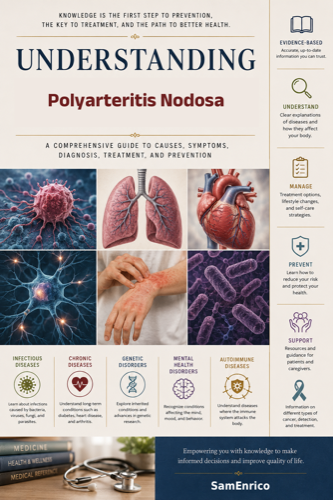
Understanding Polyarteritis Nodosa eBook
This disease publication, published by SamEnrico,
by Russo Lavera
This disease publication, published by SamEnrico, covers Understanding Polyarteritis Nodosa
Formats
Free sample
Chapter 1: The Forgotten Killer...--–- In the winter of 1865, a 32-year-old journeyman carpenter named Carl entered the medical clinic of Dr. Adolf Kussmaul in Freiburg, Germany. He was not a man accustomed to seeking help. His hands, calloused from years of gripping planes and saws, had built furniture for the burghers of the Black Forest region. But over the preceding eight months, Carl had been slowly dismantled by an invisible force.
His muscles ached with a depth that suggested they had been torn from their attachments. A peculiar net-like rash, purple and angry, had spread across his calves. Then came the burning—first in his left foot, then his right—followed by a sudden, terrifying collapse of his left wrist. He could no longer lift his hammer. He could no longer feed himself.
He was 32 years old, and he was dying of something no physician in history had ever named.Kussmaul, a meticulous clinician with a poet's sensibility, was baffled. He palpated Carl's limbs and felt, beneath the skin, a string of small, tender nodules running along the paths of arteries—like beads on a string, but made of pain. Over the following weeks, Carl's condition deteriorated with a brutality that shocked even the seasoned ward nurses. His abdomen would seize with agony after every meal, as though his intestines were being wrung like wet cloths. His blood pressure soared to dangerous heights, then crashed.
His right foot turned blue, then black. And then, one morning in March 1866, Carl was gone.Kussmaul requested an autopsy. It was a common plea in an era when medicine was still groping in the dark. But what he found, when he opened Carl's body, would echo through the corridors of medical history for the next 150 years.The Autopsy That Changed Everything When Kussmaul and his young colleague, Rudolf Maier, dissected Carl's body, they expected to find the usual suspects: tuberculosis, perhaps, or a hidden cancer. Instead, they found something they had never seen described in any anatomical text.
Scattered along nearly every medium-sized artery—the renal arteries, the mesenteric arteries, the arteries feeding the nerves—were tiny, bead-like aneurysms. The arterial walls had been destroyed by an inflammatory process so fierce that the vessels had ballooned outward in some places and narrowed to thread-like slivers in others. The nodules Kussmaul had felt through Carl's skin were not tumors or cysts. They were the physical manifestations of arteries under siege.Kussmaul and Maier published their findings in a now-legendary paper, coining the term Periarteritis Nodosa—inflammation around the arteries, with nodules. They had no idea what caused it.
They had no treatment to offer. But they had given the disease a name, and in doing so, they had drawn a map for future explorers.Today, we call it Polyarteritis Nodosa (PAN) —a rare, life-threatening vasculitis that inflames and destroys medium-sized arteries throughout the body. It is a disease of terrifying versatility, capable of mimicking stroke, heart attack, appendicitis, multiple sclerosis, and even psychiatric illness. And yet, because it is so rare—afflicting perhaps one to three people per million each year—it remains, in the words of one patient advocate, "the forgotten killer."What This Chapter Will Teach You This chapter is the foundation of everything that follows. If you or someone you love has been diagnosed with PAN—or suspects a diagnosis after years of mysterious symptoms—you need to understand what this disease actually is.
You need to understand the historical journey from Kussmaul's autopsy table to the modern rheumatology clinic. You need to grasp the basic anatomy of vasculitis: what blood vessels are, how they become inflamed, and why medium-sized arteries are the Achilles' heel in PAN. Most critically, you need to understand the distinction between systemic PAN (which attacks internal organs and can kill within months if untreated) and cutaneous PAN (c PAN) (which is limited to the skin and carries a far better prognosis, though with important caveats discussed later in this chapter and in Chapter 7).By the end of this chapter, you will have a clear, working definition of PAN. You will understand its place among the family of vasculitides. And you will be equipped to distinguish PAN from its confusing cousins—particularly microscopic polyangiitis (MPA) and granulomatosis with polyangiitis (GPA)—so that you can ask your doctors the right questions and advocate for the right tests.
This is not a dry history lesson. It is the first step toward taking control of a disease that thrives on confusion.What Is Vasculitis? Understanding the Blood Vessel Highway To understand PAN, you must first understand the concept of vasculitis—a word that literally means "inflammation of blood vessels." Imagine your body's circulatory system as a vast network of highways. The largest highways are the aorta and its major branches (the large arteries). The medium-sized roads are the medium arteries: the renal arteries that feed your kidneys, the mesenteric arteries that feed your intestines, the coronary arteries that feed your heart, and the arteries that travel alongside your peripheral nerves.
The smallest roads are the small vessels (arterioles, capillaries, and venules), which deliver oxygen directly to every cell.Vasculitis is a condition in which your immune system, for reasons that are often unclear, mistakenly identifies your own blood vessel walls as enemies and attacks them. The result is inflammation—swelling, thickening, and weakening of the vessel wall. This leads to two catastrophic consequences:Stenosis (narrowing): The vessel swells shut, cutting off blood flow to the tissues downstream. This causes ischemia (tissue starvation) and, if prolonged, infarction (tissue death). A heart attack is a myocardial infarction caused by coronary artery blockage.
In PAN, the same thing can happen in your intestines, your kidneys, your nerves, or even your testicles.Aneurysm formation (weakening): The inflamed vessel wall loses its structural integrity and balloons outward. These microaneurysms are the "beads" Kussmaul felt beneath Carl's skin. They are fragile and can rupture, causing catastrophic internal bleeding.PAN is a specific type of vasculitis. It belongs to a subgroup called necrotizing vasculitis because the inflammation doesn't just irritate the vessel wall—it kills it. The medical term fibrinoid necrosis describes the death of the smooth muscle cells and the deposition of a protein called fibrin, which turns the vessel wall into a featureless, glassy scar.
Once necrosis occurs, the vessel can never fully recover. That is why, even after successful treatment, patients may be left with permanent damage: a foot that still drags (residual neuropathy), high blood pressure (scarred renal arteries), or short bowel syndrome (prior intestinal infarction).Why Medium Arteries? The Key to Understanding PANNot all blood vessels are equally vulnerable in PAN. The disease has a distinct, almost obsessive preference for medium-sized arteries—those roughly 50 to 500 micrometers in diameter. These are the arteries you would see if you looked at a cross-section of a kidney or a piece of intestine under a microscope: muscular walls, distinct layers, and a critical role in regulating blood flow to entire organs.The large arteries (the aorta, the iliac arteries) are almost never affected in classic PAN.
The smallest vessels (capillaries, venules) are also spared. This is not an accident. The immune complexes that drive PAN—clumps of…
This is the end of the free sample. Get the eBook to keep going. Buy now
About this book
Details
- Author
- Russo Lavera
- Publisher
- SamEnrico
- Language
- English
- Genre
- Non-Fiction, Informative, Educational
- Released
- 2026-06-03
- Pages (approx.)
- 159
- Available as
- eBook, Audiobook

Read better in the ZLOADR app
Your eBooks on your phone or tablet. Sign in with your SamEnrico account and start reading.
More by Russo Lavera
 Workplace Anger Cognitive RestructuringRusso Lavera$11.99
 Waiting Mode Interruption Reduction WorkbookRusso Lavera$11.99
 Jamaican Management Training PlanRusso Lavera$11.99
 Sports Management Essay GuideRusso Lavera$11.99
 The Stress Cortisol Testosterone GuideRusso Lavera$11.99
 The Bard and the Bishop: How Shakespeare’s ‘King Lear’ Survived a Religious CrackdownRusso Lavera$11.99
 How to Become a Nursery School AttendantRusso Lavera$11.99
 Test Measurement M&A GuideRusso Lavera$12.99
 YouTube Live for Brand EngagementRusso Lavera$12.99
You may also like
 Hong Kong Handover 1997Dunn Johnnie$11.99
 Zumba For Postnatal Recovery CourseNeal Christian$11.99
 Zumba for BeginnersLadner Nikia$11.99
 YouTube Comment Mining GuideHumes Pandora$12.99
 Worry Box MeditationCarlin Rudy$11.99
 Workplace Stress MeditationNguyen Lynn$11.99
 Workplace Stress and Sleep RepairHawley Ivory$11.99
 Workplace Perfectionism CureDelaney Jeffry$11.99
 Workplace Injustice Anger GuideWallen Isabelle$11.99
 Work Addiction and Burnout LinkGreenwood Ester$11.99
 Women in Yoga and WellnessBeattie Galina$11.99
 Women in Stand Up ComedyChun Evangeline$11.99