
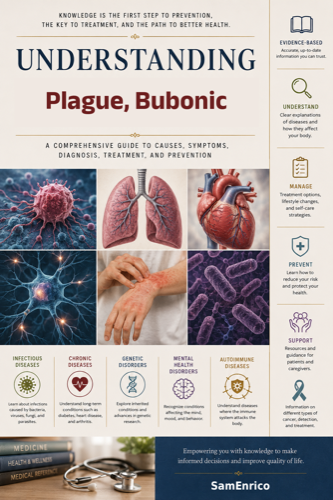
Non-FictionInformativeEducational
Understanding Plague, Bubonic eBook
This disease publication, published by SamEnrico,
This disease publication, published by SamEnrico, covers Understanding Plague, Bubonic
Formats
Free sample
Chapter 1: The Forgotten Killer...–- On a warm September morning in 2015, a father from New Mexico packed his two young children into the family SUV for a camping trip in the Cibola National Forest. He had no idea that within one week, he would be fighting for his life in an intensive care unit, his fingers turning black, his lungs filling with fluid, and his children watching through a glass window as doctors fought to save him from a disease most Americans believe vanished with the Middle Ages. The family saw a dead prairie dog near their campsite. The father thought it looked interesting. He knelt down for a closer look.
He took a photograph. He did not touch the animal. He did not need to. The fleas that had abandoned the cooling carcass were already searching for their next warm-blooded host. They found him.
Five days later, his fever spiked to 104 degrees. His armpit swelled into a painful, eggplant-colored mass the size of a golf ball. The emergency room physician, fresh out of residency, had never seen a case of plague. He ordered a CT scan for a suspected abscess. By the time the infectious disease specialist recognized the bubo, the bacteria had already entered the father's bloodstream.
He survived, but he lost two fingertips and spent three weeks on a ventilator. His children never finished the camping trip.This is not a story from 1347. This is a story from last Tuesday. And it is happening more often than you think.The Disease That Refuses to Die Plague occupies a strange place in the modern consciousness. Ask any educated person to name a disease that terrifies them, and they will say Ebola, or COVID-19, or antibiotic-resistant tuberculosis.
They will not say plague. Plague is a history lesson. Plague is the Black Death, the subject of documentaries on the History Channel, a costume drama with monks and flagellants and rats scurrying through medieval grain stores. Plague is something that happened to other people in another time. This perception is not merely inaccurate.
It is dangerous.The bacterium Yersinia pestis has never left us. It circulates quietly in rodent populations on every continent except Australia and Antarctica. It lives in the prairie dogs of Arizona, the ground squirrels of California, the gerbils of Kazakhstan, and the rats of the Democratic Republic of Congo. It waits in the soil of burrows, carried by fleas that can survive for months without a blood meal. And every year, between one thousand and two thousand humans stumble into its path.
Most of them live in rural Africa, where diagnostic delays and limited antibiotics mean that plague still kills twenty to thirty percent of its victims. But a handful live in the United States, specifically in the Four Corners region where New Mexico, Arizona, Colorado, and Utah meet. In 2015, the year of the camping father, the United States recorded sixteen cases of human plague. Four of those patients died.The purpose of this chapter—indeed, the purpose of this entire book—is to shatter the comfortable illusion that plague belongs to the past. It does not.
What has changed is not the bacterium but our relationship to it. We have antibiotics now, a luxury that medieval physicians could not imagine. We have public health surveillance, insecticides, and the germ theory of disease. We have learned to break the chain of infection before it reaches our homes. But these advantages are fragile.
Antibiotic resistance is real and spreading. Climate change is expanding the habitat of both rodents and fleas. Public health budgets have been cut in nearly every state, leaving surveillance programs understaffed and underfunded. And the average physician, trained in a system that considers plague an exotic curiosity, may go an entire career without seeing a single case—until the day one walks through the emergency room door.Why This Book Exists This book is not a textbook, though it contains rigorous science. It is not a history, though it tells the stories of three pandemics that reshaped human civilization.
It is not a survival manual, though it includes practical advice that could save your life or the life of someone you love. It is all of these things, woven together into a single narrative that moves from the microscopic to the global, from the sixth century to the twenty-first, from the flea's blocked gut to the hospital isolation room.The title Understanding Plague, Bubonic was chosen deliberately. The word "understanding" carries a double meaning here. First, it means comprehension—the kind of deep, systematic knowledge that allows you to see connections that others miss. Second, it means empathy—the recognition that plague is not just a collection of biological facts but a human tragedy that has repeated itself across centuries and continents.
To understand plague is to understand our own vulnerability. It is to see that the line between civilization and collapse is thinner than we want to believe.The twelve chapters of this book are organized into four parts. Part I, "The Shadow of History," traces the three great plague pandemics and shows how each one changed the world differently. Part II, "The Enemy Within," goes inside the bacterium itself, exploring its structure, its virulence factors, and the ingenious cycle of transmission that keeps it alive. Part III, "Survival and Solutions," moves from biology to medicine, covering treatment, prevention, and the real-world challenges of outbreak control in places like Madagascar.
Part IV, "The Future Landscape," confronts the threats that lie ahead: bioterrorism, climate change, and the erosion of our public health infrastructure. Each chapter builds on the ones before it, creating a complete picture of a disease that is at once ancient and urgently contemporary.What You Will Learn in This Chapter Before we dive into the three great pandemics, let us establish a foundation. This chapter will accomplish five specific goals. First, you will learn the basic definition of plague and its three clinical forms. Second, you will understand why plague is considered a re-emerging infectious disease, not a historical footnote.
Third, you will see the geographical distribution of plague today, including the surprising fact that the United States has a persistent, decades-long reservoir of Yersinia pestis in its western states. Fourth, you will learn why the distinction between bubonic, septicemic, and pneumonic plague matters for both diagnosis and public health. Fifth, and most importantly, you will understand why this knowledge is relevant to you, even if you have never seen a prairie dog or traveled to Madagascar.Let us begin with the basics.What Is Plague?Plague is a zoonotic disease caused by the bacterium Yersinia pestis. A zoonotic disease is one that circulates primarily in animal populations and only occasionally infects humans. This is a crucial distinction.
Diseases like measles and influenza are human-adapted; they spread from person to person and cannot survive long without a continuous supply of human hosts. Plague is different. It does not need us. It has a perfectly functional existence in the wild, moving from rodent to rodent via flea bites, with no human involvement whatsoever. We are accidental hosts, collateral damage in a war between bacteria and rodents that has been going on for thousands…
This is the end of the free sample. Get the eBook to keep going. Buy now
About this book
Details
- Author
- Boykin Andera
- Publisher
- SamEnrico
- Language
- English
- Genre
- Non-Fiction, Informative, Educational
- Released
- 2026-06-02
- Pages (approx.)
- 155
- Available as
- eBook, Audiobook

Read better in the ZLOADR app
Your eBooks on your phone or tablet. Sign in with your SamEnrico account and start reading.
More by Boykin Andera
 Workplace Chat Interruption GuideBoykin Andera$11.99
 Creative Starvation ArtsBoykin Andera$11.99
 Economics Essay GPT PromptsBoykin Andera$11.99
 Divorce and Tax FilingBoykin Andera$11.99
 The Language Learning Sleep MethodBoykin Andera$11.99
 The Golden Contract: How Pelé and His Agent Changed Football ForeverBoykin Andera$11.99
 Audience Flywheel DesignBoykin Andera$11.99
 SaaS Consolidation GuideBoykin Andera$12.99
 QuickBooks Class Tracking GuideBoykin Andera$12.99
 How to Start a Opera Production Business (Beginners Guide)Boykin Andera$11.99
You may also like
 Hong Kong Handover 1997Dunn Johnnie$11.99
 Zumba For Postnatal Recovery CourseNeal Christian$11.99
 Zumba for BeginnersLadner Nikia$11.99
 YouTube Comment Mining GuideHumes Pandora$12.99
 Worry Box MeditationCarlin Rudy$11.99
 Workplace Stress MeditationNguyen Lynn$11.99
 Workplace Stress and Sleep RepairHawley Ivory$11.99
 Workplace Perfectionism CureDelaney Jeffry$11.99
 Workplace Injustice Anger GuideWallen Isabelle$11.99
 Work Addiction and Burnout LinkGreenwood Ester$11.99
 Women in Yoga and WellnessBeattie Galina$11.99
 Women in Stand Up ComedyChun Evangeline$11.99