
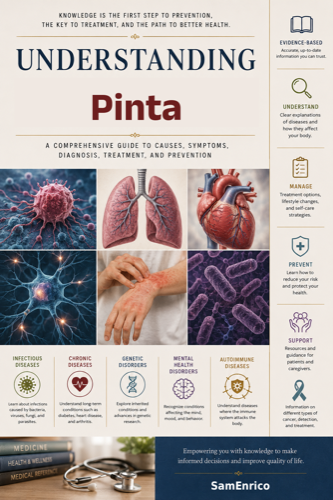
Understanding Pinta eBook
This disease publication, published by SamEnrico,
This disease publication, published by SamEnrico, covers Understanding Pinta
Formats
Free sample
Chapter 1: The Forgotten Spirochete...--–- In the vast, silent archives of the Centers for Disease Control and Prevention in Atlanta, Georgia, there exists a freezer that few people ever open. It is not a particularly remarkable freezer—white, industrial, humming with the monotony of any other laboratory appliance. But inside, nestled among vials of smallpox vaccine and samples of long-vanished viruses, sit seventeen glass ampoules sealed with wax and labeled in fading ink. The handwriting is from a different era, the kind of cursive that American schools stopped teaching decades ago. Each ampoule contains something that no living researcher has ever successfully grown in a laboratory: the spirochete known as Treponema carateum, the bacterium that causes Pinta.These ampoules are time capsules from 1962, when a team of Mexican and American public health workers traveled through the rural villages of Guerrero and Oaxaca, collecting skin scrapings from patients with the characteristic white patches of late-stage disease.
They froze the samples, shipped them to Atlanta, and placed them in storage. And there the bacteria have remained ever since—alive, theoretically, but dormant, preserved in a cryogenic sleep that has now lasted longer than the careers of the scientists who originally collected them. No one has tried to thaw them and grow them in culture. No one has sequenced their full genome until very recently. They sit in the dark, waiting for a generation of researchers curious enough to ask: what exactly is this forgotten organism, and why did we stop paying attention to it?This chapter is the story of that spirochete.
It is a story about bacterial families, about the strange and intimate relationships between microbes and their human hosts, and about how a single, seemingly insignificant bacterium came to shape the lives of hundreds of thousands of people across the tropical Americas before being almost erased from medical memory. To understand Pinta, we must first understand its place in the treponemal family tree—a family that includes some of the most infamous pathogens in human history, as well as its shyest and least-destructive member.The Treponemal Dynasty The family Treponemataceae is not a large family, but it is an extraordinarily successful one. Its members are spiral-shaped bacteria—spirochetes—that have evolved to live exclusively within the bodies of mammals. They are masters of immune evasion, capable of persisting in their hosts for decades without being eliminated. They are also, with one significant exception, quite difficult to study in the laboratory.
Unlike the common bacterium E. coli, which grows happily overnight in a flask of nutrient broth, the treponemes are fastidious and demanding. They require living tissue, warm temperatures, and precisely the right chemical environment. Some of them have never been grown in artificial media at all.The treponemes that infect humans are four in number, and they cause four distinct diseases. Yet here is the puzzle that has confounded microbiologists for more than a century: under a microscope, these four bacteria are virtually indistinguishable.
They look identical. They move with the same corkscrew motion. They stain with the same silver dyes. And yet the diseases they produce could hardly be more different.Let us introduce them in order of their notoriety.Syphilis: The Dangerous Brother The first and most infamous member of the family is Treponema pallidum pallidum, the bacterium that causes syphilis. Syphilis is a venereal disease—transmitted through sexual contact—and it is a systemic invader.
Within weeks of infection, the bacterium enters the bloodstream and travels to every organ in the body: the heart, the brain, the eyes, the bones, the joints. In its late stages, syphilis can cause dementia, blindness, aortic aneurysms, and death. It can also be transmitted from a pregnant woman to her fetus, causing congenital syphilis, a devastating condition that leads to stillbirth, deafness, facial deformities, and neurological damage in surviving infants.Syphilis has been a scourge of humanity for at least five hundred years, and possibly much longer. Its history is written in the bones of medieval Europeans, in the medical treatises of Renaissance physicians, and in the tragic stories of famous sufferers from Al Capone to Friedrich Nietzsche. It is a disease of shame and secrecy, of madness and misery.
And it is the treponeme that every medical student learns to recognize and fear.Yaws: The Destructive Middle Child The second member of the family is Treponema pertenue, the bacterium that causes Yaws. Unlike syphilis, Yaws is not venereal. It is a disease of childhood, transmitted through direct skin-to-skin contact in warm, humid, impoverished tropical communities. Yaws begins as a primary papule—a "mother yaw"—that appears at the site of inoculation, usually on the legs or arms. If untreated, it progresses to secondary lesions that can cover the body with raspberry-like papillomas.
In its late stage, Yaws attacks the bones, causing destructive gummas that can perforate the palate, collapse the nose, and deform the long bones of the legs.Yaws does not kill, but it cripples. Children with late-stage Yaws may be unable to walk normally. Adolescents may be disfigured for life. And because Yaws spreads through casual contact in conditions of poverty and overcrowding, it has historically affected millions of children in Africa, Asia, and the Pacific Islands. The World Health Organization launched a global eradication campaign against Yaws in the 1950s, treating tens of millions of people with long-acting penicillin.
The campaign was remarkably successful, reducing the global burden of Yaws by more than ninety-five percent. But Yaws was not eliminated entirely. It persists in remote pockets, and in recent decades it has made a quiet comeback, reminding us that "eradicated" is not the same as "gone forever."Bejel: The Mucous Membrane Specialist The third member of the family is Treponema endemicum, the bacterium that causes Bejel, also known as endemic syphilis. Bejel is non-venereal like Yaws, but its transmission route is different. It spreads through contaminated drinking vessels, shared utensils, and direct oral contact.
As a result, Bejel primarily affects the mucous membranes: the mouth, the throat, and the nose. Early Bejel causes painful ulcers inside the mouth. Late Bejel can destroy the hard palate, collapse the nasal bridge, and cause bone lesions similar to those of Yaws.Bejel is found in the dry, arid regions of the world, particularly the Sahel of Africa, the Arabian Peninsula, and parts of Central Asia. It is a disease of nomadic pastoralists, where sharing water from a common vessel is a cultural practice that also facilitates bacterial transmission. Like Yaws, Bejel has been targeted for eradication, and like Yaws, it has proven stubbornly persistent in remote and marginalized communities.Pinta: The Forgotten Sister And then there is the fourth member of the family: Treponema carateum, the bacterium that causes Pinta.
If the treponemes were a human family, Pinta would be the quiet, forgotten sister who never caused any trouble, never demanded attention, and ultimately was left behind when the family moved on. Pinta is non-venereal, like Yaws and Bejel. It is transmitted through direct skin-to-skin contact in warm, humid, impoverished tropical communities—exactly the same ecological niche as Yaws. But here is where Pinta diverges from its cousins in a way that is both medically remarkable and socially tragic: Treponema…
This is the end of the free sample. Get the eBook to keep going. Buy now
About this book
Details
- Author
- Baugh Asuncion
- Publisher
- SamEnrico
- Language
- English
- Genre
- Non-Fiction, Informative, Educational
- Released
- 2026-05-08
- Pages (approx.)
- 141
- Available as
- eBook, Audiobook

Read better in the ZLOADR app
Your eBooks on your phone or tablet. Sign in with your SamEnrico account and start reading.
More by Baugh Asuncion
 The Poverty of AbundanceBaugh Asuncion$11.99
 Cuddling MeditationBaugh Asuncion$11.99
 Synthesis Essay AI PromptsBaugh Asuncion$11.99
 Uncontested Divorce RecoveryBaugh Asuncion$11.99
 The Alcohol and Sleep Memory GuideBaugh Asuncion$11.99
 Keri Hulme: The Bone People’s Quiet RevolutionBaugh Asuncion$11.99
 Assistant SuperintendentBaugh Asuncion$11.99
 QuickBooks vs Wave Comparison GuideBaugh Asuncion$12.99
 JEE Alternative Career Path GuideBaugh Asuncion$12.99JEE Alternative Career Path GuideBaugh Asuncion$12.99
 How to Start a Cheese Making Machines Business (Beginners Guide)Baugh Asuncion$11.99