
Non-FictionInformativeEducational
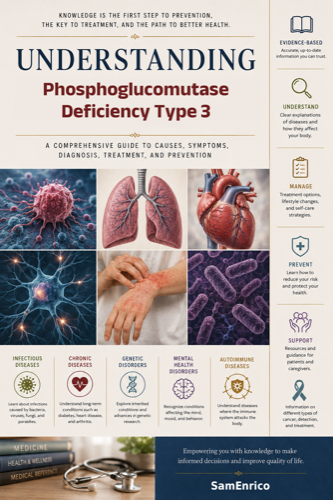
Understanding Phosphoglucomutase Deficiency Type 3 eBook
This disease publication, published by SamEnrico,
This disease publication, published by SamEnrico, covers Understanding Phosphoglucomutase Deficiency Type 3
Formats
Free sample
Chapter 1: The Invisible Enemy...--Imagine receiving a diagnosis for a disease so rare that most doctors have never heard of it. Imagine being told that your child—or you yourself—has a condition that was only identified by medical science a decade ago, a condition shared by fewer than fifty known individuals on the entire planet. Imagine the isolation, the confusion, and the terrifying uncertainty of not knowing what the future holds. This is the reality for families confronting Phosphoglucomutase 3 deficiency, a genetic disorder that attacks the body's most fundamental machinery, disrupting everything from the ability to fight off a common cold to the development of the brain and skeleton. This chapter is the first step out of that isolation.
Here, you will learn exactly what PGM3 deficiency is, how it was discovered, why it has so many confusing names, and how common—or rather, how uncommon—it truly is. By the end of this chapter, you will have a solid foundation upon which the rest of this book will build, transforming fear into knowledge and knowledge into power.What Is PGM3 Deficiency, Exactly?At its simplest level, Phosphoglucomutase 3 deficiency—abbreviated as PGM3 deficiency—is a genetic disorder that interferes with a crucial sugar-processing pathway inside every cell of the body. The name itself sounds intimidating, but it can be broken down into understandable parts. "Phosphoglucomutase" is an enzyme, a tiny molecular machine that performs one specific chemical reaction. The number "3" indicates that this is the third version of this enzyme family found in human cells.
"Deficiency" means that the enzyme is either absent entirely or present but functioning poorly due to a genetic mutation.To understand what this enzyme does, imagine for a moment that your body is a vast construction project. Proteins are the building materials, and sugars are the instructions that tell those proteins where to go and what to do. The process of attaching sugars to proteins is called glycosylation (pronounced gly-co-sy-LAY-shun), and it is one of the most fundamental and ancient biological processes in existence. Every single cell in your body relies on proper glycosylation to survive, communicate, and function. The PGM3 enzyme plays a critical role in creating one specific sugar building block that is used in glycosylation.
When PGM3 is deficient, the assembly line runs out of essential parts, and proteins throughout the body become misfolded, misplaced, or completely nonfunctional.The consequences are staggering. Because glycosylation affects virtually every organ system, PGM3 deficiency produces a wide array of symptoms that often seem unrelated at first glance. The immune system is the most consistently affected, leading to a condition called combined immunodeficiency (CID). Patients suffer from recurrent infections—pneumonia, skin abscesses, ear infections, sinusitis—that never seem to fully resolve. Many develop severe allergies, including eczema so intense that it cracks and bleeds, asthma that requires daily medication, and food allergies that can trigger life-threatening anaphylaxis.
A striking laboratory finding is an extremely high level of a substance called immunoglobulin E, or Ig E, which is normally associated with allergic reactions. In PGM3 deficiency, Ig E levels can soar to more than ten times the upper limit of normal, a feature that has led some doctors to misdiagnose the condition as Hyper-Ig E syndrome, a different but related disorder.But the immune system is only part of the story. Many patients also experience neurological problems: developmental delay, intellectual disability, seizures, difficulty walking (ataxia), slurred speech (dysarthria), and hearing loss that worsens over time. Some have skeletal abnormalities, including short stature, shortened fingers (brachydactyly), and distinctive facial features. The term "PGM3-CDG" reflects the fact that this condition is classified as a Congenital Disorder of Glycosylation (CDG), a family of over 150 rare diseases all caused by problems in the sugar-attachment process.
Another name you may encounter is Immunodeficiency 23, or IMD23, which comes from the international classification system for primary immunodeficiencies. Yet another is "Hyper-Ig E syndrome-like disorder," because the symptoms so closely mimic that better-known condition.This multiplicity of names is not merely confusing; it has real consequences. Patients may see an immunologist who calls it IMD23, a geneticist who calls it PGM3-CDG, and an allergist who calls it Hyper-Ig E syndrome-like. Without a unified label, coordinating care becomes difficult, and families may struggle to find each other for support. Throughout this book, we will primarily use "PGM3 deficiency" or "PGM3-CDG," but you should be aware that any of these names may appear in your medical records.The History: A Disease Born in the Age of Genomics The story of PGM3 deficiency is not an ancient one, whispered through generations of physicians puzzled by a mysterious illness.
It is a thoroughly modern story, made possible by technologies that did not exist twenty years ago. Specifically, PGM3 deficiency was discovered in 2014, when two independent research groups—one led by Dr. Asbjørg Stray-Pedersen in Norway and the United States, and another led by Dr. Yu Zhang in China—published back-to-back papers that changed everything.Before 2014, patients with PGM3 deficiency were medical mysteries. They presented with recurring infections, severe allergies, developmental delays, and a host of other symptoms that did not fit neatly into any known diagnostic category.
Some were diagnosed with Hyper-Ig E syndrome, a condition caused by mutations in a different gene called STAT3. Others were labeled with "combined immunodeficiency of unknown significance." Many bounced from specialist to specialist, accumulating diagnoses like eczema, asthma, chronic sinusitis, and failure to thrive, but no single unifying explanation emerged.The breakthrough came from a technology called whole-exome sequencing. Unlike older genetic tests that examined one gene at a time, whole-exome sequencing reads the DNA sequence of all twenty thousand protein-coding genes in a single experiment. This is akin to searching for a typo in a twenty-thousand-volume encyclopedia, but modern bioinformatics makes it possible. Stray-Pedersen and her colleagues studied a group of patients with a puzzling combination of infections, allergies, and neurological symptoms who had no mutations in known disease genes.
When they analyzed the patients' exomes, they found something surprising: mutations in the PGM3 gene.The discovery was a classic example of reverse genetics. Typically, scientists start with a known gene, create mutations in an animal model, and observe what goes wrong. In this case, they started with patients who had a defined set of symptoms, searched their DNA for common abnormalities, and identified a previously unknown disease gene. The 2014 papers described the first cohort of patients—fewer than twenty individuals worldwide—and established the basic framework for understanding the condition. They identified the autosomal recessive inheritance pattern (explained in detail in Chapter 3), linked PGM3 mutations to defects in glycosylation, and described the characteristic clinical features of recurrent infections, elevated Ig E, and neurological involvement.In the decade since those landmark publications, knowledge has accumulated slowly but steadily.
Case reports trickled in from around the world, each adding a new patient or family to the medical literature. In 2022, a landmark case study described the first successful treatment of a severely affected infant using cord blood transplantation, a development discussed thoroughly in Chapter 8. And in 2024, a systematic review compiled and analyzed all forty-four published cases to date, providing the most comprehensive picture yet of…
This is the end of the free sample. Get the eBook to keep going. Buy now
About this book
Details
- Author
- Courtney Dillon
- Publisher
- SamEnrico
- Language
- English
- Genre
- Non-Fiction, Informative, Educational
- Released
- 2026-06-02
- Pages (approx.)
- 153
- Available as
- eBook, Audiobook

Read better in the ZLOADR app
Your eBooks on your phone or tablet. Sign in with your SamEnrico account and start reading.
More by Courtney Dillon
 Mantra Repetition for SafetyCourtney Dillon$11.99
 The Assertiveness for Construction Workers GuideCourtney Dillon$11.99
 Creative Starvation ProtocolCourtney Dillon$11.99
 The Postpartum Anemia GuideCourtney Dillon$11.99
 Politics Office Anger GuideCourtney Dillon$11.99
 The Last Healer of the Silk RoadCourtney Dillon$11.99
 Online Travel Agency MapCourtney Dillon$12.99
 Test Tasks for VA CandidatesCourtney Dillon$12.99
 How to Start a Hobby in TurtlesCourtney Dillon$11.99
 Administrative SecretaryCourtney Dillon$11.99
You may also like
 Hong Kong Handover 1997Dunn Johnnie$11.99
 Zumba For Postnatal Recovery CourseNeal Christian$11.99
 Zumba for BeginnersLadner Nikia$11.99
 YouTube Comment Mining GuideHumes Pandora$12.99
 Worry Box MeditationCarlin Rudy$11.99
 Workplace Stress MeditationNguyen Lynn$11.99
 Workplace Stress and Sleep RepairHawley Ivory$11.99
 Workplace Perfectionism CureDelaney Jeffry$11.99
 Workplace Injustice Anger GuideWallen Isabelle$11.99
 Work Addiction and Burnout LinkGreenwood Ester$11.99
 Women in Yoga and WellnessBeattie Galina$11.99
 Women in Stand Up ComedyChun Evangeline$11.99