
Non-FictionInformativeEducational
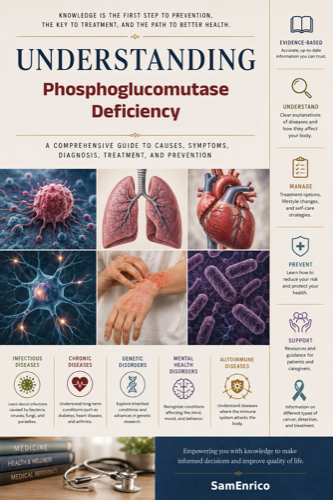
Understanding Phosphoglucomutase Deficiency eBook
This disease publication, published by SamEnrico,
This disease publication, published by SamEnrico, covers Understanding Phosphoglucomutase Deficiency
Formats
Free sample
Chapter 1: The Diagnostic Odyssey...--The call came on a Tuesday. The geneticist’s voice was careful, measured—the kind of tone doctors use when they are about to say something they know will shatter a life. “Your child has a rare genetic disorder called Phosphoglucomutase 1 Deficiency. It affects how the body processes sugar. There is no cure, but there is a treatment.”For the parents on the other end of that line, the words landed like a foreign language.
They had never heard of PGM1. Neither had their pediatrician. Neither had the cardiologist who had been monitoring their child’s enlarged heart, nor the endocrinologist tracking the unexplained low blood sugars, nor the craniofacial surgeon who had repaired the cleft palate at six months old. Over the preceding years, they had accumulated a constellation of specialists, each treating a different organ, each offering a different name for the problem—or no name at all.This chapter is about that journey. It is the story of how a disease that masquerades as many other conditions finally got its true name, and how that name changed everything.The Disease Without a Name For most of medical history, Phosphoglucomutase 1 Deficiency did not exist—not because it wasn’t harming patients, but because no one had connected its scattered clues.
The medical literature before 2014 reads like a detective novel with missing pages. Doctors reported children with cleft palates who also had inexplicable liver inflammation. Athletes in their twenties collapsed from muscle breakdown after routine workouts, their urine turning the color of Coca-Cola. Infants seized from low blood sugar despite being fed normally. These cases were written up as isolated curiosities: “idiopathic cardiomyopathy,” “exercise-induced rhabdomyolysis of unknown etiology,” “failure to thrive with intermittent hypoglycemia.”No one saw the thread connecting them.The first faint clues emerged in 1963.
A Scottish physician named Thomson described two brothers who experienced painful muscle cramps and passed dark urine after even mild exercise. He suspected a metabolic problem in the muscles but lacked the tools to identify it. For twenty-five years, that report sat in the archives, cited occasionally but never solved.Then came Sugie. In 1988, a Japanese researcher published a meticulous study of a patient with a similar presentation—exercise intolerance, elevated muscle enzymes, and a telling biochemical signature. Sugie measured the activity of various enzymes in the patient’s muscle tissue and found something striking: the activity of Phosphoglucomutase, or PGM, was severely reduced.
He proposed a new disease: Glycogen Storage Disease Type XIV, caused by PGM1 deficiency.For the next twenty-six years, that was the name. And for those twenty-six years, the medical community largely ignored it.The Problem with Being Ultra-Rare Why does a disease disappear from medical consciousness? The answer is brutally simple: economics and epidemiology. PGM1 deficiency affects approximately one in every 500,000 to one million births. In a country like the United States, that means one or two children born each year.
There are more people named “Michael” in a single medium-sized city than there are living patients with PGM1 deficiency on the entire planet.A disease this rare faces an impossible barrier: no pharmaceutical company will invest millions to develop a treatment for a condition that affects only a few hundred people worldwide. No research funding agency prioritizes a disease that most doctors have never seen. No medical textbook dedicates more than a paragraph to an entity so obscure that even specialists in metabolism might encounter it only once in their careers.And so, for decades, patients with PGM1 deficiency were diagnosed with something else—or nothing at all. They were told they had “probable muscular dystrophy” when the muscle biopsies came back inconclusive. They were labeled with “conversion disorder” when their exercise intolerance was dismissed as psychological.
They were given the cruelest non-diagnosis of all: “We don’t know what’s wrong with your child, but it’s probably nothing serious.”For the families living through this, the experience was a special kind of torture. They watched their children struggle to keep up on the playground, faint from low blood sugar at birthday parties, undergo repeated surgeries for cleft palates that never quite healed right. They became experts in their child’s condition—more expert than many doctors—simply because they had no choice. They joined online forums for parents of children with “undiagnosed metabolic disorders.” They traded theories about diet modifications and supplement regimens. They learned to read medical journal articles and to spot the case reports that sounded just like their child.And then, in 2014, everything changed.The Reclassification That Saved Lives The discovery came from an unexpected direction.
Researchers studying a completely different family of diseases—the Congenital Disorders of Glycosylation, or CDGs—noticed something strange. CDGs are caused by defects in the machinery that attaches sugar molecules to proteins, a process called glycosylation. Without proper glycosylation, proteins cannot fold correctly, travel to their proper locations, or perform their functions. The result is multisystem disease affecting the liver, heart, nervous system, and coagulation system.In 2014, a European research group led by Dr. Dirk Lefeber and Dr.
Eva Morava was analyzing the glycosylation patterns in patients with undiagnosed metabolic diseases. They tested a patient who had originally been labeled with GSD XIV—the old name for PGM1 deficiency. To their surprise, the patient’s glycosylation profile was profoundly abnormal. This was not a pure glycogen storage disease; it was a glycosylation disorder masquerading as one.The researchers sequenced the patient’s PGM1 gene and found mutations. They then tested additional patients with similar clinical features—cleft palate, liver disease, hypoglycemia, muscle problems—and found the same genetic mutations.
The conclusion was inescapable: PGM1 deficiency was not a glycogen storage disease at all. It was a Congenital Disorder of Glycosylation, specifically PGM1-CDG.This reclassification might seem like academic hair-splitting, but it was anything but. It was the difference between a disease with no treatment and a disease with a potential therapy. Because while most CDGs remain untreatable, a handful respond to simple sugar supplementation. And PGM1-CDG, it turned out, was one of them.The Sugar That Changed Everything The logic of D-galactose therapy is beautiful in its simplicity.
In healthy individuals, the PGM1 enzyme helps maintain the body’s pools of two critical molecules: UDP-glucose and UDP-galactose. These are the building blocks that cells use to attach sugar chains to proteins—the glycosylation process. In PGM1 deficiency, those pools run dry. Proteins go undecorated, malfunction, and cause disease.D-galactose is a simple sugar found naturally in milk and fruit. But when consumed as a pure, pharmaceutical-grade powder, it can be converted by the body into UDP-galactose through a separate pathway that bypasses the broken PGM1 enzyme.
In other words, feeding patients D-galactose replenishes the depleted pool of glycosylation building blocks, restoring normal protein function.The first patients treated with D-galactose showed dramatic improvements. Elevated liver enzymes normalized within weeks. Exercise tolerance increased by hundreds of percent. Coagulation abnormalities resolved. For the first time, a disease that had been considered untreatable had a targeted therapy—and it cost pennies per dose.Why This History Matters to You If you are reading this book, you are likely in one of three situations.…
This is the end of the free sample. Get the eBook to keep going. Buy now
About this book
Details
- Author
- Duckworth Eulalia
- Publisher
- SamEnrico
- Language
- English
- Genre
- Non-Fiction, Informative, Educational
- Released
- 2026-05-11
- Pages (approx.)
- 153
- Available as
- eBook, Audiobook

Read better in the ZLOADR app
Your eBooks on your phone or tablet. Sign in with your SamEnrico account and start reading.
More by Duckworth Eulalia
 Yoga Nidra for AnxietyDuckworth Eulalia$11.99
 The Underdog InventorDuckworth Eulalia$11.99
 The Assertiveness for Chefs GuideDuckworth Eulalia$11.99
 The Postpartum Wound Healing GuideDuckworth Eulalia$11.99
 Performance Review AngerDuckworth Eulalia$11.99
 The Golden Voices of Axum: Africa's Forgotten Opera LegendsDuckworth Eulalia$11.99
 Adelite MiningDuckworth Eulalia$11.99
 Kenyan Virtual Assistant Hiring GuideDuckworth Eulalia$12.99
 Food Delivery MapDuckworth Eulalia$12.99
 How to Start a Hobby in UltimateDuckworth Eulalia$11.99
You may also like
 Hong Kong Handover 1997Dunn Johnnie$11.99
 Zumba For Postnatal Recovery CourseNeal Christian$11.99
 Zumba for BeginnersLadner Nikia$11.99
 YouTube Comment Mining GuideHumes Pandora$12.99
 Worry Box MeditationCarlin Rudy$11.99
 Workplace Stress MeditationNguyen Lynn$11.99
 Workplace Stress and Sleep RepairHawley Ivory$11.99
 Workplace Perfectionism CureDelaney Jeffry$11.99
 Workplace Injustice Anger GuideWallen Isabelle$11.99
 Work Addiction and Burnout LinkGreenwood Ester$11.99
 Women in Yoga and WellnessBeattie Galina$11.99
 Women in Stand Up ComedyChun Evangeline$11.99