
Non-FictionInformativeEducational
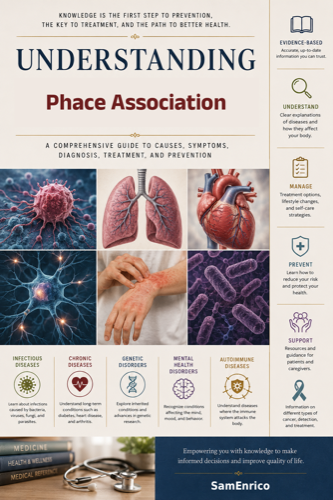
Understanding Phace Association Audiobook
This disease publication, published by SamEnrico,
This disease publication, published by SamEnrico, covers Understanding Phace Association
Formats
Free sample
Chapter 1: The Crimson Compass...--A single red mark on a newborn’s forehead changed everything for a family in Ohio in 2017. The delivery had been routine—eight hours of labor, no complications, Apgar scores of eight and nine. The parents held their daughter, named her Emma, and counted fingers and toes. Everything was perfect. Then, on the second day of life, the pediatrician noticed a faint pink patch on Emma’s right temple, just above her eyebrow.
“Probably a birthmark,” the doctor said. “Watch it and let us know if it grows.” The parents nodded, took a photo with their phone, and thought nothing more of it. Three weeks later, that pale pink patch had transformed into a raised, bright red plaque spanning from Emma’s temple down to her jaw—a “C-shaped” distribution that crossed the midline of her neck. The pediatrician referred them to a dermatologist. The dermatologist ordered an MRI of Emma’s brain.
The MRI revealed a hypoplastic right internal carotid artery with stenosis so severe that blood flow was reduced by nearly seventy percent. Emma had PHACE association. And because that large facial hemangioma served as a crimson compass pointing inward, she was diagnosed before her first stroke—a privilege denied to too many children born with this condition.This chapter is about that compass: the infantile hemangioma that defines PHACE, the clinical spectrum it represents, and the fundamental understanding that a red mark on a baby’s face is never “just a birthmark” until proven otherwise. We will define PHACE association in precise terms, clarify its nomenclature, establish its place among neurocutaneous syndromes, and introduce the organ systems involved. By the end of this chapter, you will understand why the acronym matters, why the “S” sometimes appears, and why every parent and physician who encounters a large facial hemangioma must think first of what lies beneath the skin.Defining the Syndrome: What PHACE Actually Means PHACE is an acronym, and like all medical acronyms, it risks being memorized without being understood.
Let us break each letter down not as a checkbox but as a window into the developing embryo. P stands for Posterior fossa malformations. The posterior fossa is the compartment at the back of the skull that houses the cerebellum and brainstem—structures responsible for coordination, balance, and basic life-support functions like breathing and heart rate regulation. In PHACE, this region may show Dandy-Walker…
This is the end of the free sample. Get the Audiobook to keep going. Buy now
About this book
Details
- Author
- Bunting Kayleen
- Publisher
- SamEnrico
- Language
- English
- Genre
- Non-Fiction, Informative, Educational
- Released
- 2026-05-11
- Pages (approx.)
- 160
- Available as
- eBook, Audiobook

Listen in the VoxFlicks app
Audiobooks and audio dramas wherever you go. Sign in with your SamEnrico account and press play.
More by Bunting Kayleen
 Road Rage In Heavy TrafficBunting Kayleen$11.99
 TM and Physical Health GuideBunting Kayleen$11.99
 Treepz Exit StrategyBunting Kayleen$11.99
 Anger After Hours RecoveryBunting Kayleen$11.99
 C Section Scar Recovery GuideBunting Kayleen$11.99
 The Great Escape of the Berlin Zoo: Operation Lion’s DenBunting Kayleen$11.99
 Muhammad Ali: The GreatestBunting Kayleen$11.99
 Pharma Pipeline MapBunting Kayleen$12.99
 One Page Plan for RestaurantsBunting Kayleen$12.99
 How to Become a CompanionBunting Kayleen$11.99
You may also like
 Hong Kong Handover 1997Dunn Johnnie$11.99
 Zumba For Postnatal Recovery CourseNeal Christian$11.99
 Zumba for BeginnersLadner Nikia$11.99
 YouTube Comment Mining GuideHumes Pandora$12.99
 Worry Box MeditationCarlin Rudy$11.99
 Workplace Stress MeditationNguyen Lynn$11.99
 Workplace Stress and Sleep RepairHawley Ivory$11.99
 Workplace Perfectionism CureDelaney Jeffry$11.99
 Workplace Injustice Anger GuideWallen Isabelle$11.99
 Work Addiction and Burnout LinkGreenwood Ester$11.99
 Women in Yoga and WellnessBeattie Galina$11.99
 Women in Stand Up ComedyChun Evangeline$11.99