
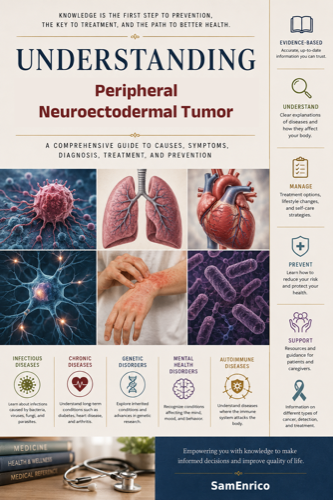
Understanding Peripheral Neuroectodermal Tumor eBook
This disease publication, published by SamEnrico,
This disease publication, published by SamEnrico, covers Understanding Peripheral Neuroectodermal Tumor
Formats
Free sample
Chapter 1: The Unspoken Diagnosis...--–- The phone rings on a Tuesday afternoon. You recognize the hospital’s number. Your heart accelerates before your mind even registers why. The voice on the other end—calm, practiced, careful—says words you have never heard before: “Peripheral Primitive Neuroectodermal Tumor.” The syllables feel foreign, like a language you do not speak. You ask the voice to repeat the name.
You write it down. You misspell it. You hang up and stare at the paper, realizing that your life has just split into two halves: everything before that phone call, and everything after.This chapter is written for that exact moment. For the hours and days following a diagnosis you cannot pronounce, for the search engine queries that return frightening fragments of information, for the sleepless nights when your mind cycles between denial and terror. You are not alone.
Thousands of families have received this same phone call. And while Peripheral Primitive Neuroectodermal Tumor (p PNET) is rare—striking only 2.9 people per million each year—its impact on those it touches is seismic. This chapter will walk you through what this diagnosis actually means, what it does not mean, and how to take the first steady breaths after the ground has fallen away.What Exactly Is p PNET? Breaking Down the Name Let us begin by dismantling the intimidating name. Medical terminology often hides simple concepts behind complex Greek and Latin roots.
Peripheral Primitive Neuroectodermal Tumor is no exception, but each word carries meaning that matters.Peripheral: This word is your first and most important clue. In medicine, “peripheral” means outside the central nervous system—the brain and spinal cord. Unlike a brain tumor (which arises inside the skull) or a spinal cord tumor (which arises within the vertebral column), p PNET grows in the “periphery” of the body: the soft tissues, the bones of the arms and legs, the chest wall, the abdomen, the pelvis. This distinction is not merely academic. It determines everything from symptoms to surgical approach to long-term prognosis.
A tumor in the peripheral nervous system is surgically accessible in ways that central nervous system tumors often are not. Understanding that p PNET is not a brain tumor is the first step toward reclaiming a sense of possibility.Primitive: In cancer biology, “primitive” does not mean unsophisticated or simple. Quite the opposite. It refers to cells that resemble embryonic or fetal tissue—cells that never fully matured into their final, specialized form. Imagine a tree that sprouted branches but never developed leaves.
The cells of p PNET are stuck in an early stage of development, frozen in a “primitive” state where they multiply rapidly instead of differentiating into functional nerve cells. This immaturity is what makes the tumor aggressive but also what makes it recognizable under a microscope. Pathologists look for these primitive cells as a fingerprint of the disease.Neuroectodermal: This word traces the tumor’s origin. During embryonic development, a layer of cells called the neuroectoderm forms the foundation of the nervous system. These cells are destined to become neurons, glial cells, and other components of the nerves that run throughout your body.
In p PNET, something goes wrong in this lineage. A single neuroectodermal cell acquires a genetic mutation that transforms it from a normal developing cell into a cancer cell. That single rogue cell then divides uncontrollably, creating a mass of primitive nerve precursor cells that should have matured but did not. The “neuroectodermal” label tells you that this tumor belongs to the same family as other nerve-related cancers, but with a critical difference: it stays outside the brain.Tumor: Finally, the most straightforward word. A tumor is simply an abnormal growth of tissue.
It may be benign (non-cancerous) or malignant (cancerous). p PNET is unequivocally malignant. It invades local structures, grows relentlessly if untreated, and has the potential to spread (metastasize) to distant organs—most commonly the lungs, bones, and bone marrow. Calling it a “tumor” rather than a “cancer” does not soften its behavior. But understanding the term helps you read medical reports with greater clarity.Taken together, “Peripheral Primitive Neuroectodermal Tumor” describes a malignant growth arising from immature nerve precursor cells located outside the brain and spinal cord.
That is the definition. But definitions alone do not comfort a frightened parent or a young adult staring at an uncertain future. So let us go further.The Ewing Family Connection: Why Your Doctor Mentions Another Name Almost immediately after receiving a p PNET diagnosis, you will hear another term: Ewing sarcoma. Your oncologist may say, “This is a member of the Ewing family of tumors.” You may read medical articles that use “p PNET” and “Ewing sarcoma” almost interchangeably. This relationship confuses nearly every newly diagnosed patient, so let us clarify it completely.In the 1970s and 1980s, pathologists noticed that certain bone tumors (called Ewing sarcoma) and certain soft tissue tumors (called peripheral neuroectodermal tumors) looked remarkably similar under the microscope.
Both consisted of small, round, blue cells. Both occurred in children and young adults. Both were highly aggressive. For years, they were classified as separate diseases based on subtle differences in appearance. Then came the genetic revolution.In the 1990s, researchers discovered that both tumors share an identical genetic accident: a translocation between chromosome 11 and chromosome 22, written as t(11;22)(q24;q12).
This translocation fuses two genes—EWSR1 on chromosome 22 and FLI1 on chromosome 11—into a single, abnormal fusion gene called EWSR1-FLI1. This fusion gene produces a protein that acts as a broken transcription factor, continuously turning on growth-promoting genes that should have been silenced after fetal development. Every case of classical Ewing sarcoma and every case of classical p PNET harbors this same translocation or a very close variant. (See Figure 2.1 for a diagram of this translocation, which will be explained in depth in Chapter 2.)Today, the World Health Organization classifies Ewing sarcoma and p PNET as a single diagnostic category: the Ewing sarcoma family of tumors. The distinction between “bone” and “soft tissue” origin is no longer considered biologically meaningful.
Some oncologists use “Ewing sarcoma” as the umbrella term for all tumors with the EWSR1-FLI1 fusion, regardless of location. Others reserve “p PNET” for tumors that show more neural differentiation under the microscope. For practical purposes—treatment, prognosis, clinical trials—the two are identical.Why does this matter to you? Because it dramatically expands the pool of knowledge and experience available to your medical team. Ewing sarcoma, while still rare, is several times more common than p PNET alone.
Hundreds of clinical trials, thousands of research papers, and decades of treatment protocols developed for Ewing sarcoma apply directly to p PNET. Your doctors are not flying blind. They are applying a well-established roadmap developed over fifty years of international collaboration. The Ewing family connection is not a medical technicality—it is a lifeline.Epidemiology: Who Gets This Diagnosis and How Rare Is It?Numbers can be terrifying or reassuring, depending on how they are framed. Let us approach the epidemiology of p PNET with both honesty and perspective.The incidence of p PNET is approximately 2.9 cases per 1 million people per year.
To make sense of this number, consider that the United States population is roughly 335 million people. That means approximately…
This is the end of the free sample. Get the eBook to keep going. Buy now
About this book
Details
- Author
- Babin Elfrieda
- Publisher
- SamEnrico
- Language
- English
- Genre
- Non-Fiction, Informative, Educational
- Released
- 2026-05-23
- Pages (approx.)
- 149
- Available as
- eBook, Audiobook

Read better in the ZLOADR app
Your eBooks on your phone or tablet. Sign in with your SamEnrico account and start reading.
More by Babin Elfrieda
 Twiga Foods Trade Sale GuideBabin Elfrieda$11.99
 The McKenzie Method Exercise GuideBabin Elfrieda$11.99
 Water Tech Capital AllocationBabin Elfrieda$11.99
 HRT For Teens With Gender Dysphoria CourseBabin Elfrieda$11.99
 The Embrace of LimitsBabin Elfrieda$11.99
 The Beyrut Butcher: The Shadow of Ottoman Beirut (1880-1885)Babin Elfrieda$11.99
 PayPal Seller Protection GuideBabin Elfrieda$12.99
 Fashion Pop Up in Lagos GuideBabin Elfrieda$12.99
 Software QA ManagerBabin Elfrieda$11.99
 How to Become a Offset-press Operator IBabin Elfrieda$11.99