
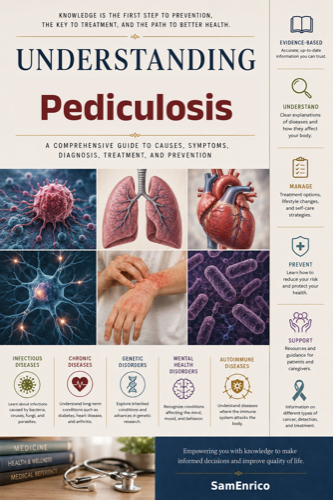
Understanding Pediculosis
This disease publication, published by SamEnrico,
This disease publication, published by SamEnrico, covers Understanding Pediculosis
Formats
About this book
Free sample
Chapter 1: The Midnight Itch...–- The first sign of pediculosis is rarely the louse itself. It is the itch – a small, maddening, persistent crawl on the scalp that arrives without invitation, usually sometime after dinner, and grows into a full-blown emergency by bedtime. For millions of parents each year, the moment of discovery follows a predictable arc: a child complaining of a tickling sensation, a quick glance with a phone flashlight, and then the frozen dread of seeing something move. Not dandruff. Not a piece of lint.
Something with legs. This chapter is not about the biology of the parasite – that comes later. It is about the epidemiology of panic, the geography of infestation, and the single most important truth that every affected family needs to hear before they reach for a bottle of poison or a blowtorch: lice are not a moral failure, and you are not alone.The Geography of Infestation: Who Gets Lice and Why Pediculosis capitis – head lice infestation – is one of the most ubiquitous parasitic conditions affecting humans worldwide. Unlike malaria or dengue, which are constrained by climate and vector ecology, head lice flourish wherever humans congregate in close physical proximity. The global incidence is staggering.
Conservative estimates place the annual number of cases between 6 million and 12 million in the United States alone, with similar proportional burdens in Europe, Australia, and parts of Asia. In resource-limited settings where crowding is more intense and access to treatment is restricted, prevalence rates can exceed 50% in certain age groups.The single most important demographic risk factor is not hygiene, not income, not race, and not geography. It is age. Specifically, the ages between three and eleven years. Children in this range account for approximately 85% of all identified infestations.
The reasons are straightforward and have nothing to do with cleanliness. Young children engage in the kind of sustained, close physical contact that lice require for transmission: heads touching during group activities, sharing headphones on school tablets, huddling over a single i Pad, sleeping in close quarters during nap time, and posing for photographs with arms around one another. Lice…
This is the end of the free sample. Get the eBook to keep going. Buy now
Contents
- Chapter 1
- Chapter 2
- Chapter 3
- Chapter 4
- Chapter 5
- Chapter 6
- Chapter 7
- Chapter 8
- Chapter 9
- Chapter 10
- Chapter 11
- Chapter 12
Details
- Author
- Cardona Marylee
- Publisher
- SamEnrico
- Language
- English
- Genre
- Non-Fiction, Informative, Educational
- Released
- 2026-05-09
- Pages (approx.)
- 149
- Available as
- eBook, Audiobook

Read better in the ZLOADR app
Your eBooks on your phone or tablet. Sign in with your SamEnrico account and start reading.
More by Cardona Marylee
 Trigger Installation HandbookCardona Marylee$11.99
 HRT For Osteoporosis Prevention HandbookCardona Marylee$11.99
 PCOS Mental Health GuideCardona Marylee$11.99
 Peterson Mistress Police Cooperation DealCardona Marylee$11.99
 The Senior Business Succession GuideCardona Marylee$11.99
 Frozen in Time: The Lost Expedition of the *Aurora Borealis*Cardona Marylee$11.99
 Personal Brand Geo Domain GuideCardona Marylee$12.99
 Boston Scientific GuideCardona Marylee$12.99
 Molding Process Quality Technician*Cardona Marylee$11.99
 How to Start a Oral Hygiene Preparations Business (Beginners Guide)Cardona Marylee$11.99