
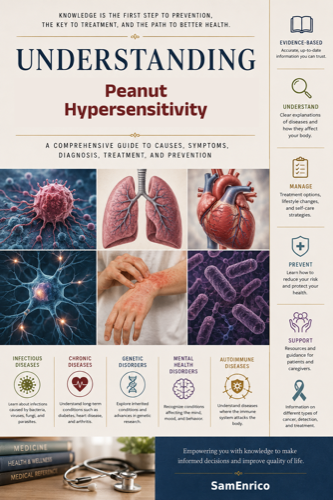
Non-FictionInformativeEducational
Understanding Peanut Hypersensitivity eBook
This disease publication, published by SamEnrico,
This disease publication, published by SamEnrico, covers Understanding Peanut Hypersensitivity
Formats
Free sample
Chapter 1: The Unseen Epidemic--–- The first time four-year-old Maya touched a peanut butter sandwich, her mother was standing right next to her. It was a Tuesday afternoon, and Maya had climbed onto a kitchen chair to reach the counter where her older brother’s lunch waited. Her mother, Sarah, turned for just a moment—to grab a paper towel, a reflex, a second. When she looked back, Maya had a smear of peanut butter on her finger. She was raising it to her mouth.
Sarah shouted, “No!” and lunged across the kitchen, grabbing Maya’s hand. But she was too late. The peanut butter touched Maya’s tongue.Within thirty seconds, Maya’s lips began to swell. Within two minutes, red hives spread across her face and neck. Within five minutes, she was vomiting.
And within ten minutes, her breathing became a high-pitched whistle, her eyes wide with panic, her tiny chest heaving. Sarah had never seen anaphylaxis before. She did not know what was happening. She did not know that her daughter was dying in her arms. By the time the ambulance arrived, Maya’s blood pressure had dropped so low that the paramedics could barely find a vein.
She survived because the emergency room was six minutes away. But Sarah would never forget those ten minutes. And neither, she would later say, “do I want anyone else to.”Maya’s story is not rare. It is repeated thousands of times every year in the United States alone. Peanut allergy is now the most common food allergy among children in Western nations, and it is the food allergy most likely to cause fatal anaphylaxis.
Between 1997 and 2010, the prevalence of peanut allergy among American children more than tripled—from 0.4% to over 2%. Today, approximately one in every fifty children in the United States, the United Kingdom, Canada, and Australia lives with this diagnosis. That is nearly 1.5 million children in the US alone. And yet, as recently as the year 2000, the official medical advice was to avoid peanuts entirely during pregnancy, breastfeeding, and early childhood—advice that we now understand likely made the epidemic worse.This chapter is about how we got here. It traces the peanut allergy epidemic from its first medical descriptions in the 1970s to its current status as a public health crisis.
It explores the leading scientific theories for why peanut allergy has exploded in Western nations while remaining rare in other parts of the world. It introduces the genetic, environmental, and immunological forces that shape who develops peanut allergy and who does not. And it tells the story of a well-intentioned medical guideline that inadvertently fed the very fire it was trying to extinguish. By the end of this chapter, you will understand not just the facts of the epidemic, but the historical and scientific context that every patient, parent, and healthcare provider must know.The First Descriptions: When Peanut Allergy Was Rare Before 1970, peanut allergy was so rarely described in medical literature that many physicians doubted it existed as a distinct condition. Allergies to eggs, milk, and wheat were recognized.
Hay fever and asthma were well understood. But peanuts? A handful of case reports appeared in European journals in the 1960s, describing patients who had collapsed or died after eating peanut products. These reports were treated as medical curiosities—interesting, but not indicative of a broader problem.That began to change in the 1980s. As peanut butter became a staple of school lunches, as processed foods containing peanut protein proliferated, and as physicians became better at recognizing allergic reactions, case reports accumulated.
By 1990, peanut allergy had been identified as a distinct, often severe, and frequently persistent condition. Unlike milk or egg allergy, which most children outgrow by school age, peanut allergy was found to persist into adulthood in approximately 80% of cases. It was also found to be uniquely dangerous: the doses required to trigger a reaction were often tiny (milligrams), and the reactions were often systemic (affecting the whole body) rather than localized.The numbers told a story that could no longer be ignored. Between 1997 and 2002, peanut allergy prevalence among US children doubled. Between 2002 and 2008, it doubled again.
By 2010, researchers were using words like "epidemic" and "crisis." The question was not whether peanut allergy had increased. The question was why.The Geographic Mystery: Why the West?One of the most revealing clues to the peanut allergy epidemic comes from comparing Western nations to the rest of the world. Peanut allergy is rare in China, Thailand, India, and the Philippines—countries where peanut consumption is actually higher than in the United States. In Israel, where infants are regularly fed a peanut-based snack called Bamba, peanut allergy prevalence is ten times lower than in the United Kingdom, despite similar genetic backgrounds. In Greece, where children eat boiled peanuts (which appear to be less allergenic than roasted peanuts), peanut allergy is almost nonexistent.These geographic contrasts rule out a purely genetic explanation.
The genetic makeup of Western European populations has not changed dramatically in the past thirty years. Something in the environment—something about how Western children are exposed to peanuts—must explain the difference.The leading theory, proposed by Professor Gideon Lack of King's College London, is called the dual-allergen exposure hypothesis. The hypothesis is elegant in its simplicity: the body decides whether to tolerate or attack a food protein based on the route of first exposure. Exposure through the skin (through broken skin, via lotions, dust, or food particles on hands) teaches the immune system that the protein is a danger. Exposure through the gut (by eating the food) teaches the immune system that the protein is safe.This explains why children with eczema—a condition that compromises the skin barrier—are at dramatically higher risk of developing peanut allergy.
Their broken skin allows peanut protein particles from the environment to slip through, where immune cells in the skin carry them to lymph nodes and initiate an allergic response. It also explains why the rise in peanut allergy tracked so closely with the rise in eczema rates in Western nations. And it explains why countries where infants eat peanuts early have lower rates of peanut allergy: those children were exposed through the gut first, establishing tolerance.The Historical Medical Advice That Made It Worse If the dual-allergen exposure hypothesis is correct, then the medical advice given to parents in the 1990s and early 2000s was exactly wrong. In 2000, the American Academy of Pediatrics issued guidelines recommending that women avoid peanuts during pregnancy and breastfeeding, and that children avoid peanuts until age three. The reasoning seemed sound: if allergies were developing, delaying exposure should prevent them.
The same logic had been applied to eggs and milk with some success.But peanuts were different. By advising avoidance, the AAP inadvertently increased the chance that the first exposure to peanut protein would come through the skin, not the gut. Pregnant women who avoided peanuts still had peanut protein in their household dust, on their hands, in their skin creams. Their infants, with compromised skin barriers from undiagnosed eczema, were being sensitized through the skin while their guts remained naive to peanut protein. Then, when those infants finally ate peanuts at…
This is the end of the free sample. Get the eBook to keep going. Buy now
About this book
Details
- Author
- Rader Jaquelyn
- Publisher
- SamEnrico
- Language
- English
- Genre
- Non-Fiction, Informative, Educational
- Released
- 2026-06-02
- Pages (approx.)
- 141
- Available as
- eBook, Audiobook

Read better in the ZLOADR app
Your eBooks on your phone or tablet. Sign in with your SamEnrico account and start reading.
More by Rader Jaquelyn
 Joy Nonverbal Expression GuideRader Jaquelyn$11.99
 Annuity Purchase for Retirement GuideRader Jaquelyn$11.99
 HRT Formulations Comparison GuideRader Jaquelyn$11.99
 Scott Peterson Laci Body Disposal MethodRader Jaquelyn$11.99
 PCOS Teen Diagnosis GuideRader Jaquelyn$11.99
 Bloodlines of Betrayal: The DNA of the Italian WarsRader Jaquelyn$11.99
 Mine Permitting Regulatory SpecialistRader Jaquelyn$11.99
 Startup Geo Domain StrategyRader Jaquelyn$12.99
 Eli Lilly Patent LandscapeRader Jaquelyn$12.99
 How to Start a Pagers Business (Beginners Guide)Rader Jaquelyn$11.99
You may also like
 Hong Kong Handover 1997Dunn Johnnie$11.99
 Zumba For Postnatal Recovery CourseNeal Christian$11.99
 Zumba for BeginnersLadner Nikia$11.99
 YouTube Comment Mining GuideHumes Pandora$12.99
 Worry Box MeditationCarlin Rudy$11.99
 Workplace Stress MeditationNguyen Lynn$11.99
 Workplace Stress and Sleep RepairHawley Ivory$11.99
 Workplace Perfectionism CureDelaney Jeffry$11.99
 Workplace Injustice Anger GuideWallen Isabelle$11.99
 Work Addiction and Burnout LinkGreenwood Ester$11.99
 Women in Yoga and WellnessBeattie Galina$11.99
 Women in Stand Up ComedyChun Evangeline$11.99