
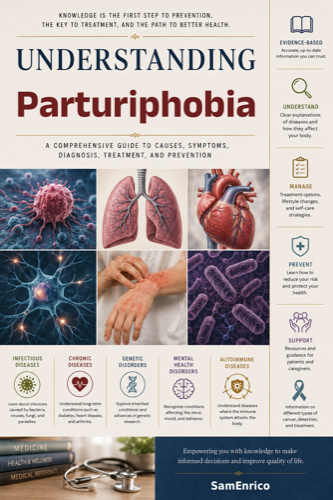
Non-FictionInformativeEducational
Understanding Parturiphobia eBook
This disease publication, published by SamEnrico,
This disease publication, published by SamEnrico, covers Understanding Parturiphobia
Formats
Free sample
Chapter 1: The Cereal Aisle Moment...--The first time Elena imagined her own death, she was twelve weeks pregnant and standing in the cereal aisle of a Kroger in suburban Ohio. She had just picked up a box of oatmeal—the kind she had eaten since childhood, the one with the smiling Quaker on the front—when a thought arrived without warning, fully formed and terrifyingly rational: If I die in childbirth, this will be the last ordinary thing I ever do. She stood there for eleven minutes, a young woman with a master's degree in library science, a husband who had painted the nursery a soft shade called "Morning Mist," and a wanted, planned, celebrated pregnancy. She stood there while other shoppers reached past her for Cheerios. She stood there while the automatic doors hissed open and closed, open and closed.
And she stood there because she had suddenly become certain that giving birth would kill her.Elena did not have a history of anxiety disorders. She had never needed therapy. She had never googled symptoms of anything more serious than a sinus infection. But in that cereal aisle, her body transformed from a vessel of life into a trap. Her heart pounded so hard she could feel it in her throat.
Her vision narrowed to a pinprick. The fluorescent lights seemed to flicker, though later the store's security footage would show they had not. She left the oatmeal on the shelf—she would not remember abandoning it—and walked to her car on legs that felt like they belonged to someone else.What Elena was experiencing, though she would not learn the word for another six months, was parturiphobia. From the Latin parturire ("to be in labor") and the Greek phobos ("fear"), parturiphobia—also known clinically as tokophobia, from the Greek tokos ("childbirth")—is a specific phobia disorder characterized by an intense, persistent, and debilitating fear of pregnancy and childbirth that is disproportionate to the actual danger and that significantly impairs daily functioning. It is not the mild, common anxiety about labor that many pregnant people experience.
It is not the reasonable concern about pain that leads someone to request an epidural. It is not even the understandable nervousness that prompts a pregnant person to read everything they can about birth. Parturiphobia is a clinical condition that hijacks the brain's threat-detection system, transforms the ordinary sensations of pregnancy into evidence of catastrophe, and, for some, makes the prospect of delivery feel more like a death sentence than a medical event.This book is written for the Elenas of the world. It is written for the person who has just discovered they are pregnant and felt not joy but a cold, sinking certainty that they have made a terrible mistake. It is written for the partner who has watched their loved one shake uncontrollably every time someone mentions the hospital.
It is written for the clinician who has encountered a patient so terrified they cannot tolerate a pelvic exam, a blood draw, or even the sound of a fetal heartbeat monitor. And it is written for the millions of people who suffer in silence, believing they are alone, broken, or simply "too dramatic" to be taken seriously.Because here is the truth that Elena did not know in that cereal aisle: parturiphobia affects between six and fifteen percent of pregnant individuals worldwide. In some studies, the numbers are even higher. A 2019 meta-analysis published in the Journal of Affective Disorders found that approximately fourteen percent of pregnant people meet diagnostic criteria for severe fear of childbirth, with an additional twenty percent experiencing moderate fear that causes clinically significant distress. That means in a typical prenatal yoga class of fifteen women, at least two are secretly terrified—and those are only the ones who meet diagnostic thresholds.
Many more are frightened but not yet phobic, suffering but not yet diagnosed, silent but not by choice.Yet despite its prevalence, parturiphobia remains one of the most underdiagnosed and undertreated conditions in reproductive medicine. A 2021 survey of obstetricians in the United States and United Kingdom found that fewer than thirty percent routinely screened for fear of childbirth, and fewer than ten percent felt adequately trained to address it. Patients who disclose their fears are often met with well-meaning but invalidating responses: "Every mother is nervous," or "Your body was made for this," or the particularly cruel, "Just wait until you feel the contractions—then you'll really know fear." These responses, however unintentionally harmful, communicate a single devastating message: Your fear is not real. Your fear is not important. Your fear is your fault.This book is dedicated to the proposition that those messages are wrong.What This Chapter Covers Before we go further, let me tell you exactly what you will learn in this opening chapter.
We will establish a clear, clinically accurate definition of parturiphobia and distinguish it from normal pregnancy anxiety—a distinction that matters because one requires treatment while the other may not. We will explore the two primary subtypes of the condition: primary tokophobia, which emerges before a first pregnancy, and secondary tokophobia, which develops after a traumatic birth experience. We will review the epidemiology—who gets this phobia, when, and how often—with attention to populations at elevated risk. We will examine the sociocultural forces that keep parturiphobia hidden: shame, medical dismissal, and the powerful pressure to perform gratitude for pregnancy. And we will conclude with this book's core argument: parturiphobia is a distinct clinical entity requiring specialized intervention, and recovery—defined in specific, measurable terms—is possible.By the end of this chapter, you will have a framework for understanding your own experience or the experience of someone you love.
You will have a vocabulary for describing what has been, perhaps for years, unspeakable. And you will have, I hope, the beginning of permission: permission to stop pretending, permission to ask for help, and permission to believe that fear and love can coexist in the same pregnant body.Defining Parturiphobia: More Than Just Nerves Let us begin with precision. The Diagnostic and Statistical Manual of Mental Disorders, Fifth Edition, Text Revision (DSM-5-TR)—the standard classification of mental disorders used by clinicians in the United States—defines a specific phobia as an anxiety disorder characterized by marked fear or anxiety about a specific object or situation that is actively avoided or endured with intense fear. For a diagnosis of specific phobia, the fear must be out of proportion to the actual danger posed by the object or situation, must persist for six months or more, and must cause clinically significant distress or impairment in social, occupational, or other important areas of functioning.Parturiphobia is a specific phobia with childbirth as the feared stimulus. This means the person with parturiphobia experiences intense fear not only during labor itself but also in anticipation of labor—sometimes months in advance—and in response to reminders of childbirth, such as seeing a pregnant person, hearing a birth story, walking past a hospital, or even seeing a diaper commercial that features a newborn.But here is where precision becomes crucial: not every pregnant person who is nervous about giving birth has parturiphobia.
Pregnancy is a major medical event. It involves pain, vulnerability, loss of control, and real—if statistically small—risks. Some anxiety in…
This is the end of the free sample. Get the eBook to keep going. Buy now
About this book
Details
- Author
- Scoggins Madelene
- Publisher
- SamEnrico
- Language
- English
- Genre
- Non-Fiction, Informative, Educational
- Released
- 2026-05-08
- Pages (approx.)
- 158
- Available as
- eBook, Audiobook

Read better in the ZLOADR app
Your eBooks on your phone or tablet. Sign in with your SamEnrico account and start reading.
More by Scoggins Madelene
 Loci for World CapitalsScoggins Madelene$11.99
 Lip Reading Emotions GuideScoggins Madelene$11.99
 PCOS Hirsutism Treatment GuideScoggins Madelene$11.99
 Peterson Ware House InvestigationScoggins Madelene$11.99
 The Senior Tax Planning HandbookScoggins Madelene$11.99
 The Silk Road’s Forgotten Tycoon: The Rise and Fall of a Medieval MogulScoggins Madelene$11.99
 How to Start a Padlock Business (Beginners Guide)Scoggins Madelene$11.99
 SASB Materiality Comparison GuideScoggins Madelene$12.99
 Dot Us Nexus Requirements GuideScoggins Madelene$12.99
 IT Help Desk AssociateScoggins Madelene$11.99
You may also like
 Hong Kong Handover 1997Dunn Johnnie$11.99
 Zumba For Postnatal Recovery CourseNeal Christian$11.99
 Zumba for BeginnersLadner Nikia$11.99
 YouTube Comment Mining GuideHumes Pandora$12.99
 Worry Box MeditationCarlin Rudy$11.99
 Workplace Stress MeditationNguyen Lynn$11.99
 Workplace Stress and Sleep RepairHawley Ivory$11.99
 Workplace Perfectionism CureDelaney Jeffry$11.99
 Workplace Injustice Anger GuideWallen Isabelle$11.99
 Work Addiction and Burnout LinkGreenwood Ester$11.99
 Women in Yoga and WellnessBeattie Galina$11.99
 Women in Stand Up ComedyChun Evangeline$11.99