
Non-FictionInformativeEducational
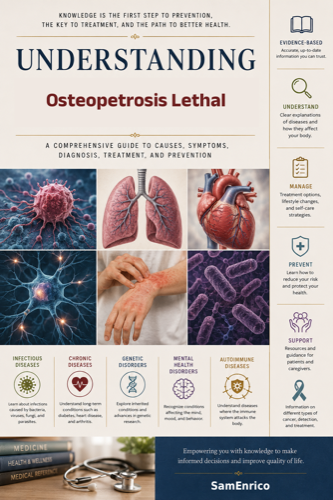
Understanding Osteopetrosis Lethal eBook
This disease publication, published by SamEnrico,
by Moon Cherise
This disease publication, published by SamEnrico, covers Understanding Osteopetrosis Lethal
Formats
Free sample
Chapter 1: When Bones Betray--–- The infant’s cry was different. Maria had given birth to three healthy children before little Gabriel, and she knew the sound of a hungry cry, a tired cry, a wet cry. But Gabriel’s cry was something else entirely—a high-pitched, almost feline wail that seemed to come from a place of deep discomfort rather than simple need. When she lifted him from the bassinet to nurse, she noticed something else: his head felt heavy, too heavy for a two-month-old, and his arms, when she held them, seemed dense and unyielding, as though the soft flesh of infancy had been replaced by something harder. Maria dismissed these observations as new-mother anxiety, the kind of hypervigilance that came with sleepless nights and hormonal shifts.
But the pediatrician noticed, too. At Gabriel’s two-month checkup, she ran her fingers over his skull, palpated his long bones, and frowned. “I’d like to get some X-rays,” she said, her voice carefully neutral. “Just to be safe.”Those X-rays revealed a skeleton that looked unlike any she had seen in her fifteen years of practice. Every bone—the skull, the spine, the ribs, the femurs, the tibias—appeared uniformly white, dense, almost ghostly.
The normal trabecular pattern, the honeycomb of bone that gives X-rays their characteristic texture, was completely absent. Instead, there were layers within layers, as if each bone contained the ghost of a smaller bone inside it. The radiologist’s report used words that the pediatrician had only read about in medical journals: “generalized osteosclerosis,” “endobones,” “Erlenmeyer flask deformity.” The conclusion was unambiguous: “Findings highly suggestive of malignant infantile osteopetrosis.”In that moment, Maria’s world split into a before and an after. The benign anxieties of new motherhood—sleep schedules, feeding volumes, milestone tracking—evaporated, replaced by a terrifying new vocabulary of pancytopenia, optic atrophy, and hematopoietic stem cell transplantation. Gabriel had a disease she had never heard of, a disease that was slowly filling his bones with stone, crushing his marrow, strangling his nerves.
The bones that were meant to protect him were betraying him instead. And the clock was already ticking.This chapter is about those betraying bones. It is about the fundamental biology of lethal osteopetrosis—what it is, how it was discovered, how it differs from milder forms, why it kills, and who is at risk. By the end of this chapter, you will understand why this disease has been called “marble bone disease,” why the term “lethal” is not hyperbole but clinical reality, and why the first months of life represent both the greatest danger and the narrowest window for hope. You will meet the cells that fail, the genes that mutate, and the families who navigate this devastating diagnosis.
And you will begin to understand that while the bones betray, science offers a path to redemption.The Discovery: From Marble to Malignancy The story of osteopetrosis begins in the early years of radiology, when X-ray machines were still novel and the human skeleton was largely understood as a static, unchanging scaffold. In 1904, a German radiologist named Heinrich Albers-Schönberg published a case report describing a patient with unusually dense bones visible on X-ray. The patient, an adult who had presented with a fracture after a minor fall, was otherwise healthy and unaware of any underlying condition. Albers-Schönberg called the condition “marble bone disease” (marmorknochenkrankheit) because the X-ray images reminded him of carved white marble—dense, heavy, and lacking the normal internal architecture of living bone. For decades thereafter, the eponym “Albers-Schönberg disease” became synonymous with osteopetrosis, and the condition was generally considered a benign curiosity.But the marble metaphor, while evocative, was incomplete.
Throughout the 1920s and 1930s, case reports began to emerge of infants who died within the first year of life from severe anemia, recurrent infections, and progressive blindness. These infants had bones that were even denser than Albers-Schönberg’s adult patient, but the tragedy was not the density itself—it was what the density caused. Autopsies revealed that the marrow cavities, the spongy centers of bone where blood cells are born, were completely obliterated, replaced by solid sheets of calcified tissue. The cranial nerves, especially the optic nerves, were compressed as they exited the skull through bony canals that had narrowed to pinholes. These children, unlike Albers-Schönberg’s patient, did not survive to see their first birthday.The medical community gradually recognized that osteopetrosis was not one disease but a spectrum.
At one end stood the benign adult form, often asymptomatic and discovered incidentally. At the other end stood the malignant infantile form, uniformly fatal without treatment. By the 1950s, the terms “malignant infantile osteopetrosis” and “lethal osteopetrosis” had entered the medical lexicon, distinguishing the severe autosomal recessive form from the milder autosomal dominant adult form.The cellular and molecular basis of the disease remained mysterious for decades. In the 1960s and 1970s, researchers observed that affected individuals had normal or even increased numbers of osteoclasts—the cells responsible for breaking down bone—but these cells appeared flattened and dysfunctional under the microscope. The problem was not a lack of osteoclasts but a failure of function.
In the 1980s, advances in bone biology identified the critical role of acidification in bone resorption: osteoclasts must pump protons into the space between themselves and the bone to dissolve the mineral matrix. Without this acidification, bone resorption halts completely. The search for the genes encoding the proton pump and its associated channels began in earnest, culminating in the 1990s and 2000s with the discovery of mutations in TCIRG1, CLCN7, OSTM1, SNX10, and RANKL as the primary causes of lethal osteopetrosis.Today, the disease is understood as a disorder of osteoclast failure. The bones are not inherently abnormal; they are normal bones that are never resorbed. The osteoblasts, the bone-building cells, continue their work unopposed, laying down new bone on top of old bone.
The skeleton grows denser and denser, but it grows without wisdom, without the intricate architecture that gives bone its combination of strength and lightness. The result is a prison of the body’s own making.The Spectrum of Osteopetrosis: Not All Marble Bone Disease Is Lethal One of the most critical distinctions any reader must understand is that osteopetrosis is not a single disease but a family of disorders with vastly different prognoses. Confusion between the forms is common and dangerous. A family whose child is diagnosed with “osteopetrosis” based on an X-ray may initially believe the condition is benign if they consult outdated sources. Conversely, a clinician unfamiliar with the spectrum may fail to recognize the urgency of the infantile form, delaying life-saving treatment.
This book focuses exclusively on the lethal form, but understanding where it fits in the larger family of diseases is essential.The Adult (Benign) Form The adult form of osteopetrosis is typically inherited in an autosomal dominant pattern, meaning that inheriting just one copy of the mutated gene is sufficient to cause the condition. Affected individuals may have no symptoms at all, and the diagnosis is often made incidentally when an X-ray taken for another reason—a car accident, a sports injury, a routine physical—reveals generalized osteosclerosis. The most…
This is the end of the free sample. Get the eBook to keep going. Buy now
About this book
Details
- Author
- Moon Cherise
- Publisher
- SamEnrico
- Language
- English
- Genre
- Non-Fiction, Informative, Educational
- Released
- 2026-06-01
- Pages (approx.)
- 142
- Available as
- eBook, Audiobook

Read better in the ZLOADR app
Your eBooks on your phone or tablet. Sign in with your SamEnrico account and start reading.
More by Moon Cherise
 Journaling for Work AnxietyMoon Cherise$11.99
 MBSR For Grief And Loss CourseMoon Cherise$11.99
 Volcano Visualization Release GuideMoon Cherise$11.99
 The Arthur Ashkin Optical TweezersMoon Cherise$11.99
 PCOS Specialist FinderMoon Cherise$11.99
 The Levees of Denial: How New Orleans Drowned in Debt Before KatrinaMoon Cherise$11.99
 How to Start a Choppers Business (Beginners Guide)Moon Cherise$11.99
 Refund Policy Terms Integration GuideMoon Cherise$12.99
 Advanced English for Chinese LearnersMoon Cherise$12.99
 Transportation PlannerMoon Cherise$11.99
You may also like
 Hong Kong Handover 1997Dunn Johnnie$11.99
 Zumba For Postnatal Recovery CourseNeal Christian$11.99
 Zumba for BeginnersLadner Nikia$11.99
 YouTube Comment Mining GuideHumes Pandora$12.99
 Worry Box MeditationCarlin Rudy$11.99
 Workplace Stress MeditationNguyen Lynn$11.99
 Workplace Stress and Sleep RepairHawley Ivory$11.99
 Workplace Perfectionism CureDelaney Jeffry$11.99
 Workplace Injustice Anger GuideWallen Isabelle$11.99
 Work Addiction and Burnout LinkGreenwood Ester$11.99
 Women in Yoga and WellnessBeattie Galina$11.99
 Women in Stand Up ComedyChun Evangeline$11.99