
Non-FictionInformativeEducational
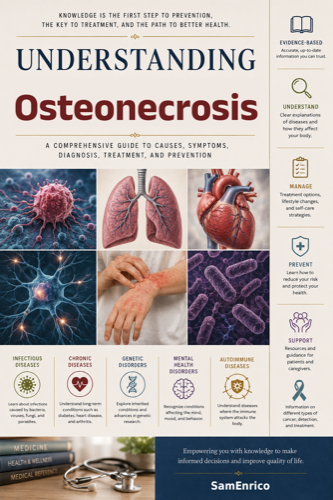
Understanding Osteonecrosis eBook
This disease publication, published by SamEnrico,
by Rickman Tu
This disease publication, published by SamEnrico, covers Understanding Osteonecrosis
Formats
Free sample
Chapter 1: The Silent Thief--It begins not with a bang, not with a dramatic fall or a sickening crack of bone, but with a whisper. A vague ache in the groin that you might mistake for a pulled muscle from yesterday’s workout. A dull throb in the buttock that you blame on the new office chair. A twinge in the thigh that you dismiss as “just getting older.” And because the human body is remarkably good at lying to us—and because we are remarkably good at lying to ourselves—you ignore it. You take an ibuprofen.
You stretch. You switch to a softer mattress. You wait for it to go away.But it does not go away.Weeks pass. Maybe months. The ache becomes a persistent gnawing.
You begin to limp, just a little, just at the end of the day. Your spouse notices before you do. “You’re walking funny,” they say. You shrug it off. Then one morning, you put weight on that leg to get out of bed, and a bolt of pain shoots through your hip—sharp, deep, unmistakable.
You gasp. Something is seriously wrong. You make an appointment with your primary care doctor, who orders X-rays. You wait anxiously for the results. The doctor calls back with what sounds like good news: “The X-rays are normal.
No fracture, no arthritis. Probably just a muscle strain. Rest, ice, and follow up in six weeks if it’s not better.”You feel relieved. The X-rays are normal. The doctor isn’t worried.
You go home, you rest, you wait.And inside your femoral head—the ball-shaped top of your thigh bone, hidden deep within your hip joint—the bone is quietly, steadily, irrevocably dying.The Diagnosis You Don’t See Coming This is the story of osteonecrosis. It is a disease that most people have never heard of, that most primary care doctors see only a handful of times in their careers, and that, when missed—as it so often is—can rob a person of their natural joint and condemn them to a lifetime of replacements, revisions, and regrets. But it does not have to be that way. Not if you know what to look for. Not if you know what questions to ask.
Not if you understand, from this moment forward, that normal X-rays do not mean a normal hip.My name is not important. What matters is the condition we are about to explore together. Osteonecrosis—often abbreviated as ON—literally means “bone death.” It is also called avascular necrosis (AVN) or aseptic necrosis. These are not separate diseases; they are different labels for the same underlying process. And that process is deceptively simple: blood flow to a segment of bone is interrupted, and that segment dies.Let that sink in for a moment.
Bone dies.We tend to think of bone as inert, like a building’s steel frame—strong, static, unchanging. But living bone is anything but inert. It is a riot of metabolic activity. Your skeleton is constantly remodeling itself, breaking down old bone and building new bone in a delicate dance between cells called osteoclasts (the demolishers) and osteoblasts (the builders). This remodeling requires energy.
Energy requires oxygen. Oxygen requires blood. When blood flow stops, the bone cells starve. They suffocate. They die.
And unlike skin or liver tissue, dead bone does not simply regenerate. The body’s attempt to repair it often makes things worse, triggering a cascade of collapse, fragmentation, and arthritis.That is the thief. That is the silent enemy. And it is stealing your joint while you are being told to rest and take ibuprofen.A Disease of the Young (and the Unlucky)One of the cruelest aspects of osteonecrosis is who it strikes. This is not a disease of the elderly, not a predictable consequence of wear and tear like osteoarthritis.
The average age of an osteonecrosis patient is just 38 to 45 years old. These are people in the prime of their lives: parents raising young children, professionals building careers, athletes competing, workers earning a living. They are too young for joint replacement to be an easy decision—because even the best modern hip replacements last 20 to 25 years, and a 40-year-old facing a replacement may need two or even three revision surgeries over a lifetime.And here is the second cruel fact: osteonecrosis is not rare. Not really. The medical literature often calls it an “orphan disease” or a “rare condition,” but that is a misdirection.
In the United States alone, an estimated 10,000 to 20,000 new cases are diagnosed each year. That is roughly the same number of people diagnosed with Hodgkin lymphoma or testicular cancer. But unlike those diseases, which have high public awareness and robust research funding, osteonecrosis languishes in obscurity. There are no celebrity spokespeople. No annual walks for the cure.
No orange ribbons. Just millions of people limping through life, many of whom never receive a correct diagnosis until it is too late.The most common site for osteonecrosis is the femoral head—the ball of the hip joint. Approximately 75% of all cases occur here. The shoulder (humeral head) is the second most common, followed by the knee, the ankle (talus), and the wrist (lunate bone, in a condition called Kienböck’s disease). But the hip is the most unforgiving.
It bears the greatest weight. It has the most precarious blood supply. And when the femoral head collapses, the pain is disabling and the loss of function is profound.Why “Normal X-Rays” Are a Trap Let me tell you about Sarah. (Her name has been changed, but her story is real and tragically common.) Sarah was a 34-year-old marathon runner and mother of two. She developed a dull ache in her right groin that she noticed during her long runs.
She saw her primary care doctor, who ordered X-rays. The X-rays were read as normal. She was diagnosed with a hip flexor strain, prescribed physical therapy, and told to take NSAIDs. She did the therapy faithfully. She rested.
She iced. The pain got worse. She went back to her doctor. Another set of X-rays. Still normal.
Her doctor ordered an MRI only after six months of persistent symptoms—and only because Sarah insisted, having read online about something called “avascular necrosis.”The MRI showed a large area of necrosis involving more than 50% of her femoral head. Worse, there was already a subchondral fracture—a tiny crack just beneath the cartilage, invisible on X-ray but devastating in its implications. That crack meant the bone had already begun to collapse. Sarah was stage III. She was no longer a candidate for joint-preserving surgery like core decompression or bone grafting.
Her only reliable option was total hip replacement. At 34 years old.This is not a rare story. This is the story of countless osteonecrosis patients who were misdiagnosed for months or even years because their X-rays were normal. And here is the hard truth: X-rays only become abnormal when the bone has already collapsed. That is not a failure of radiology; it is a failure of biology.
Dead bone looks exactly like living bone on an X-ray—until it collapses. By the time the “crescent sign” (the radiographic…
This is the end of the free sample. Get the eBook to keep going. Buy now
About this book
Details
- Author
- Rickman Tu
- Publisher
- SamEnrico
- Language
- English
- Genre
- Non-Fiction, Informative, Educational
- Released
- 2026-06-03
- Pages (approx.)
- 158
- Available as
- eBook, Audiobook

Read better in the ZLOADR app
Your eBooks on your phone or tablet. Sign in with your SamEnrico account and start reading.
More by Rickman Tu
 Rainbow Visualization Color PeaceRickman Tu$11.99
 Missed Exit Anger PreventionRickman Tu$11.99
 PCOS Restaurant OrderingRickman Tu$11.99
 The Charles Glover Barkla X RaysRickman Tu$11.99
 Work Stress Breathing TechniqueRickman Tu$11.99
 The Great Salters' Fraud: London's First Corporate Scandal (1873)Rickman Tu$11.99
 Chinese Student Grammar Tutoring GuideRickman Tu$12.99
 Agency Terms of Service Action GuideRickman Tu$12.99
 Technical RecruiterRickman Tu$11.99
 How to Start a Christmas Tree Growing Business (Beginners Guide)Rickman Tu$11.99
You may also like
 Hong Kong Handover 1997Dunn Johnnie$11.99
 Zumba For Postnatal Recovery CourseNeal Christian$11.99
 Zumba for BeginnersLadner Nikia$11.99
 YouTube Comment Mining GuideHumes Pandora$12.99
 Worry Box MeditationCarlin Rudy$11.99
 Workplace Stress MeditationNguyen Lynn$11.99
 Workplace Stress and Sleep RepairHawley Ivory$11.99
 Workplace Perfectionism CureDelaney Jeffry$11.99
 Workplace Injustice Anger GuideWallen Isabelle$11.99
 Work Addiction and Burnout LinkGreenwood Ester$11.99
 Women in Yoga and WellnessBeattie Galina$11.99
 Women in Stand Up ComedyChun Evangeline$11.99