
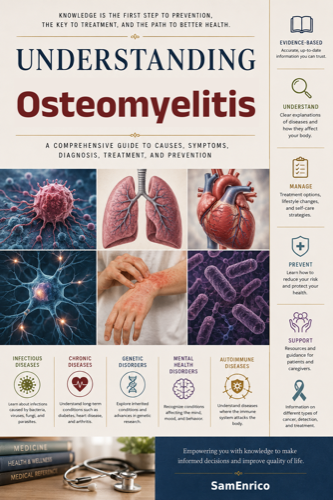
Non-FictionInformativeEducational
Understanding Osteomyelitis eBook
This disease publication, published by SamEnrico,
This disease publication, published by SamEnrico, covers Understanding Osteomyelitis
Formats
Free sample
Chapter 1: The Silent Eater--–- The morning started like any other for Maria Vasquez, a 52-year-old schoolteacher and mother of three from San Antonio, Texas. She woke at 5:30 AM, made coffee, packed lunches, and checked her blood sugar—a ritual she had performed every morning for the fourteen years since her diagnosis with type 2 diabetes. Her left foot had felt a little warm the night before, but she dismissed it as a long day spent standing in front of her fourth-grade classroom. There was a small blister on her heel, no bigger than a pencil eraser. She had stepped on a piece of gravel in the driveway two weeks earlier, and the blister had never quite healed.
But there was no pain. There was never any pain. That was the problem.Three months later, Maria lay in a hospital bed at University Hospital in San Antonio, staring at the ceiling while an infectious disease specialist explained that she would need a below-knee amputation. The blister had become an ulcer. The ulcer had become a deep infection.
The infection had eaten through the soft tissues of her heel and invaded the calcaneus—the large bone that forms the foundation of the foot. Despite six weeks of intravenous antibiotics, despite two surgical debridements, despite the best efforts of a multidisciplinary wound care team, the bacteria had won. They had formed a biofilm, a protective fortress that no antibiotic could penetrate. The bone was dead. And dead bone, the surgeon explained gently, cannot be brought back to life.Maria’s story is not unusual.
It is not even remarkable. Across the United States, approximately 50,000 people are diagnosed with osteomyelitis each year. Worldwide, the number exceeds 2 million annually. And yet, despite its prevalence, osteomyelitis remains one of the most misunderstood, underdiagnosed, and mismanaged conditions in all of medicine. Patients wait months for a correct diagnosis.
Doctors order the wrong imaging tests. Antibiotics are started without a bone biopsy. And limbs—preventable, salvageable limbs—are amputated every single day.This book is the answer to that tragedy.What This Chapter Will Teach You Before we dive into the biology, the diagnosis, and the treatment of osteomyelitis, we must first understand what it is—truly, deeply, viscerally—and why it has haunted humanity for thousands of years. By the end of this chapter, you will understand the fundamental nature of bone infection, recognize why it is so dangerous, and know why the history of medicine’s battle against osteomyelitis is one of the most dramatic stories ever told. You will learn why the word itself—osteomyelitis—contains the key to understanding the disease.
You will hear the stories of patients who lived before antibiotics, when amputation was the only hope. And you will gain a new appreciation for the medical revolution that turned a death sentence into a survivable condition.Most importantly, you will learn the single most important lesson of this entire book: osteomyelitis is curable, but only if it is caught early and treated aggressively. Delays, misdiagnosis, and half-measures lead to chronic infection, limb loss, and sometimes death. But with prompt recognition, appropriate imaging, targeted antibiotics, and expert surgery, the vast majority of patients can be cured.Let us begin at the beginning.What Is Osteomyelitis? A Definition in Plain English The word “osteomyelitis” comes from three Greek roots: osteon (bone), myelos (marrow), and itis (inflammation).
Put together, it means inflammation of the bone and bone marrow caused by an infection. But that clinical definition, while accurate, fails to capture the lived reality of the disease.Here is what osteomyelitis actually is: an infection that establishes itself inside your bones, where your immune system cannot easily reach it and where antibiotics struggle to penetrate.Think of your bones not as dry, dead sticks but as living, dynamic organs. They contain blood vessels, nerves, marrow that produces your red and white blood cells, and a complex network of microscopic channels called Haversian canals. When bacteria—usually Staphylococcus aureus, a common germ that lives harmlessly on many people’s skin—find their way into this intricate architecture, they set up camp. They multiply.
They trigger an inflammatory response. And because bone is rigid and cannot swell, the pressure builds, blood flow is compromised, and the bone begins to die.That dead bone—called sequestrum (plural: sequestra)—becomes a sanctuary for bacteria. No antibiotic can penetrate dead tissue because dead tissue has no blood supply. No immune cell can reach the bacteria because the immune system travels through the bloodstream, and the sequestrum has no blood flow. The bacteria living inside a sequestrum are safe, protected, and free to multiply at their leisure.This is why osteomyelitis is so difficult to cure.
This is why a simple infection can become a chronic, lifelong condition. And this is why understanding the disease—truly understanding it—is the first step toward beating it.The Many Faces of Osteomyelitis: Acute, Chronic, and Everything In Between Osteomyelitis is not one disease but many. It can present as a sudden, severe illness with high fever and excruciating bone pain—what doctors call acute hematogenous osteomyelitis, most common in children. Or it can smolder for months or even years, causing little more than a draining sinus tract and a dull ache—chronic osteomyelitis, the bane of diabetic patients and those with prosthetic joints.Acute Osteomyelitis Acute osteomyelitis typically announces itself with unmistakable symptoms. The patient—often a child or an elderly adult—develops a fever, sometimes as high as 103 or 104 degrees Fahrenheit.
There is intense, localized bone pain that worsens with any movement or weight-bearing. The skin over the affected bone becomes red, warm, and swollen. The patient looks and feels systemically ill, as if fighting off a severe flu.In children, acute osteomyelitis most commonly affects the long bones—the tibia (shinbone), femur (thighbone), and humerus (upper arm bone). The infection begins in the metaphysis, the flared end of the bone near the growth plate. The metaphysis is highly vascularized, meaning it receives a rich blood supply, which is why bacteria traveling through the bloodstream tend to settle there.If caught early—within the first 48 to 72 hours of symptoms—acute osteomyelitis can often be cured with intravenous antibiotics alone, without surgery.
But if diagnosis is delayed, the infection can progress, forming an abscess (a pocket of pus) within the bone. That abscess can extend through the bone cortex (the hard outer layer) and lift the periosteum (the fibrous membrane covering the bone), further compromising blood supply. At this point, surgery is almost always required to drain the pus and remove dead bone.Chronic Osteomyelitis Chronic osteomyelitis is a different beast entirely. It often begins as an inadequately treated acute infection, but it can also develop insidiously, without any clear acute phase. Patients with chronic osteomyelitis may have no fever, no redness, and no systemic symptoms.
Instead, they experience:A persistent ulcer or wound that does not heal, often over a bony prominence such as the heel, the ankle, or the sacrum A draining sinus tract that oozes pus intermittently—sometimes daily, sometimes weekly, sometimes every few months Chronic fatigue and malaise Unexplained weight loss A dull, aching pain in the affected bone that has…
This is the end of the free sample. Get the eBook to keep going. Buy now
About this book
Details
- Author
- Mcgovern Sheridan
- Publisher
- SamEnrico
- Language
- English
- Genre
- Non-Fiction, Informative, Educational
- Released
- 2026-06-02
- Pages (approx.)
- 160
- Available as
- eBook, Audiobook

Read better in the ZLOADR app
Your eBooks on your phone or tablet. Sign in with your SamEnrico account and start reading.
More by Mcgovern Sheridan
 Cocoon Visualization Safe WrappingMcgovern Sheridan$11.99
 GPS Error Rage StrategyMcgovern Sheridan$11.99
 Desk Stretch Stress ReliefMcgovern Sheridan$11.99
 PCOS Grocery Shopping ListMcgovern Sheridan$11.99
 The Percy Bridgman High PressureMcgovern Sheridan$11.99
 The Ghost of Station X: Breaking the Enigma Code of World War IIMcgovern Sheridan$11.99
 Pronunciation Teaching for Chinese LearnersMcgovern Sheridan$12.99
 Freemium Terms of Service HandbookMcgovern Sheridan$12.99
 Team Leader Case Management ServicesMcgovern Sheridan$11.99
 How to Start a Christmas Tree Lights (wholesale) Business (Beginners Guide)Mcgovern Sheridan$11.99
You may also like
 Hong Kong Handover 1997Dunn Johnnie$11.99
 Zumba For Postnatal Recovery CourseNeal Christian$11.99
 Zumba for BeginnersLadner Nikia$11.99
 YouTube Comment Mining GuideHumes Pandora$12.99
 Worry Box MeditationCarlin Rudy$11.99
 Workplace Stress MeditationNguyen Lynn$11.99
 Workplace Stress and Sleep RepairHawley Ivory$11.99
 Workplace Perfectionism CureDelaney Jeffry$11.99
 Workplace Injustice Anger GuideWallen Isabelle$11.99
 Work Addiction and Burnout LinkGreenwood Ester$11.99
 Women in Yoga and WellnessBeattie Galina$11.99
 Women in Stand Up ComedyChun Evangeline$11.99