
Non-FictionInformativeEducational
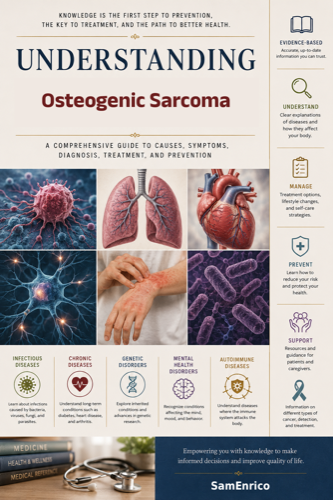
Understanding Osteogenic Sarcoma eBook
This disease publication, published by SamEnrico,
This disease publication, published by SamEnrico, covers Understanding Osteogenic Sarcoma
Formats
Free sample
Chapter 1: The Bone That Changed Everything...--The pain started as a whisper. For sixteen-year-old Marcus, it was a dull ache in his left knee after basketball practice—the kind he had felt a hundred times before. He iced it, stretched it, and ignored it. His mother scheduled a pediatrician appointment anyway, just in case. The pediatrician said "growing pains" and sent them home.
Three months later, Marcus could not walk without a limp. The mass in his distal femur was the size of a golf ball. The biopsy report read: Osteogenic sarcoma, high-grade.This is not a rare disease story. It is a story repeated in orthopedics clinics and emergency rooms every week—yet almost no one has heard of osteogenic sarcoma until they or their child are diagnosed with it. In that moment, the word "osteogenic" becomes the most important word in your vocabulary.
It is also the most terrifying.This book is written for the Marcuses of the world and their families. It is for the parents who hear "cancer" and immediately search for survival statistics. It is for the young adults who wonder if they will ever run again. It is for the older adults who receive this diagnosis at age sixty-five and worry not just about themselves but about who will care for their spouse. And it is for the medical professionals who want to understand not just the biology of this disease but the human being attached to it.Before we can fight osteogenic sarcoma, we must understand what it is, where it comes from, and why it behaves the way it does.
This chapter establishes that foundation. You will learn the definition, the biology, the typical locations, the age distribution, the genetic underpinnings, and—most importantly—why this knowledge matters for the journey ahead.What Exactly Is Osteogenic Sarcoma?At its simplest level, osteogenic sarcoma is a cancer of the bone. But that definition is like saying a hurricane is a weather event. It is accurate, but it misses the destructive specificity of the disease. More precisely, osteogenic sarcoma is a primary bone cancer characterized by the production of immature bone tissue—called osteoid—by malignant mesenchymal cells.
Let us break that down.Primary bone cancer means the cancer started in the bone itself. This distinguishes it from metastatic bone cancer, where cancer from somewhere else (such as the breast, lung, or prostate) spreads to the bone. Primary bone cancers are rare. Among all cancers diagnosed in the United States each year, primary bone cancers account for less than one percent. Osteogenic sarcoma is the most common type of primary bone cancer, but it is still uncommon enough that most general practitioners will see only one or two cases in their entire career.Osteoid is the key to understanding the disease.
Osteoid is the unmineralized, organic portion of the bone matrix that is produced by cells called osteoblasts. In normal bone development, osteoblasts lay down osteoid, which then calcifies to become mature, hard bone. In osteogenic sarcoma, the cancer cells are rogue osteoblasts. They produce osteoid—but it is disorganized, immature, and structurally unsound. This osteoid production is what pathologists look for under the microscope to confirm the diagnosis.
If a bone tumor does not produce osteoid, it is not osteogenic sarcoma.Malignant mesenchymal cells refers to the origin of the cancer. Mesenchymal cells are primitive, undifferentiated cells that have the potential to become bone, cartilage, muscle, or fat. In osteogenic sarcoma, these cells undergo malignant transformation and commit to becoming osteoblasts—but something goes terribly wrong in the process.Think of it this way: A normal osteoblast is like a skilled carpenter who follows blueprints, uses quality lumber, and builds a sturdy house. An osteogenic sarcoma cell is like a carpenter who has lost the blueprints, uses rotten wood, and builds a chaotic, unstable structure that collapses under its own weight—but keeps building anyway. And unlike normal bone growth, which stops when the skeleton matures, this chaotic construction never stops.How Osteogenic Sarcoma Differs from Other Bone Tumors One of the most common sources of confusion for newly diagnosed patients is understanding how osteogenic sarcoma fits into the broader category of bone tumors.
Many patients hear "bone cancer" and assume all bone cancers are the same. They are not. Understanding the distinctions matters because treatment protocols, prognosis, and even the surgical approaches differ dramatically.Ewing sarcoma is the second most common primary bone cancer in children and adolescents. Unlike osteogenic sarcoma, Ewing sarcoma cells do not produce osteoid. Instead, they are characterized by specific genetic translocations—most commonly between chromosomes 11 and 22.
Ewing sarcoma is more responsive to radiation therapy than osteogenic sarcoma, and its chemotherapy protocols are different. The age distribution is similar to osteogenic sarcoma, but Ewing sarcoma is more likely to occur in the pelvis, ribs, and flat bones.Chondrosarcoma is a cancer of cartilage-producing cells, not bone-producing cells. It is the most common primary bone cancer in adults over forty. Chondrosarcoma is generally slower-growing and less responsive to chemotherapy than osteogenic sarcoma. Surgery is the primary treatment.
The key distinction under the microscope is that chondrosarcoma produces cartilage matrix, not osteoid.Osteoblastoma and osteoid osteoma are benign bone tumors that can be mistaken for osteogenic sarcoma on imaging. Both produce osteoid like osteogenic sarcoma, but their cells are not malignant. They are smaller, grow more slowly, and do not metastasize. The distinction between a benign osteoblastoma and a low-grade osteogenic sarcoma can sometimes be challenging even for expert pathologists.Giant cell tumor of bone is another benign but locally aggressive tumor that typically occurs in young adults. It does not produce osteoid.
Instead, it is characterized by multinucleated giant cells that resemble osteoclasts.Why does this distinction matter for you as a patient? Because misdiagnosis can be catastrophic. A patient with Ewing sarcoma treated with osteogenic sarcoma protocols may receive ineffective therapy. A patient with chondrosarcoma subjected to osteogenic sarcoma chemotherapy will suffer the toxicity without benefit. A benign osteoblastoma misdiagnosed as osteogenic sarcoma could lead to unnecessary amputation.
This is why expert pathology review at a high-volume sarcoma center is non-negotiable—a point that will be emphasized throughout this book.The Anatomy of Osteogenic Sarcoma: Where It Grows Osteogenic sarcoma has a striking predilection for specific locations in the skeleton. Understanding these patterns helps explain both the presenting symptoms and the surgical challenges.The Metaphysis: The Cancer's Preferred Home The metaphysis is the wide portion of a long bone located between the growth plate (physis) and the shaft (diaphysis). In children and adolescents, this is the zone of active bone growth—the region where new bone is being laid down most rapidly. It is also the region where osteogenic sarcoma most commonly arises.Think of the metaphysis as a construction zone. The cells are dividing rapidly, blood flow is robust, and the environment is primed for growth.
In a developing skeleton, this is normal and healthy. But in a patient with the genetic and molecular changes that predispose to osteogenic sarcoma, this high-activity environment becomes fertile ground for malignant transformation.The Most Common Sites Distal femur (around the knee). This is the single most common location, accounting for approximately…
This is the end of the free sample. Get the eBook to keep going. Buy now
About this book
Details
- Author
- Dempsey Marita
- Publisher
- SamEnrico
- Language
- English
- Genre
- Non-Fiction, Informative, Educational
- Released
- 2026-06-03
- Pages (approx.)
- 160
- Available as
- eBook, Audiobook

Read better in the ZLOADR app
Your eBooks on your phone or tablet. Sign in with your SamEnrico account and start reading.
More by Dempsey Marita
 MBSR For Migraine Prevention GuideDempsey Marita$11.99
 Workplace Burnout Reversal GuideDempsey Marita$11.99
 The Arthur Compton Light ParticleDempsey Marita$11.99
 Balloon Release Visualization ToolDempsey Marita$11.99
 PCOS Mediterranean DietDempsey Marita$11.99
 The Silk Roads of the Andes: How Inca Weavers Wove a Fashion EmpireDempsey Marita$11.99
 Mobile App Terms of Service GuideDempsey Marita$12.99
 ESL Teaching to Chinese Kids HandbookDempsey Marita$12.99
 Supply Chain SupervisorDempsey Marita$11.99
 A Beginners Guide to Freestyle competition (Volume 1)Dempsey Marita$11.99
You may also like
 Hong Kong Handover 1997Dunn Johnnie$11.99
 Zumba For Postnatal Recovery CourseNeal Christian$11.99
 Zumba for BeginnersLadner Nikia$11.99
 YouTube Comment Mining GuideHumes Pandora$12.99
 Worry Box MeditationCarlin Rudy$11.99
 Workplace Stress MeditationNguyen Lynn$11.99
 Workplace Stress and Sleep RepairHawley Ivory$11.99
 Workplace Perfectionism CureDelaney Jeffry$11.99
 Workplace Injustice Anger GuideWallen Isabelle$11.99
 Work Addiction and Burnout LinkGreenwood Ester$11.99
 Women in Yoga and WellnessBeattie Galina$11.99
 Women in Stand Up ComedyChun Evangeline$11.99