
Non-FictionInformativeEducational
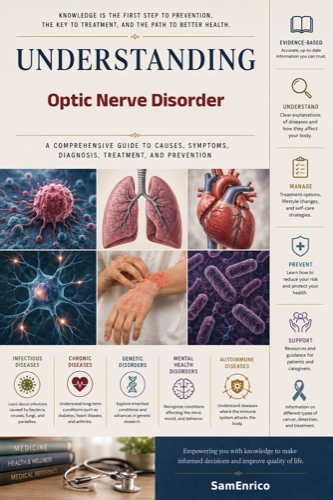
Understanding Optic Nerve Disorder eBook
This disease publication, published by SamEnrico,
by Burgess Andy
This disease publication, published by SamEnrico, covers Understanding Optic Nerve Disorder
Formats
Free sample
Chapter 1: The Million-to-One Betrayal--–- The human body is a masterpiece of redundancy. You have two lungs, two kidneys, two hemispheres of the brain, and over 600 muscles that can compensate for one another’s weakness. But your optic nerve? You have exactly two of those—one for each eye—and there is no backup system, no secondary pathway, no plan B. When that nerve begins to die, it does so silently, progressively, and often without a single symptom until nearly half of its fibers have already been destroyed.This is the million-to-one betrayal: the cruel reality that your optic nerve, the only visible part of your central nervous system, is also one of the most vulnerable structures in your body.
And yet, most people—including many doctors—do not understand how it works, how it fails, or how to recognize the early warning signs before it is too late.This chapter is not a dry anatomy lesson. It is a wake-up call. By the time you finish these pages, you will understand why a routine eye exam can miss early optic nerve damage, why “perfect” 20/20 vision does not mean your optic nerve is healthy, and why the story of a 29-year-old marathon runner named Jennifer should change how you think about your own sight.The Anatomy of an Invisible Cable To understand how the optic nerve can fail, you must first understand what it is—and what it is not.The optic nerve is not a single wire. It is a cable. A living, metabolic, electrically active cable composed of approximately 1.2 million individual nerve fibers, each one an axon extending from a retinal ganglion cell in the back of your eye all the way to the visual processing centers deep inside your brain.
If you could unravel all those fibers and lay them end to end, they would stretch for nearly three miles.The journey begins at the optic disc, that pale, round structure your eye doctor examines during a dilated exam. From there, the nerve fibers converge, pass through a sieve-like structure called the lamina cribrosa, exit the back of the eye, and travel through the bony optic canal—a tight, unforgiving tunnel—before finally reaching the optic chiasm, where fibers from both eyes partially cross, and then continue onward to the lateral geniculate nucleus and ultimately the occipital cortex at the back of your brain.Here is the first critical fact that most patients never learn: the optic nerve is not part of the peripheral nervous system. It is not like the nerves in your fingers or toes, which can regenerate after injury. The optic nerve is an extension of your brain—literally. It is myelinated by oligodendrocytes (not Schwann cells), it is bathed in cerebrospinal fluid, and it shares the same vulnerability to inflammation, compression, and metabolic stress as the brain itself.
This means that when the optic nerve is damaged, it does not heal like a cut on your skin. It scars. And that scarring is permanent.The Concept of Axonal Transport: The Nerve’s Lifeline Every second of every day, your optic nerve is engaged in a frantic, high-stakes logistical operation called axonal transport. Think of it as a highway system with 1.2 million lanes, each lane carrying two types of traffic.Fast anterograde transport moves essential materials from the retinal ganglion cell body down to the nerve terminal at speeds of up to 400 millimeters per day—about the length of a football field every hour. This traffic includes mitochondria (the power plants of the cell), synaptic vesicles (the messengers), and enzymes (the maintenance crew).
Fast retrograde transport moves waste products and signaling molecules back up to the cell body, providing feedback about the health of the nerve terminal.Slow axonal transport is the workhorse. It moves structural proteins—the scaffolding that holds the nerve together—at a leisurely pace of 1 to 5 millimeters per day. A single molecule making this journey from the eye to the brain takes two to three months to arrive.Why does this matter? Because almost every optic nerve disorder—whether inflammatory, vascular, compressive, genetic, toxic, or traumatic—ultimately disrupts axonal transport. When the highway is blocked, the nerve terminal starves.
When the power plants fail, the axon withers. When the scaffolding collapses, the entire structure crumbles.This is why vision loss from optic nerve disease is often irreversible. Once an axon dies, it does not regrow. And because 1.2 million axons die one by one over months or years, the brain adapts to incremental losses—until one day, it cannot adapt anymore, and the patient finally notices that something is wrong.The Jennifer Story: A Cautionary Tale of Missed Clues Jennifer was 29 years old when she noticed that something felt off with her left eye. It was not blurry, exactly.
It was more like looking through a slightly smudged pair of glasses that she could not clean. Colors seemed a little less vibrant. Red had lost its richness, becoming a dull brownish-pink.She made an appointment with her optometrist, who performed a standard eye exam. Her visual acuity was 20/20 in both eyes. Her eye pressure was normal.
Her retina looked fine. “Probably allergies,” the optometrist said. “Try some artificial tears.”Jennifer was a marathon runner and a lawyer. She did not have time to be sick. She accepted the diagnosis and moved on with her life.Three months later, she woke up and realized that her left eye felt strange when she moved it—not pain, exactly, but a deep ache, like a muscle she had overused at the gym.
She went back to the optometrist, who this time noted that her optic disc looked “a little pink” but still within normal limits. “Maybe a mild case of optic neuritis,” the doctor said. “It will probably go away on its own.”Another three months passed. The ache evolved into sharp pain whenever Jennifer looked to the left. The smudge in her vision became a gray spot just off center.
She could still read the 20/20 line, but something was undeniably wrong. She demanded a referral to an ophthalmologist.The ophthalmologist ordered an Optical Coherence Tomography scan—a test that measures the thickness of the nerve fiber layer with micrometer precision. The results were devastating. Jennifer’s left optic nerve had already lost 42 percent of its thickness. The damage was permanent.She was diagnosed with optic neuritis, an inflammatory attack on the optic nerve that is often the first sign of multiple sclerosis.
An MRI of her brain revealed three white matter lesions—subtle scars of previous, silent inflammatory attacks. She had, in fact, already had MS for years without knowing it.Jennifer’s story is not rare. It is the rule. By the time a patient notices vision loss from optic nerve disease, they may have already lost 40 to 50 percent of their nerve fibers. This is not because doctors are incompetent.
It is because the brain is extraordinarily good at compensating for damage—until it is not.Why 20/20 Vision Is Not Enough The standard Snellen eye chart—that familiar wall of letters with the big E at the top—measures one thing and one thing only: high-contrast, stationary visual acuity at distance. It tells you nothing…
This is the end of the free sample. Get the eBook to keep going. Buy now
About this book
Details
- Author
- Burgess Andy
- Publisher
- SamEnrico
- Language
- English
- Genre
- Non-Fiction, Informative, Educational
- Released
- 2026-06-02
- Pages (approx.)
- 159
- Available as
- eBook, Audiobook

Read better in the ZLOADR app
Your eBooks on your phone or tablet. Sign in with your SamEnrico account and start reading.
More by Burgess Andy
 Mindful Walking MBSR Practice WorkbookBurgess Andy$11.99
 Titanic's Boiler Field DiscoveryBurgess Andy$11.99
 Pomodoro for Home ImprovementBurgess Andy$11.99
 The Postpartum Depression ConnectionBurgess Andy$11.99
 The Desert Fox and the Iron Admiral: Rommel vs. Montgomery in the Sands of North AfricaBurgess Andy$11.99
 Medical Device AssemblerBurgess Andy$11.99
 Pricing for Automotive and Parts IndustryBurgess Andy$12.99
 African Coding Education GuideBurgess Andy$12.99
 How to Start a Water and Sewer Line Construction BusinessBurgess Andy$11.99
You may also like
 Hong Kong Handover 1997Dunn Johnnie$11.99
 Zumba For Postnatal Recovery CourseNeal Christian$11.99
 Zumba for BeginnersLadner Nikia$11.99
 YouTube Comment Mining GuideHumes Pandora$12.99
 Worry Box MeditationCarlin Rudy$11.99
 Workplace Stress MeditationNguyen Lynn$11.99
 Workplace Stress and Sleep RepairHawley Ivory$11.99
 Workplace Perfectionism CureDelaney Jeffry$11.99
 Workplace Injustice Anger GuideWallen Isabelle$11.99
 Work Addiction and Burnout LinkGreenwood Ester$11.99
 Women in Yoga and WellnessBeattie Galina$11.99
 Women in Stand Up ComedyChun Evangeline$11.99