
Non-FictionInformativeEducational
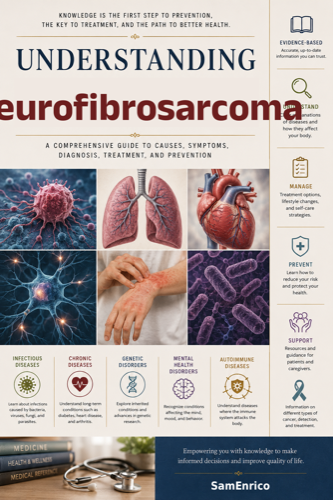
Understanding Neurofibrosarcoma eBook
This disease publication, published by SamEnrico,
by Yost Melodee
This disease publication, published by SamEnrico, covers Understanding Neurofibrosarcoma
Formats
Free sample
Chapter 1: The Vanished Name...--It begins with a word that is dying. Walk into any major academic tumor board in 2024, mention “neurofibrosarcoma,” and you will likely be met with a raised eyebrow or a gentle correction. “You mean MPNST,” someone will say. “Malignant Peripheral Nerve Sheath Tumor.” The World Health Organization made the change official years ago, standardizing the nomenclature across continents and languages. And yet, step into the office of a senior surgeon who trained in the 1980s, or open a pathology textbook from that era, and the old word stares back at you.
Neurofibrosarcoma. It lingers in the margins of the literature, in the memories of patients who received that diagnosis decades ago, in the foundation names and support group materials that have not been updated. This chapter is about that vanished name—why it existed, why it fell from favor, and why understanding its history is essential to understanding the disease itself.The Man Behind the Eponym Friedrich Daniel von Recklinghausen was one of the giants of 19th-century German pathology. A student of Rudolf Virchow—the father of modern pathology—von Recklinghausen made contributions that still echo through medicine today. He was the first to describe the cellular structure of bone marrow.
He identified the characteristic “recurrent laryngeal nerve” nodes in tuberculosis. He described the yellow nodules of xanthoma. But his most enduring legacy, at least for the purposes of this book, is his 1882 monograph on the multiple fibromas of the skin and their relationship to multiple neuromas.The monograph, titled Über die multiplen Fibrome der Haut und ihre Beziehung zu den multiplen Neuromen, was a masterpiece of clinical observation. Von Recklinghausen had collected a series of patients with a striking constellation of findings: multiple soft tumors protruding from the skin, patches of hyperpigmentation that he called “café-au-lait” spots (coffee with milk), and deeper tumors that seemed to arise directly from nerves. He distinguished these from other nerve tumors of the era, which were often lumped together under vague diagnostic labels like “sarcoma of the nerve” or “neuroma.” Von Recklinghausen noted that while most of these nerve-associated tumors were benign and slow-growing, a subset behaved very differently.
These tumors were firm rather than soft, fixed rather than mobile, and painful rather than merely uncomfortable. They grew relentlessly, invaded surrounding tissues, recurred after surgical removal, and eventually killed the patient. He had described, without knowing the genetics or the molecular biology, what we now call neurofibrosarcoma.The eponym “von Recklinghausen’s disease” stuck, and for more than a century, it was the standard term for Neurofibromatosis Type 1. Even today, older patients and clinicians may use the term. But von Recklinghausen himself would likely be surprised by the complexity of the disease that bears his name.
He saw the tumors and the spots. He did not see the gene.The Tower of Babel: A Century of Confusing Names After von Recklinghausen’s monograph, the nomenclature of malignant nerve sheath tumors descended into chaos. The problem was simple: no one knew which cell gave rise to these tumors. Was it the Schwann cell, named after Theodor Schwann, which wraps around axons to form the insulating myelin sheath? That seemed plausible, given the intimate association between tumors and nerves.
Pathologists proposed the name “malignant schwannoma.” Was it the perineurial cell, which forms the protective perineurium around nerve fascicles? That cell also had its advocates, leading to names like “perineurial sarcoma.” Was it some undifferentiated precursor cell within the nerve sheath? That uncertainty produced vague terms like “neurogenic sarcoma” and “malignant neurilemmoma.”The result was a diagnostic Tower of Babel. A study published in the American Journal of Surgical Pathology might use “malignant schwannoma.” A study in Cancer might prefer “neurofibrosarcoma.” A study in the Journal of Neurosurgery might call it “neurogenic sarcoma.” And crucially, these different names were not always used consistently. One pathologist’s “malignant schwannoma” might include only tumors with obvious Schwann cell differentiation, while another’s might include all malignant nerve sheath tumors regardless of differentiation.
This made it nearly impossible to compare results across studies. A reported 5-year survival of 60% for “malignant schwannoma” might reflect a carefully selected group of low-grade tumors, while a reported 30% survival for “neurofibrosarcoma” might include high-grade, NF1-associated cases. The literature was fragmented, and patients suffered from the confusion.The problem was not merely academic. In the 1950s and 1960s, as surgical oncology advanced and limb-sparing surgery became feasible, clinicians needed reliable prognostic information. They needed to know which tumors required radical resection and which could be treated with wide local excision alone.
But without a consistent naming system, the data were unreliable. A surgeon reading a study on “neurofibrosarcoma” might apply its conclusions to a patient with a tumor that a different pathologist would have called “malignant schwannoma,” potentially leading to inadequate surgery.The Genetic Breakthrough That Changed Everything The turning point came in 1990. Two independent research groups—one led by Francis Collins at the University of Michigan, the other by Ray White at the University of Utah—identified the gene responsible for Neurofibromatosis Type 1. The gene, located on chromosome 17q11.2, was enormous, spanning more than 350,000 base pairs of DNA. It encoded a protein that was largely unfamiliar at the time, which they named neurofibromin.The discovery of the NF1 gene was a watershed moment for several reasons.
First, it provided a molecular diagnosis. For the first time, patients with clinical features of NF1 could have their diagnosis confirmed by DNA testing. Second, it opened the door to understanding the biology of the disease. Neurofibromin, researchers soon discovered, is a tumor suppressor. It normally acts as a brake on cell growth.
When one copy of the NF1 gene is mutated—the first hit—the brake is partially released. Cells grow more readily, but they do not become cancerous. When the second copy is also mutated—the second hit—the brake is completely released, and the affected cell can proliferate without restraint. This two-hit mechanism explains why NF1 patients develop multiple benign tumors (each tumor arises from a cell that has lost both copies of NF1) and why they have an elevated risk of malignancy (additional mutations can accumulate in those rapidly dividing cells).The second hit mechanism also explains sporadic (non-NF1) cases of neurofibrosarcoma. In a patient without inherited NF1, both copies of the gene must be mutated somatically—that is, within a single cell during the patient’s lifetime.
This is a much rarer event, which is why sporadic MPNST is less common than NF1-associated MPNST. It also explains why sporadic cases occur later in life: it takes time for two independent somatic mutations to occur in the same cell.With the molecular mechanism understood, the pathology community finally had a rational basis for naming the tumor. The World Health Organization convened its expert panel on soft tissue tumors and, in its 1999 classification, adopted a new term: Malignant Peripheral Nerve Sheath Tumor, or MPNST. The term was deliberately broad, acknowledging that the tumor could show Schwannian, perineurial, or fibroblastic differentiation, and that the exact cell of origin might vary from case to case. What mattered was the nerve sheath origin and the malignant behavior.
MPNST became the standard term, and over the next decade, it gradually replaced the older, inconsistent nomenclature.Why This Book Uses…
This is the end of the free sample. Get the eBook to keep going. Buy now
About this book
Details
- Author
- Yost Melodee
- Publisher
- SamEnrico
- Language
- English
- Genre
- Non-Fiction, Informative, Educational
- Released
- 2026-05-07
- Pages (approx.)
- 145
- Available as
- eBook, Audiobook

Read better in the ZLOADR app
Your eBooks on your phone or tablet. Sign in with your SamEnrico account and start reading.
More by Yost Melodee
 Mindfulness For Plantar FasciitisYost Melodee$11.99
 Campus Involvement Overload HandbookYost Melodee$11.99
 Vegan Soup Nutrition GuideYost Melodee$11.99
 Retirement Plan Recordkeeper GuideYost Melodee$11.99
 Road Rage and Low Blood Sugar LinkYost Melodee$11.99
 The Flying Monk: How a 16th-Century Athlete Defied the Church and Changed RunningYost Melodee$11.99
 Network Design EngineerYost Melodee$11.99
 AI Fraud Detection for Small BusinessYost Melodee$12.99
 Scholarship Financial Literacy GuideYost Melodee$12.99
 How to Start a Chlorination Plant for Water Treatment Business (Beginners Guide)Yost Melodee$11.99
You may also like
 Hong Kong Handover 1997Dunn Johnnie$11.99
 Zumba For Postnatal Recovery CourseNeal Christian$11.99
 Zumba for BeginnersLadner Nikia$11.99
 YouTube Comment Mining GuideHumes Pandora$12.99
 Worry Box MeditationCarlin Rudy$11.99
 Workplace Stress MeditationNguyen Lynn$11.99
 Workplace Stress and Sleep RepairHawley Ivory$11.99
 Workplace Perfectionism CureDelaney Jeffry$11.99
 Workplace Injustice Anger GuideWallen Isabelle$11.99
 Work Addiction and Burnout LinkGreenwood Ester$11.99
 Women in Yoga and WellnessBeattie Galina$11.99
 Women in Stand Up ComedyChun Evangeline$11.99