
Non-FictionInformativeEducational
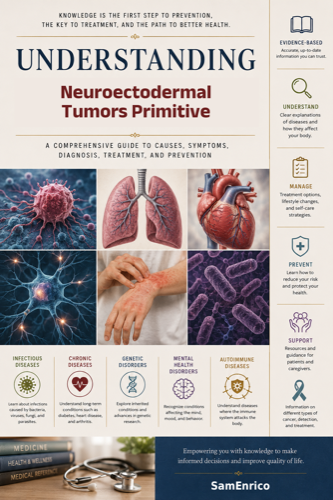
Understanding Neuroectodermal Tumors Primitive eBook
This disease publication, published by SamEnrico,
by Kohl Liberty
This disease publication, published by SamEnrico, covers Understanding Neuroectodermal Tumors Primitive
Formats
Free sample
Chapter 1: The Source Code...--Before you were born—before you had a face, a name, or a first breath—you were a map.Not a map of mountains and rivers, but a map of possibilities. A folded sheet of cells that knew exactly where to become brain, where to become spine, where to become the thousand miles of wiring that would one day let you read these words. That map is called the neuroectoderm, and it is the most extraordinary tissue you will never see.It forms in the third week of embryonic life. You were smaller than a grain of rice. But inside that microscopic sphere, a flat plate of cells began to roll itself into a tube—like closing a zipper from the middle outward.
When that zipper failed to close completely, you would have been born with a neural tube defect. When it closed perfectly, you had the blueprint for a central nervous system. And when something went wrong inside those cells—not with the closing, but with the cells themselves—you could one day develop a primitive neuroectodermal tumor.This chapter is not a biology lesson. It is an origin story. Because before you can understand why these tumors are so aggressive, why they resist treatment, and why the future of oncology depends on decoding their genetics, you need to understand one thing: these tumors are not invaders from the outside.
They are your own cells that forgot how to grow up.The Embryo’s First Decision Every human begins as a single cell—a fertilized egg that contains the complete instruction manual for building a human being. That cell divides, and divides again, and within days it becomes a hollow ball of identical cells called a blastocyst. Then something remarkable happens. The cells specialize.The outer layer becomes the placenta. The inner mass becomes the embryo.
And within that inner mass, three distinct layers form: the ectoderm (outer layer), the mesoderm (middle layer), and the endoderm (inner layer). The ectoderm is the one that concerns us. From the ectoderm comes the skin, the hair, the nails—and the entire nervous system.But the nervous system doesn't appear overnight. A special strip of ectoderm running down the middle of the embryo thickens into what embryologists call the neural plate. Then, like a piece of paper folding into a paper airplane, the edges of that plate rise up, curl inward, and fuse together.
The result is the neural tube. The front end of that tube will become the brain. The rest will become the spinal cord.This process is called neurulation, and it is complete by the end of the fourth week of pregnancy. You were four weeks old—younger than a sesame seed—and you already had a nervous system.Now here is the part that matters for understanding primitive neuroectodermal tumors. Inside that newly formed neural tube, the cells are not yet neurons or glia.
They are neuroepithelial cells—primitive, undifferentiated, and astonishingly capable. They can become anything. They can divide hundreds of times. They are, in the most literal sense, the source code of your brain.Most of these cells will receive signals telling them to stop dividing and start specializing. They will become neurons that fire electricity.
They will become astrocytes that support those neurons. They will become oligodendrocytes that insulate the wires. They will grow up, in other words.But sometimes—very rarely—a cell misses that signal. It keeps dividing. It keeps its primitive, fetal appearance.
And decades later, that cell or one of its descendants will begin dividing uncontrollably, forming a tumor made of cells that look exactly like the tissue you had when you were four weeks old.That is what "primitive" means in oncology. It does not mean unsophisticated. It does not mean less evolved. It means embryologic. Fetal.
Original. The word points backward in time, not sideways in intelligence.What Pathologists See When They Look Through the Microscope If a neurosurgeon removes a primitive neuroectodermal tumor and sends it to the pathology lab, the pathologist will perform a series of steps that haven't changed much in a hundred years. The tissue is fixed in formalin, embedded in paraffin wax, sliced thinner than a human hair, mounted on a glass slide, and stained with dyes. The most common stain is called hematoxylin and eosin—H&E for short.Under the microscope, at low power, the tumor looks like a sea of blue. The hematoxylin stains cell nuclei dark purple to blue, and primitive tumors are so densely packed with nuclei that they obscure the pale pink cytoplasm that would normally separate them.
At high power, the pathologist sees cells that are uniformly small, round, and blue. They look like a handful of blueberries scattered across a white plate. This appearance has a name: the small round blue cell tumor.Now, here is the critical insight that drove oncology for nearly fifty years and then fell apart in 2016. Many different tumors look like small round blue cells under the microscope. Medulloblastoma looks like that.
ETMR looks like that. Pineoblastoma looks like that. Even non-brain tumors like Ewing sarcoma (which grows in bone) and neuroblastoma (which grows in the adrenal gland) look like that.For decades, pathologists grouped all the brain-based small round blue cell tumors together under a single name: primitive neuroectodermal tumor, or PNET. The assumption was that if they looked the same, they must be the same disease. That assumption was wrong.
But before we could discover how wrong, thousands of patients received treatments designed for one type of tumor when they actually had another. Some were over-treated. Some were under-treated. Some died because of the confusion.That history is the subject of Chapter 2. For now, the takeaway is this: when you look at a primitive tumor under a microscope, you are seeing a ghost.
You are seeing the tissue you once were—the tissue of a four-week-old embryo. The tumor has not transformed into something alien. It has simply refused to grow up.The Two Pathways to Primitive Tumors Not all primitive neuroectodermal tumors arise the same way. Understanding the difference between the two pathways is essential for grasping why some of these tumors are curable and others remain nightmares.Pathway One: The Developmental Arrest Imagine a construction crew building a skyscraper. The crew pours the foundation, erects the steel frame, installs the floors.
But then, for reasons no one understands, the workers on the 20th floor never receive the signal to stop building. They keep adding steel beams, pouring concrete, running wires—long after the 20th floor should have been finished. The result is not a building. It is a chaotic mass of construction activity that crushes the floors beneath it.This is the developmental arrest model. A population of neuroepithelial cells simply fails to receive the molecular signal that tells them, "Stop dividing.
Start specializing." They remain frozen in a primitive, proliferative state. Over time, they accumulate additional mutations. Eventually, they become frankly malignant.This pathway explains most medulloblastomas, especially those arising in the cerebellum. The cells that should have become granule neuron precursors never exit the cell cycle. They just keep dividing.Pathway Two: The…
This is the end of the free sample. Get the eBook to keep going. Buy now
About this book
Details
- Author
- Kohl Liberty
- Publisher
- SamEnrico
- Language
- English
- Genre
- Non-Fiction, Informative, Educational
- Released
- 2026-05-25
- Pages (approx.)
- 155
- Available as
- eBook, Audiobook

Read better in the ZLOADR app
Your eBooks on your phone or tablet. Sign in with your SamEnrico account and start reading.
More by Kohl Liberty
 Retirement Account Bankruptcy ProtectionKohl Liberty$11.99
 Treehouse Rest VisualizationKohl Liberty$11.99
 The Scream ArtistKohl Liberty$11.99
 Vegan Child Growth GuideKohl Liberty$11.99
 Road Rage Cognitive RestructuringKohl Liberty$11.99
 The Jade Serpent’s Last WhisperKohl Liberty$11.99
 How to Start a Chocolate Confectionery Business (Beginners Guide)Kohl Liberty$11.99
 Mail & Supplies SpecialistKohl Liberty$11.99
 Petco SWOT LibraryKohl Liberty$12.99
 Scholarships for African Medical StudentsKohl Liberty$12.99
You may also like
 Hong Kong Handover 1997Dunn Johnnie$11.99
 Zumba For Postnatal Recovery CourseNeal Christian$11.99
 Zumba for BeginnersLadner Nikia$11.99
 YouTube Comment Mining GuideHumes Pandora$12.99
 Worry Box MeditationCarlin Rudy$11.99
 Workplace Stress MeditationNguyen Lynn$11.99
 Workplace Stress and Sleep RepairHawley Ivory$11.99
 Workplace Perfectionism CureDelaney Jeffry$11.99
 Workplace Injustice Anger GuideWallen Isabelle$11.99
 Work Addiction and Burnout LinkGreenwood Ester$11.99
 Women in Yoga and WellnessBeattie Galina$11.99
 Women in Stand Up ComedyChun Evangeline$11.99