
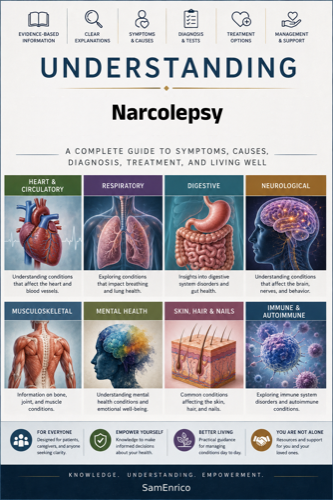
Understanding Narcolepsy eBook
This condition publication, published by SamEnrico
This condition publication, published by SamEnrico, covers Understanding Narcolepsy
Formats
Free sample
Chapter 1: The Faulty Gearbox...--Imagine waking up after a full night's sleep—eight hours, no interruptions—yet feeling as though you haven't slept at all. Your eyelids weigh ten pounds each. Your thoughts move through molasses. Coffee, even a second or third cup, does nothing but make your heart race while your brain remains submerged in fog. Now imagine that someone watching you from across the room thinks you're lazy.
Your boss assumes you stayed up too late. A well-meaning friend suggests you try yoga or melatonin or "just going to bed earlier."This is the daily reality of narcolepsy. And it is almost never what Hollywood portrays.If your only knowledge of narcolepsy comes from movies or sitcoms, you probably imagine someone falling face-first into a bowl of soup mid-sentence, then snoring loudly while others laugh. You might picture a character who collapses without warning, asleep before they hit the ground. These images are not merely exaggerated—they are fundamentally wrong.
They have caused immeasurable harm to the millions of people worldwide who live with this neurological disorder, turning a serious medical condition into a punchline.The truth is far more complex, far more interesting, and far more deserving of your attention. Narcolepsy is not a sleep disorder in the way you might think. It is not primarily about an excess of sleep. Rather, it is a disorder of boundary control—the brain's inability to properly regulate the switch between wakefulness and sleep, and more specifically, between wakefulness and a particular sleep state called REM (rapid eye movement) sleep.This chapter will dismantle the myths, introduce you to the real science, and give you a new framework for understanding what narcolepsy actually is. By the end, you will never again think of it as the "falling asleep disorder." You will understand it as what it truly is: a neurological condition involving a critical brain chemical called hypocretin, an autoimmune attack on the brain's wakefulness centers, and a faulty gearbox that gets stuck in the wrong state at the wrong time.The Cartoon vs.
The Reality Let us begin with a simple experiment. Ask ten people on the street what they know about narcolepsy. At least eight will describe someone suddenly collapsing asleep. This image has been reinforced for decades. In the 2003 film Rat Race, a character portrayed as having narcolepsy falls face-first into a plate of food at a buffet.
In television sitcoms, from The Simpsons to Family Guy, the narcoleptic character is a one-note joke: they fall asleep, others laugh, scene ends.The damage from these portrayals is not abstract. Real people with narcolepsy report being laughed at when they mention their diagnosis. Employers hesitate to hire them. Friends tell them to "just try harder" to stay awake. Parents of children with narcolepsy are accused of not enforcing reasonable bedtimes.
The trivialization of this condition has real consequences, including the average eight-to-ten-year delay between symptom onset and correct diagnosis—a statistic we will explore in depth in Chapter 5.Here is what actually happens in narcolepsy.A person with narcolepsy does not suddenly lose consciousness like a switched-off light bulb. They do not collapse into deep sleep without warning, at least not in the way cartoons depict. What they experience is an overwhelming, crushing urge to sleep that builds over minutes—a sensation often described as a "sleep attack." During this attack, they may struggle to keep their eyes open, lose the thread of conversation, or find themselves unable to focus on a task. But they are usually aware of what is happening. They can often fight it, though fighting it is exhausting and not always successful.When they do fall asleep, it is usually a normal-looking nap—not a dramatic collapse.
And importantly, they wake up feeling no more rested than before. This is the cruel irony of narcolepsy: the sleep itself is not restorative.The famous "sudden collapse" depicted in movies is not actually sleep. It is a separate symptom called cataplexy (from the Greek kataplexis, meaning "striking down with fear"). Cataplexy is a sudden loss of muscle tone while remaining fully conscious. The person does not fall asleep.
They hear everything. They see everything. They simply cannot move their muscles. This symptom, which we will examine in detail in Chapters 3 and 4, is triggered by strong emotions—most commonly laughter, surprise, or anger. A person with cataplexy might laugh at a joke and feel their knees buckle, their jaw go slack, or their head droop.
But they are awake the entire time.The cartoon version conflates two completely different phenomena. This would be like confusing a seizure with a faint—medically dangerous and socially damaging.The Brain's Gatekeeper To understand narcolepsy, you must first understand a small but mighty molecule called hypocretin (also known as orexin). Discovered independently by two research teams in 1998—one at Stanford University and one at Emory University—hypocretin is produced by a mere 50,000 to 80,000 neurons in a tiny region of the brain called the hypothalamus. That sounds like a lot of cells, but consider that the human brain contains approximately 86 billion neurons. These hypocretin-producing neurons represent less than one-tenth of one percent of all brain cells.Yet these few cells have an outsized job.
They act as the brain's master stability officer, the gatekeeper that keeps the borders between wakefulness, non-REM sleep, and REM sleep clearly demarcated. Think of the brain's sleep-wake states as three separate rooms: wakefulness, non-REM sleep (deep, dreamless rest), and REM sleep (the state in which most dreaming occurs). In a healthy brain, hypocretin neurons fire during wakefulness to keep you firmly in the "awake" room. When you fall asleep, they quiet down. When you enter REM sleep, they remain quiet.
The boundaries are clear.In narcolepsy, particularly Type 1 narcolepsy, the vast majority of these hypocretin-producing neurons have been destroyed. The brain's immune system has attacked them, mistaking them for invaders. The gatekeeper is gone. The doors between the rooms swing open randomly.This is why people with narcolepsy do not simply feel sleepy. They experience state instability.
They may be awake but suddenly slip into REM sleep for a few seconds—long enough to have a hypnagogic hallucination (a dream-like experience while still technically awake) or a brief episode of sleep paralysis (waking up but being unable to move). They may be asleep but experience fragmented, restless sleep because their brain keeps flickering into wakefulness. They may be laughing at a joke and suddenly their muscles go limp—cataplexy—because the emotion triggered a switch into a REM-like state where the body is normally paralyzed to prevent acting out dreams.The old metaphor for narcolepsy was a "broken switch"—a light that stays off when it should be on. But as we noted in the preface to this edition, that metaphor is incorrect. A broken switch would leave you stuck in one position, always sleepy.
That is not narcolepsy. People with narcolepsy experience both too much sleepiness during the day and too much wakefulness at night. Their nighttime sleep is fragmented, filled with awakenings, vivid nightmares, and restless legs.A better metaphor is a faulty gearbox. Imagine a car with a transmission that randomly shifts from drive to…
This is the end of the free sample. Get the eBook to keep going. Buy now
About this book
Details
- Author
- Mercer Alaina
- Publisher
- SamEnrico
- Language
- English
- Genre
- Non-Fiction, Informative, Educational
- Released
- 2026-06-02
- Pages (approx.)
- 158
- Available as
- eBook, Audiobook

Read better in the ZLOADR app
Your eBooks on your phone or tablet. Sign in with your SamEnrico account and start reading.
More by Mercer Alaina
 Women's Biohacking MovementMercer Alaina$11.99
 Dubai Student VolunteeringMercer Alaina$11.99
 Bhagwan Oregon Ruins TodayMercer Alaina$11.99
 New Zealand Green CreditsMercer Alaina$11.99
 Cannabis Use Disorder and Occupational FunctioningMercer Alaina$11.99
 Profile QR Code UseMercer Alaina$11.99
 Circadian Rhythm Autism GuideMercer Alaina$11.99
 Caregiver Grief AnticipatoryMercer Alaina$11.99
 The Great Cyber Escape: How a Hacker Outsmarted Dubai’s High-Tech PrisonMercer Alaina$11.99
 The Blackout: The Night the Lights Went Out in New YorkMercer Alaina$11.99
 How to Produce Garment Steamer AccessoriesMercer Alaina$11.99
 Spot Factoring Emerging Markets HandbookMercer Alaina$12.99