
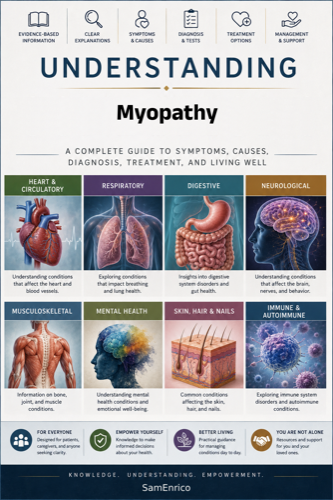
Non-FictionInformativeEducational
Understanding Myopathy eBook
This condition publication, published by SamEnrico
This condition publication, published by SamEnrico, covers Understanding Myopathy
Formats
Free sample
Chapter 1: The Hidden Language...--–- Imagine waking up one morning, reaching for your coffee mug, and finding that your fingers will not close around the handle. You try again, harder this time, but your hand merely trembles. Your arm feels heavy, as though someone has strapped a weight to it overnight. You stand up, and your legs wobble. Climbing the stairs to your bedroom feels like scaling a mountain.
Your mind is clear—perfectly, painfully clear—but your body has begun to speak a different language, one you do not understand.This is not a scene from a horror novel. This is the lived reality of thousands of people every year who are told, after weeks or months of bewildering tests, that they have a myopathy. The word itself sounds clinical, cold, and final. But here is the first truth this book wants you to hold onto: myopathy is not a verdict. It is a beginning.The term “myopathy” comes from the Greek roots myo- (muscle) and -pathy (suffering or disease).
In the simplest terms, a myopathy is any disease of the muscle tissue itself. That seems straightforward enough. Yet the moment you begin to look closer, you realize that this single word conceals an astonishing universe of conditions, each with its own cause, its own course, and its own possibilities for treatment. Some myopathies are present from birth, written into the very blueprint of a person’s DNA. Others appear suddenly in middle age, triggered by a rogue immune system or a medication taken for an entirely different problem.
Some progress rapidly, stealing strength over a matter of years. Others remain nearly stable for decades, requiring only modest adjustments to daily life.The single most important idea in this entire book—the foundation upon which everything else rests—is this: myopathy is not one disease. It is a category. And categories are meant to be understood, organized, and navigated. Once you understand which type of myopathy you or your loved one is facing, the path forward becomes clearer.
The fear of the unknown begins to lift.This chapter will give you that foundation. We will walk together through the basic landscape of myopathy: what it is, what it is not, how to recognize its common signs, and—most critically—why you have every reason to be hopeful. By the end of this chapter, you will no longer be a passive recipient of a frightening diagnosis. You will be an informed partner in your own care.What Myopathy Is (and What It Is Not)To understand myopathy, you must first understand what your muscles are and how they are supposed to work. Your skeletal muscles—the ones attached to your bones that allow you to walk, lift, smile, and breathe—are remarkable machines.
Each muscle is composed of thousands of long, cylindrical cells called muscle fibers. These fibers are designed to do one thing exceptionally well: contract. When a signal travels from your brain down through your spinal cord and out along a nerve to a muscle, that nerve releases a chemical messenger that tells the muscle fiber to shorten. Thousands of fibers shortening in coordination produce movement.Now, here is the crucial distinction. A myopathy is a problem within the muscle fiber itself.
That is different from other kinds of neurological and muscular disorders that can look similar on the surface. For example:Neuropathies are diseases of the peripheral nerves—the wires that carry signals from your spinal cord to your muscles. In a neuropathy, the signal gets lost or distorted along the way. Sensation is often affected, and patients may feel numbness, tingling, or burning pain in addition to weakness.Neuromuscular junction disorders, such as myasthenia gravis, affect the tiny gap between the nerve ending and the muscle fiber. The signal arrives at the nerve but fails to cross over to the muscle properly.
These conditions typically cause weakness that fluctuates dramatically—better in the morning, worse by evening—and often affect the eyes and throat first.Myopathies, by contrast, are problems that originate inside the muscle cell itself. The nerve signal arrives just fine. The neuromuscular junction works correctly. But the muscle fiber cannot respond properly. It may be structurally fragile, lacking key proteins that hold it together.
It may be unable to produce enough energy to sustain contraction. It may be under attack by the body’s own immune system. Or it may have an electrical instability that causes it to become paralyzed or stiff at random moments.This distinction is not just academic. It guides everything from which tests a doctor orders to which treatments are likely to work. A patient with a neuropathy might need immune therapy or pain management.
A patient with a neuromuscular junction disorder might benefit from medications that boost the nerve signal. But a patient with a myopathy needs a strategy focused on the muscle itself—protecting it, strengthening it safely, and addressing the specific mechanism that is causing it to fail.The Great Divide: Inherited vs. Acquired Myopathies Once you understand that a myopathy is a muscle problem, the next most important distinction is between inherited myopathies and acquired myopathies. This divide shapes everything: who in your family might be at risk, what kind of specialist you need, and what treatments are available.Inherited myopathies are caused by mutations in your DNA—changes in the genetic code that you were born with. Some of these mutations are passed down from one or both parents.
Others arise spontaneously as a new mutation in the affected individual, with no family history at all. Inherited myopathies include the muscular dystrophies (such as Duchenne, Becker, and myotonic dystrophy), the congenital myopathies (present from birth or early infancy), the metabolic myopathies (where the muscle cannot properly use sugars or fats for energy), and the mitochondrial myopathies (where the energy-producing centers of the cell are defective). These conditions are generally lifelong. That sounds frightening, but it is not the same as saying they are untreatable. Many inherited myopathies have specific management strategies that dramatically improve quality of life and longevity.
And as you will see in later chapters, the era of genetic therapies is already here.Acquired myopathies, by contrast, develop later in life in people whose genes are perfectly normal. Something from the outside environment—or from within the body’s own systems—triggers muscle damage. The most common acquired myopathies are the inflammatory myopathies (also called myositis), where the immune system mistakenly attacks healthy muscle tissue. Others include endocrine myopathies caused by thyroid disorders or excess cortisol, toxic myopathies caused by medications like statins or by substances like alcohol, and nutritional myopathies caused by severe vitamin D deficiency. The critical thing to understand about acquired myopathies is that they are often reversible.
Treat the underlying thyroid condition, remove the offending medication, or suppress the rogue immune system, and the muscle weakness may improve—sometimes completely.To make this concrete, consider two patients. Maria is a 35-year-old woman who has noticed over the past six months that she cannot lift her arms above her shoulders to brush her hair. Her blood work shows extremely high levels of a muscle enzyme called creatine kinase. A muscle…
This is the end of the free sample. Get the eBook to keep going. Buy now
About this book
Details
- Author
- Salcido Tobie
- Publisher
- SamEnrico
- Language
- English
- Genre
- Non-Fiction, Informative, Educational
- Released
- 2026-06-02
- Pages (approx.)
- 144
- Available as
- eBook, Audiobook

Read better in the ZLOADR app
Your eBooks on your phone or tablet. Sign in with your SamEnrico account and start reading.
More by Salcido Tobie
 Dubai Student Legal RightsSalcido Tobie$11.99
 Female Sneakerhead CultureSalcido Tobie$11.99
 Colombia Green CreditsSalcido Tobie$11.99
 Bhagwan Deportation HearingSalcido Tobie$11.99
 Circadian Rhythm And DepressionSalcido Tobie$11.99
 Cannabis Use Disorder and Sexual HealthSalcido Tobie$11.99
 Caregiver Family CommunicationSalcido Tobie$11.99
 A/B Test Headline ToolSalcido Tobie$11.99
 The Lament of Ziryab: The Eighth String of BaghdadSalcido Tobie$11.99
 How to Produce Garment AccessoriesSalcido Tobie$11.99
 Babe Ruth's Swing: The Rhythm of a Baseball LegendSalcido Tobie$11.99
 Invoice Factoring Cost Structure WorkbookSalcido Tobie$12.99
You may also like
 Hong Kong Handover 1997Dunn Johnnie$11.99
 Zumba For Postnatal Recovery CourseNeal Christian$11.99
 Zumba for BeginnersLadner Nikia$11.99
 YouTube Comment Mining GuideHumes Pandora$12.99
 Worry Box MeditationCarlin Rudy$11.99
 Workplace Stress MeditationNguyen Lynn$11.99
 Workplace Stress and Sleep RepairHawley Ivory$11.99
 Workplace Perfectionism CureDelaney Jeffry$11.99
 Workplace Injustice Anger GuideWallen Isabelle$11.99
 Work Addiction and Burnout LinkGreenwood Ester$11.99
 Women in Yoga and WellnessBeattie Galina$11.99
 Women in Stand Up ComedyChun Evangeline$11.99