
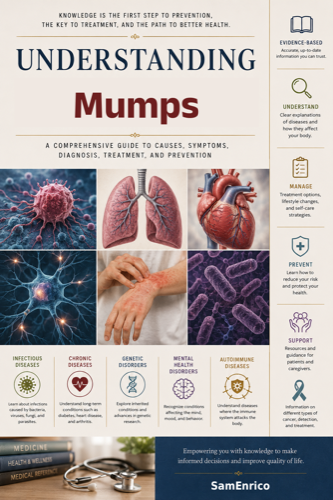
Non-FictionInformativeEducational
Understanding Mumps eBook
This disease publication, published by SamEnrico,
This disease publication, published by SamEnrico, covers Understanding Mumps
Formats
Free sample
Chapter 1: The Forgotten Swelling--–- On a chilly February morning in 2006, an eighteen-year-old college freshman named Kyle woke up thinking he had the flu. His jaw ached. His cheeks felt puffy. His temperature read 101.4°F. He texted his roommate: “Got something.
Going to health center.” By noon, a nurse practitioner told him he had “probable viral parotitis” and sent him back to his dorm with ibuprofen. Three days later, Kyle’s scrotum swelled to the size of a grapefruit. He could barely walk. He was the first confirmed case of what would become the largest mumps outbreak in the United States in two decades—over 6,500 cases across eleven states. Kyle was fully vaccinated.
He had received both doses of the MMR vaccine as a child, exactly as recommended. His story is not an anomaly. It is a warning.This book is about a disease most people have forgotten exists. Mumps—officially known as epidemic parotitis—is a viral illness that was once as common as chickenpox, a childhood rite of passage that almost every parent expected their child to endure. Then came the vaccine.
And mumps nearly disappeared. Nearly, but not completely. In the past two decades, mumps has staged a quiet, perplexing comeback, not among the unvaccinated (though they remain at highest risk) but among the fully vaccinated young adults who populate college dorms, military barracks, and summer camps. This chapter lays the foundation for everything that follows: what mumps is, how to recognize it, why it matters, and why you—whether you are a parent, a student, a healthcare worker, or simply a concerned citizen—need to understand this virus before the next outbreak finds you.What Exactly Is Mumps?At its core, mumps is an acute, contagious disease caused by a virus. That virus belongs to the family Paramyxoviridae, genus Rubulavirus.
Its scientific name is Mumps orthorubulavirus, and it is a close cousin of the viruses that cause parainfluenza (croup) and Newcastle disease (a poultry illness). Under an electron microscope, the mumps virus looks like a tangled piece of yarn—an enveloped, single-stranded RNA virus with a helical nucleocapsid. Its surface is studded with two critical glycoproteins: the hemagglutinin-neuraminidase (HN) protein, which attaches the virus to host cells, and the fusion (F) protein, which allows the virus to merge with the cell membrane and inject its genetic material inside.Once inside a human cell, the virus hijacks the cell’s machinery to replicate itself, producing thousands of new viral particles that burst out and infect neighboring cells. This process is not subtle. It triggers inflammation, fever, and the characteristic swelling of glandular tissue that gives mumps its name (from the old English word “mump,” meaning to grimace or mumble, because patients could not chew or speak properly).Mumps is exquisitely picky about where it attacks.
Unlike influenza, which targets the respiratory epithelium, or norovirus, which attacks the gut, mumps has a tropism—a biological affinity—for glandular and nervous tissue. The virus is drawn to cells that display sialic acid receptors on their surfaces, and certain tissues display these receptors in abundance: the salivary glands (especially the parotids), the testicles, the ovaries, the pancreas, and the central nervous system (the meninges and the cochlea of the inner ear). This explains why mumps is not just “a swelling in the neck.” It is a systemic disease that can strike the reproductive system, the brain, and the organs of hearing.The Clinical Course: From Exposure to Recovery Understanding the timeline of mumps infection is essential for both recognition and public health response. The disease unfolds in predictable stages, though the severity varies dramatically from person to person—from completely asymptomatic (no symptoms at all) to debilitating complications requiring hospitalization.Exposure and Entry The journey begins when an infected person coughs, sneezes, talks, or even breathes near a susceptible individual. Mumps is transmitted via respiratory droplets—those tiny, invisible clouds of moisture that we expel with every exhalation.
These droplets can travel up to six feet and can survive on surfaces for several hours. A susceptible person inhales the droplets or touches a contaminated surface (a doorknob, a shared water bottle, a cafeteria tray) and then touches their own nose or mouth.Once the virus enters the respiratory tract, it immediately begins replicating in the nasopharynx and upper respiratory epithelium. This initial replication phase is silent. The person feels perfectly normal. They go to class, to work, to the gym.
They hug their family members. They share a drink with a friend. All the while, the virus is multiplying, preparing for its next move.Incubation Period: The Silent Spread The incubation period—the time between exposure and the first appearance of symptoms—ranges from 12 to 25 days. The average is 16 to 18 days. This is a crucial fact for contact tracing.
If you were exposed to someone with mumps on a Monday, you could become symptomatic as early as the following Saturday (12 days later) or as late as nearly four weeks afterward. Most cases, however, appear around day 16 or 17.During this incubation period, the virus spreads from the respiratory tract to regional lymph nodes in the neck (the cervical and submandibular nodes). From there, it enters the bloodstream in what virologists call a primary viremia. This initial seeding of the blood allows the virus to travel to multiple organs. A second, more intense secondary viremia follows, during which the virus arrives at its target tissues: the salivary glands, the testes, the ovaries, the pancreas, and the central nervous system.Prodromal Phase: The Mistaken Identity One to two days before the appearance of parotid swelling (and sometimes without any swelling at all), the infected person enters the prodromal phase.
Symptoms during this phase are frustratingly nonspecific:Low-grade to moderate fever (38°C to 39°C / 100.4°F to 102.2°F)Headache (often described as dull and frontal)Malaise (a general feeling of being unwell, as if “coming down with something”)Myalgia (muscle aches, particularly in the neck, shoulders, and back)Anorexia (loss of appetite)Sore throat (pharyngitis, sometimes with mild erythema)These symptoms are virtually identical to those of a mild flu or a bad cold. This is why mumps is so often misdiagnosed in its early stages. A patient who sees a doctor during the prodromal phase—and who has not yet developed the telltale parotid swelling—is likely to be sent home with a diagnosis of “viral syndrome” and told to rest and hydrate. Meanwhile, they are contagious and spreading the virus to everyone around them.Acute Parotitis: The Hallmark Sign The defining feature of mumps is parotitis—inflammation of the parotid glands, the largest of the salivary glands, located just below and in front of the ears, extending down to the angle of the jaw. When both parotids swell, the patient develops the classic “chipmunk cheek” appearance that has been recognized for centuries.Parotitis typically appears on one side first (unilateral) and then moves to the other side (bilateral) within one to five days.
Approximately 70% of patients develop bilateral swelling. The gland feels rubbery or doughy to palpation—not hard, not fluctuant, not hot to the touch. The skin overlying the gland may appear stretched but is rarely red or discolored. The swelling is…
This is the end of the free sample. Get the eBook to keep going. Buy now
About this book
Details
- Author
- Marion Earnestine
- Publisher
- SamEnrico
- Language
- English
- Genre
- Non-Fiction, Informative, Educational
- Released
- 2026-06-02
- Pages (approx.)
- 156
- Available as
- eBook, Audiobook

Read better in the ZLOADR app
Your eBooks on your phone or tablet. Sign in with your SamEnrico account and start reading.
More by Marion Earnestine
 Widow Self Worth RecoveryMarion Earnestine$11.99
 Equifax's Canadian Breach ImpactMarion Earnestine$11.99
 Adolescent EQ DevelopmentMarion Earnestine$11.99
 Global Vaccine Alliance GAVIMarion Earnestine$11.99
 The People Pleasing in Relationships CureMarion Earnestine$11.99
 Hops & Empire: The Rise of the Pilsner KingsMarion Earnestine$11.99
 Meta SWOT Analysis GuideMarion Earnestine$12.99
 AI Financial Data ValidationMarion Earnestine$12.99
 Training ConsultantMarion Earnestine$11.99
 How to Become a Cloth FramerMarion Earnestine$11.99
You may also like
 Hong Kong Handover 1997Dunn Johnnie$11.99
 Zumba For Postnatal Recovery CourseNeal Christian$11.99
 Zumba for BeginnersLadner Nikia$11.99
 YouTube Comment Mining GuideHumes Pandora$12.99
 Worry Box MeditationCarlin Rudy$11.99
 Workplace Stress MeditationNguyen Lynn$11.99
 Workplace Stress and Sleep RepairHawley Ivory$11.99
 Workplace Perfectionism CureDelaney Jeffry$11.99
 Workplace Injustice Anger GuideWallen Isabelle$11.99
 Work Addiction and Burnout LinkGreenwood Ester$11.99
 Women in Yoga and WellnessBeattie Galina$11.99
 Women in Stand Up ComedyChun Evangeline$11.99