
Non-FictionInformativeEducational
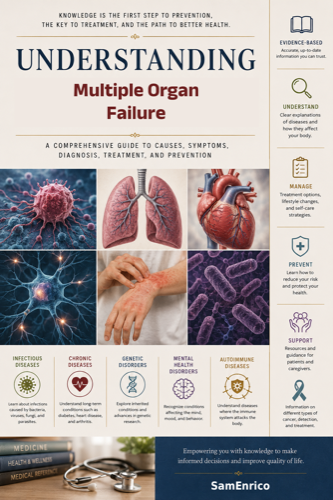
Understanding Multiple Organ Failure eBook
This disease publication, published by SamEnrico,
This disease publication, published by SamEnrico, covers Understanding Multiple Organ Failure
Formats
Free sample
Chapter 1: The Preventable Pandemic...--The call came in at 2:17 AM on a Tuesday. Maria Rodriguez was sleeping when her phone buzzed with a number she did not recognize. She almost ignored it. Her husband James, a healthy fifty-two-year-old accountant with no major medical problems, had gone in for routine laparoscopic gallbladder removal that morning. The surgeon had said he would be home by dinner.
Instead, Maria found herself driving through empty city streets to the intensive care unit, where a resident she had never met used words she could not understand: hypotension, tachypnea, vasopressors, intubation. By the time she arrived, James was sedated, paralyzed, and connected to a ventilator that breathed for him. His face was swollen. His skin was mottled. He did not look like her husband anymore."What happened?" Maria asked the intensivist, a woman in her forties with tired eyes and a calm voice that seemed practiced in delivering bad news."His body is overreacting to the surgery," the doctor said.
"We call it multiple organ failure. His lungs aren't working. His kidneys are shutting down. His blood pressure is unstable despite three different medications. We're doing everything we can."Maria did not know it then, but she had just become one of hundreds of thousands of family members each year who hear those three words for the first time in the worst possible moment.
Multiple organ failure. MOF. The syndrome that kills more Americans annually than breast cancer, prostate cancer, and car accidents combined. The syndrome that is the number one cause of prolonged ICU stay and the number two cause of death in intensive care units across the developed world, surpassed only by catastrophic brain injury. The syndrome that almost no one has heard of until it is happening to someone they love.This book exists because that silence is unacceptable.The Hidden Epidemic James Rodriguez's case is not unusual.
It is, in fact, archetypal. A previously healthy individual undergoes a routine procedure. The procedure goes well by all surgical metrics. There is no massive bleeding, no technical error, no obvious complication. And yet, within twenty-four to seventy-two hours, the patient is in the ICU on life support.
Family members are bewildered. The surgical team is defensive. The intensivists are frustrated. And everyone is searching for someone to blame.The truth is that multiple organ failure is rarely anyone's fault in the way that a retained surgical sponge or a wrong-site surgery is clearly someone's fault. It is a biological process, not a medical error.
But that does not mean it is inevitable. And that does not mean families should remain ignorant of its existence until they are standing in an ICU corridor at three in the morning, trying to remember what the doctor said about creatinine levels and Pa O2/Fi O2 ratios.Multiple organ failure is the progressive dysfunction of two or more organ systems following an insult such as infection, trauma, surgery, or pancreatitis. The lungs fail first in approximately eighty percent of cases, leading to acute respiratory distress syndrome (ARDS). The kidneys follow, with urine output dropping and toxins accumulating in the blood. The liver begins to struggle, bilirubin rises, and the patient turns yellow.
The blood stops clotting properly, or paradoxically clots too much, leading to bleeding or thrombosis. The heart weakens, becoming resistant to the medications meant to support it. And the brain becomes clouded with delirium, sepsis-associated encephalopathy, or coma.When three or more organs fail, mortality approaches fifty to sixty percent. When six organs fail, mortality exceeds ninety percent. James Rodriguez had four failing organs by the time Maria arrived at the ICU.But here is what Maria did not know and what most families are never told: multiple organ failure is not an all-or-nothing event that strikes like lightning.
It is a cascade, and cascades can be interrupted. It is a process, and processes can be modified. It is predictable in many cases, and prediction enables prevention. The patients who die of MOF are often not the sickest patients who arrive. They are the patients whose inflammatory response goes unchecked, whose iatrogenic triggers accumulate, whose care is reactive rather than proactive, and whose families do not know what questions to ask.This book is designed to change that for you, whether you are a clinician seeking to master the management of MOF, a medical student encountering the syndrome for the first time, or a family member who wants to understand what is happening to someone you love.A Brief History of a Syndrome No One Wanted to Name To understand where we are, we must understand where we came from.
The history of multiple organ failure is a history of intellectual humility—of doctors realizing that what they thought they knew was wrong, and that the human body is more complex and more perverse than their models allowed.Before 1973, critically ill patients who died after surgery or trauma were said to have died of "sepsis," "shock," or simply "organ failure." But in that year, a surgeon named Tilney published a paper that would change intensive care forever. He described eighteen patients who had undergone surgery for ruptured abdominal aortic aneurysms. Ten of them died. But what was striking was not the mortality rate—aneurysm surgery was dangerous then—but the pattern of death. Patients did not die of a single catastrophic event like a heart attack or a massive hemorrhage.
Instead, they died of what Tilney called "sequential system failure." First the lungs would fail, then the kidneys, then the liver, then the blood, then the gut. Each organ failed in a predictable sequence, and each failure seemed to accelerate the next.Two years later, in 1975, a surgeon named Baue gave the syndrome its modern name: multiple organ failure. Baue argued that this was not simply a collection of independent organ failures but a unified syndrome with a common underlying mechanism. He was right, but it would take another two decades to understand what that mechanism was.The 1980s and 1990s were a dark era for MOF. Mortality rates approached eighty percent.
The prevailing view was that MOF represented the inevitable end-stage of irreversible shock or uncontrolled sepsis. If a patient developed MOF, the thinking went, they were already dead; the ICU was just a place to die slowly and expensively. This nihilism was not born of cruelty but of evidence. Nothing worked. Antibiotics did not stop the cascade.
Vasopressors kept blood pressure up but did not improve survival. Dialysis cleaned the blood but did not fix the kidneys. The ventilator supported the lungs but could not heal them.The turning point came with the "two-hit" hypothesis, proposed by Moore and colleagues in the early 1990s. This model reframed MOF not as a single catastrophic event but as a two-stage process. The first hit—infection, trauma, surgery, pancreatitis—primes the immune system.
It does not cause organ failure directly. Instead, it sets the stage, like a cocked gun waiting for a trigger. The second hit—often a seemingly minor event like a small infection, a blood transfusion, a bedside procedure, or even a day of fasting—pulls the trigger. The primed immune system overreacts, unleashing a cytokine storm…
This is the end of the free sample. Get the eBook to keep going. Buy now
About this book
Details
- Author
- Scanlon Lakesha
- Publisher
- SamEnrico
- Language
- English
- Genre
- Non-Fiction, Informative, Educational
- Released
- 2026-06-02
- Pages (approx.)
- 150
- Available as
- eBook, Audiobook

Read better in the ZLOADR app
Your eBooks on your phone or tablet. Sign in with your SamEnrico account and start reading.
More by Scanlon Lakesha
 Orchard Harvest CalmScanlon Lakesha$11.99
 Vaccine Efficacy ExplainedScanlon Lakesha$11.99
 TM Personal Mantra Selection HandbookScanlon Lakesha$11.99
 The Gacy Clown Painting AnalysisScanlon Lakesha$11.99
 Grief Self Talk Healing GuideScanlon Lakesha$11.99
 The Feast of the Nobel: A Culinary Tribute to Black Genius in ScienceScanlon Lakesha$11.99
 Team DeveloperScanlon Lakesha$11.99
 Mitsubishi Supply GuideScanlon Lakesha$12.99
 AI Cost Allocation GuideScanlon Lakesha$12.99
 How to Start a Building Products Made of Plastic Business (Beginners Guide)Scanlon Lakesha$11.99
You may also like
 Hong Kong Handover 1997Dunn Johnnie$11.99
 Zumba For Postnatal Recovery CourseNeal Christian$11.99
 Zumba for BeginnersLadner Nikia$11.99
 YouTube Comment Mining GuideHumes Pandora$12.99
 Worry Box MeditationCarlin Rudy$11.99
 Workplace Stress MeditationNguyen Lynn$11.99
 Workplace Stress and Sleep RepairHawley Ivory$11.99
 Workplace Perfectionism CureDelaney Jeffry$11.99
 Workplace Injustice Anger GuideWallen Isabelle$11.99
 Work Addiction and Burnout LinkGreenwood Ester$11.99
 Women in Yoga and WellnessBeattie Galina$11.99
 Women in Stand Up ComedyChun Evangeline$11.99