
Non-FictionInformativeEducational
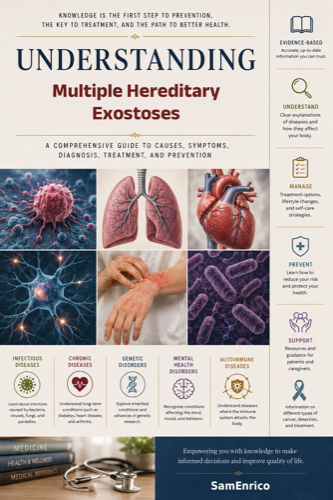
Understanding Multiple Hereditary Exostoses eBook
This disease publication, published by SamEnrico,
by Keener Shara
This disease publication, published by SamEnrico, covers Understanding Multiple Hereditary Exostoses
Formats
Free sample
Chapter 1: The Bone Garden...--–- Every family has a story. Some are written in letters, photographs, or whispered secrets passed down through generations. Others are written in the body itself—in the silent, unexpected growth of bone where bone should not grow. If you are reading this book, you or someone you love has likely received a diagnosis of Multiple Hereditary Exostoses, known throughout these pages as MHE. Perhaps you found a lump on your child's leg during bath time, a hard ridge that had not been there the week before.
Perhaps you are an adult who has lived with these bumps for decades, only recently learning that they have a name, a genetic cause, and a set of rules for surveillance. Perhaps you are a newly diagnosed teenager, angry and confused, wondering why your body is betraying you just as you are trying to figure out who you are. Perhaps you are a partner, a parent, a sibling, or a friend, trying to understand what your loved one is facing.Wherever you stand, welcome. This book is for you.This first chapter is not a dry recitation of medical facts, though those facts matter enormously and will come in due time. Instead, this chapter is an invitation to see MHE differently—not as a collection of random bone bumps, not as a cosmetic embarrassment to be hidden, and not as a curse you must endure alone.
MHE is a systemic skeletal disorder that affects the very architecture of the growing skeleton. Understanding that fundamental truth—that MHE is a whole-body condition with implications far beyond visible lumps—is the first and most important step toward taking control of your health. Let us begin that journey together.What This Chapter Will Teach You Before we dive into the science and the stories, let me tell you exactly what you will learn in the pages ahead. By the end of this chapter, you will understand the true definition of MHE—not the oversimplified "bone bumps" version, but the deeper reality of a condition that affects how your entire skeleton grows. You will learn the history of how this condition has been understood over the centuries, from ancient bones to modern genetics.
You will discover who gets MHE, how common it is, and why certain populations have higher rates than others. Most importantly, you will begin to shift your perspective from seeing MHE as a collection of isolated problems to understanding it as a systemic condition that requires systemic thinking. This paradigm shift is the foundation upon which everything else in this book is built.The Name That Hides More Than It Reveals Multiple Hereditary Exostoses. Say the words slowly. Multiple.
Hereditary. Exostoses. The term "exostosis" comes from the Greek roots "ex-" meaning "out of" and "osteon" meaning "bone." An exostosis is quite literally a bone growth that projects outward from the surface of a normal bone. It is a bony bump, a ridge, a protuberance that has no business being there. In the plural, exostoses are many such bumps.The name is accurate as far as it goes.
Patients with MHE develop multiple benign bone tumors called osteochondromas—a term you will learn in detail throughout this book—that typically appear during childhood and continue to grow until the skeleton matures around age 16 to 18. These osteochondromas can be felt as hard, immovable lumps beneath the skin. They can be seen as distortions of the normal contour of arms, legs, ribs, and shoulders. The condition is hereditary in approximately 90% of cases, passed from parent to child through a genetic mutation that affects how bones grow. The name tells you these three things: multiple tumors, inherited, on bones.But the name also hides far more than it reveals.The name "Multiple Hereditary Exostoses" suggests a condition of scattered lumps.
It suggests a cosmetic problem, perhaps an annoyance, perhaps something that makes finding well-fitting pants a challenge. It does not suggest a condition that can shorten a forearm by several centimeters, causing the wrist to tilt and the ulna to protrude like a second joint. It does not suggest a condition that can cause knock-knees so severe that walking becomes painful and unstable. It does not suggest a condition that can produce bone spurs inside the spinal canal, pressing on the spinal cord and threatening paralysis. It does not suggest a condition that carries a 5 to 10 percent lifetime risk of malignant transformation—of a benign bump becoming a life-threatening cancer called chondrosarcoma.The name hides all of this.
And so one of the first tasks of this book is to expand your understanding of what MHE truly is: not a collection of bumps, but a disorder of endochondral ossification, the fundamental process by which most of the bones in the human body grow long and straight.A Note on Terminology Throughout This Book Before we go further, let me clarify how medical terms will be used throughout these pages. You will encounter the words "exostosis" and "osteochondroma" frequently. These terms are often used interchangeably in both medical literature and patient discussions, but they have distinct meanings that are worth understanding. An exostosis is any bony outgrowth from the surface of a bone. An osteochondroma is a specific type of exostosis that has a cartilage cap covering its bony stalk.
In MHE, the lesions are osteochondromas—they have both bone and cartilage components. However, because the condition is named Multiple Hereditary Exostoses, the term "exostosis" appears in the name even though "osteochondroma" is technically more precise.Throughout this book, I will use both terms. When discussing the condition itself, I will refer to MHE or, occasionally, HME (Hereditary Multiple Exostoses), which is used interchangeably in the medical literature. When discussing the individual growths, I will typically use "osteochondroma" to emphasize the cartilage cap that is critical for understanding both growth and malignant transformation. When quoting older medical literature or using established diagnostic criteria, I may use "exostosis." The glossary at the end of this book provides clear definitions of all terms, and you will find that the distinctions become natural as you read further.The Hidden Architecture of Growing Bones To understand MHE, you must first understand how a normal bone grows.
This is not merely academic curiosity. The entire pathophysiology of MHE—everything from why the bumps form where they form, to why the bones sometimes grow crooked, to why the cancer risk exists at all—flows directly from a single point of failure in the bone growth process.Consider the long bones of your body: the femur in your thigh, the tibia in your lower leg, the humerus in your upper arm, the radius and ulna in your forearm. At birth, these bones are mostly cartilage. They are soft, flexible, and dramatically shorter than they will be in adulthood. Over the next fifteen to eighteen years, these bones must lengthen enormously—the femur alone grows from approximately 6 centimeters at birth to nearly 50 centimeters in an average adult male.
This lengthening does not happen uniformly throughout the bone. Instead, it happens at specific locations called growth plates, or physes, which are disks of cartilage located near the ends of each long bone.The growth…
This is the end of the free sample. Get the eBook to keep going. Buy now
About this book
Details
- Author
- Keener Shara
- Publisher
- SamEnrico
- Language
- English
- Genre
- Non-Fiction, Informative, Educational
- Released
- 2026-05-08
- Pages (approx.)
- 125
- Available as
- eBook, Audiobook

Read better in the ZLOADR app
Your eBooks on your phone or tablet. Sign in with your SamEnrico account and start reading.
More by Keener Shara
 Senior Friendship Esteem GuideKeener Shara$11.99
 Hot Spring SoakKeener Shara$11.99
 Autism Vaccine Link RefutedKeener Shara$11.99
 Loneliness EQ ApproachKeener Shara$11.99
 Gacy's Other Potential VictimsKeener Shara$11.99
 Silicon Prophets: The AI Oracle of DelphiKeener Shara$11.99
 How to Start a Building Sites Clearance Business (Beginners Guide)Keener Shara$11.99
 AI Financial Consolidation GuideKeener Shara$12.99
 Remote Conflict Exit Interview GuideKeener Shara$12.99
 Supervisor Front EndKeener Shara$11.99
You may also like
 Hong Kong Handover 1997Dunn Johnnie$11.99
 Zumba For Postnatal Recovery CourseNeal Christian$11.99
 Zumba for BeginnersLadner Nikia$11.99
 YouTube Comment Mining GuideHumes Pandora$12.99
 Worry Box MeditationCarlin Rudy$11.99
 Workplace Stress MeditationNguyen Lynn$11.99
 Workplace Stress and Sleep RepairHawley Ivory$11.99
 Workplace Perfectionism CureDelaney Jeffry$11.99
 Workplace Injustice Anger GuideWallen Isabelle$11.99
 Work Addiction and Burnout LinkGreenwood Ester$11.99
 Women in Yoga and WellnessBeattie Galina$11.99
 Women in Stand Up ComedyChun Evangeline$11.99