
Non-FictionInformativeEducational
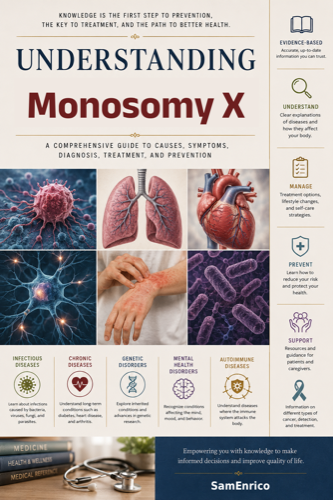
Understanding Monosomy X eBook
This disease publication, published by SamEnrico,
This disease publication, published by SamEnrico, covers Understanding Monosomy X
Formats
Free sample
Chapter 1: The Missing Blueprint...--Every human life begins with a blueprint. Forty-six chromosomes, arranged in twenty-three pairs, carry the instructions for every system, every organ, every silent metabolic exchange that keeps a body alive. For most girls and women, the twenty-third pair consists of two X chromosomes—a matched set, a backup system, a redundancy that evolution embedded into the female genome. But for approximately one in every two thousand to twenty-five hundred live female births, that blueprint arrives incomplete. One X chromosome is missing entirely, or partially, or present in only some cells of the body.
This is Monosomy X.The name sounds clinical, abstract, like something from a textbook rather than a lived reality. But for the families who receive this diagnosis—whether through a prenatal screening, a newborn’s unexpected physical features, or a teenager’s failure to begin puberty—the abstraction collapses into something intensely personal. Questions flood in: What does this mean for my child’s heart? Will she grow? Will she be able to have children of her own?
Is she going to be okay? These questions have answers, though not always simple ones. This chapter provides the genetic foundation upon which all those answers rest.What Is Monosomy X, Exactly?At its simplest level, Monosomy X is a condition in which a female has only one functioning X chromosome instead of the usual two. The term “monosomy” comes from the Greek monos meaning “alone” and soma meaning “body”—literally, one body (or one chromosome) where two should exist. This stands in contrast to trisomies, such as Down syndrome (trisomy 21), where an extra chromosome creates a triplet rather than a pair.The human genome is remarkably tolerant of variation in some chromosomes and mercilessly intolerant in others.
Monosomy of any autosome—the first twenty-two pairs—is almost always lethal early in development, resulting in miscarriage long before a pregnancy is even detected. The X chromosome is unique. Because one X is normally inactivated in every cell of a typical female (a process called X-inactivation, discussed later in this chapter), the loss of a second X is survivable. But survivable does not mean without consequence. The genes that escape X-inactivation—those that require two active copies for normal function—are precisely the genes that cause the clinical features of Monosomy X when only one copy is present.It is crucial to understand that Monosomy X is not a disease in the traditional sense.
It carries no pathogen, no infectious agent, no toxin that can be avoided or cured. It is a variation in the fundamental architecture of human development. That distinction matters because language shapes perception. A “disease” implies something acquired, something that might be fought and defeated. A chromosomal variation implies something built into the fabric of a person from the very first cell division—not a flaw to be eradicated but a difference to be understood and managed.Complete versus Mosaic: Two Families Within One Condition One of the most important distinctions in Monosomy X is whether the condition is complete or mosaic.
This single distinction predicts more about clinical outcomes than almost any other factor.Complete Monosomy X (45,X) means that every cell in the body examined—typically through a blood karyotype—shows only one X chromosome. The karyotype is written as 45,X, indicating forty-five total chromosomes with a single X. These individuals tend to have the most classic features of the condition: short stature, webbed neck, low hairline, broad chest with widely spaced nipples, and a higher incidence of congenital heart defects and kidney anomalies. They almost always require growth hormone therapy to reach average height and estrogen replacement to undergo puberty. Spontaneous pregnancy is extremely rare, occurring in fewer than five percent of classic 45,X individuals.Mosaic Monosomy X means that some cells have the typical 46,XX complement (or sometimes 47,XXX) while other cells have 45,X.
The karyotype might read 45,X/46,XX or 45,X/47,XXX. The proportion of affected cells varies widely—from as little as five percent to as much as ninety-five percent—and that proportion can differ dramatically between tissues. A person might have ninety percent 45,X cells in their blood but only twenty percent in their ovaries, or the reverse. This tissue-specific variation explains why two people with the same blood karyotype can have wildly different clinical presentations.The term “mosaic” comes from the art of creating images by assembling small pieces of colored glass or stone. In Monosomy X, the body is a mosaic of genetically different cell populations.
Some systems may function normally if they contain mostly 46,XX cells; others may show classic features if 45,X cells predominate. This unpredictability is both a challenge and, often, a source of relief. Mosaic individuals may have no physical features at all. They may have normal height, a structurally normal heart, and even spontaneous puberty and fertility. Many mosaic women live into their thirties or forties without ever knowing they have Monosomy X, diagnosed only when they seek help for infertility or early menopause.A less common but important variant is partial Monosomy X, where one X chromosome is present but missing a segment.
The clinical effects depend on which genes are deleted. Deletions of the short arm (Xp) tend to cause short stature and certain physical features, while deletions of the long arm (Xq) are more strongly associated with ovarian failure. Some deletions are so small that they produce no detectable features at all, discovered incidentally during genetic testing for other reasons.How Does Monosomy X Occur? The Error in Division The vast majority of Monosomy X cases are not inherited. They occur as random errors during the formation of reproductive cells—eggs in the mother, sperm in the father—or during the earliest cell divisions after fertilization.
This is perhaps the most important reassurance a newly diagnosed family can receive: you did not cause this. Nothing you ate, drank, breathed, or experienced during pregnancy created this condition. No vaccine, no medication, no environmental exposure. It is a random accident of cellular mechanics.Understanding that randomness requires a brief journey into the microscopic world of cell division. Human cells normally divide in two ways: mitosis, which produces identical daughter cells for growth and repair, and meiosis, which produces eggs and sperm with half the usual number of chromosomes.
During both processes, chromosomes must align, separate, and move to opposite poles of the cell. Errors in this separation are called nondisjunction—literally, “failure to come apart.”In the case of Monosomy X, nondisjunction most commonly occurs during paternal meiosis, meaning the error happens in the father’s sperm production. Studies using DNA markers that distinguish the maternal from paternal X chromosome have consistently found that approximately seventy to eighty percent of classic 45,X cases result from loss of the paternal X. The father’s sperm was missing an X chromosome entirely, or the X it carried was structurally abnormal and subsequently lost. This finding offers a strange sort of comfort: the condition arises from a single, random mistake in one sperm cell among millions, with no bearing on the father’s overall health or the couple’s future reproductive chances.Maternal errors account for the remaining twenty to thirty percent of classic cases.…
This is the end of the free sample. Get the eBook to keep going. Buy now
About this book
Details
- Author
- Jaramillo Desire
- Publisher
- SamEnrico
- Language
- English
- Genre
- Non-Fiction, Informative, Educational
- Released
- 2026-06-02
- Pages (approx.)
- 158
- Available as
- eBook, Audiobook

Read better in the ZLOADR app
Your eBooks on your phone or tablet. Sign in with your SamEnrico account and start reading.
More by Jaramillo Desire
 Low Income Wellness AccessJaramillo Desire$11.99
 High Altitude Breath AwarenessJaramillo Desire$11.99
 Nigeria Independence Coups GuideJaramillo Desire$11.99
 The Self Doubt Perfectionism ConnectionJaramillo Desire$11.99
 The Favelas' Shadow War: Rio's Bloody Rise of the Drug Cartels (1980s-1990s)Jaramillo Desire$11.99
 Zara Fast Fashion LogisticsJaramillo Desire$12.99
 Technical Readability ScoringJaramillo Desire$12.99
 How to Become a Laborer - Concrete PlantJaramillo Desire$11.99
 History TutorJaramillo Desire$11.99
You may also like
 Hong Kong Handover 1997Dunn Johnnie$11.99
 Zumba For Postnatal Recovery CourseNeal Christian$11.99
 Zumba for BeginnersLadner Nikia$11.99
 YouTube Comment Mining GuideHumes Pandora$12.99
 Worry Box MeditationCarlin Rudy$11.99
 Workplace Stress MeditationNguyen Lynn$11.99
 Workplace Stress and Sleep RepairHawley Ivory$11.99
 Workplace Perfectionism CureDelaney Jeffry$11.99
 Workplace Injustice Anger GuideWallen Isabelle$11.99
 Work Addiction and Burnout LinkGreenwood Ester$11.99
 Women in Yoga and WellnessBeattie Galina$11.99
 Women in Stand Up ComedyChun Evangeline$11.99