
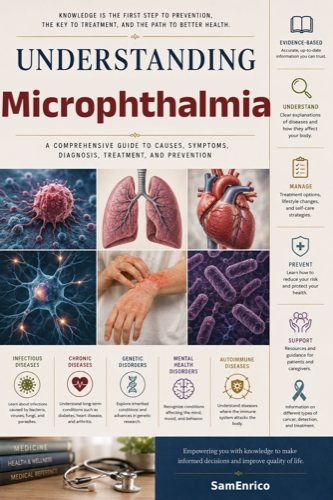
Non-FictionInformativeEducational
Understanding Microphthalmia eBook
This disease publication, published by SamEnrico,
This disease publication, published by SamEnrico, covers Understanding Microphthalmia
Formats
Free sample
Chapter 1: The Small Question...--– It arrives without warning, often in a room that smells of antiseptic and hope. One moment you are staring at the ultrasound screen, counting ten fingers and ten toes, celebrating the mundane miracle of a heartbeat. The next, the technician's hand pauses on the transducer. Her expression shifts from professional neutrality to something else—concern, or perhaps the careful blankness of someone about to deliver news she wishes she did not have to share. "Has anyone talked to you about the baby's eyes?" she asks.
And just like that, your world divides into before and after.This is how most parents first encounter the word microphthalmia. Not in a textbook. Not during a polite genetic counseling session. But in the vulnerable, half-lit space of a medical office, clutching a printed report filled with terms they cannot pronounce. For others, the discovery comes later—in the delivery room when a newborn's eyes do not open as expected, or during a routine pediatric examination when a doctor shines a light and notices something asymmetrical.
However it arrives, the moment carries the same weight: the sudden awareness that your child's body does not conform to the template you had taken for granted.Understanding Microphthalmia begins here, not with a cold clinical definition but with the recognition that behind every medical term is a family whose life has just been rerouted. This chapter exists to give you the solid ground beneath that terrifying uncertainty. It will not overwhelm you with every possible complication or surgical option—those come later, in their proper place. Instead, this chapter does something more foundational: it tells you exactly what microphthalmia is, what it is not, and why the difference between those two things will shape every decision you make from this moment forward.The Name Itself Microphthalmia comes from Greek roots: mikros (small) and ophthalmos (eye). In the simplest possible terms, the condition means one or both eyes are abnormally small.
But that definition, while technically accurate, is like saying a symphony is just a collection of notes. It misses everything that matters.The medical definition is more precise: microphthalmia is a congenital malformation in which the eye's axial length (the measurement from front to back) is at least two standard deviations below the mean for the patient's age. For a full-term newborn, the average axial length is approximately 16 to 17 millimeters. A child with microphthalmia might have an axial length of 10 to 14 millimeters, though severe cases can be even smaller. These numbers matter to ophthalmologists because they guide diagnosis and prognosis, but they matter to parents only insofar as they confirm that what they are seeing—an eye that looks different, that sits differently in the socket, that may or may not function—has a name and a reason.The critical fact to understand from the very first page of this book is that microphthalmia exists on a spectrum.
At one end are children whose eyes are modestly small but otherwise completely normal. At the other end are children whose eyes are so underdeveloped that they contain almost no functional tissue. And between these poles lies an enormous range of variation. Your child's experience of microphthalmia will be unique. No two cases are identical.
This variation is not a failure of medical science to classify things neatly; it is simply the nature of how development works.The Crucial Distinction: True Versus Relative Before we go any further, we must resolve a point of confusion that has frustrated countless parents and even some clinicians. In medical literature and online forums, you will encounter two terms that sound similar but mean very different things: true microphthalmia and relative microphthalmia. Understanding this distinction is not an academic exercise. It determines everything from what complications you need to watch for to your child's long-term visual prognosis.Relative microphthalmia describes an eye that is smaller than average but structurally normal. Every part of the eye—the cornea, lens, retina, optic nerve, and so on—is present and correctly formed.
The eye is simply a smaller version of a typical eye. Children with relative microphthalmia usually have vision that ranges from normal to mildly impaired. They may need glasses, sometimes with very strong prescriptions, but they do not face the cascade of secondary complications that characterize the other form of the condition. Importantly, relative microphthalmia is not associated with colobomas, cataracts, glaucoma, or orbital cysts. If your child has been diagnosed with relative microphthalmia and you later read about these complications, you should understand that those chapters likely do not apply to your situation.True microphthalmia is different in kind, not just degree.
In true microphthalmia, the small size of the eye is accompanied by internal structural abnormalities. The eye did not just stop growing; it developed incorrectly from the very beginning. These abnormalities might include colobomas (gaps in the ocular tissue, which we will explore in depth in Chapter 6), lens malformations leading to early cataracts, angle anomalies that predispose to glaucoma, or the formation of orbital cysts contiguous with the eye. Children with true microphthalmia face a much wider range of potential complications, and their visual outcomes vary dramatically based on which structures are affected and how severely.Feature Relative Microphthalmia True Microphthalmia Eye size Small Small Internal eye structure Normal Abnormal (colobomas, cysts, etc.)Associated complications None Colobomas, glaucoma, cataracts, orbital cysts Typical vision potential Near-normal to mild impairment Moderate to profound impairment (varies widely)Need for monitoring Routine pediatric eye exams Lifelong multidisciplinary care Why does this distinction matter so much? Because a parent who has been told their child has "microphthalmia" may search online and find terrifying information about glaucoma surgeries or prosthetic eyes, not realizing that those pages apply only to the true form of the condition.
Conversely, a parent whose child has true microphthalmia might mistakenly believe, after reading a vague definition, that the condition is "just a small eye" and miss critical early interventions. This book will maintain this distinction throughout. When subsequent chapters discuss complications, monitoring strategies, or surgical interventions, they will specify whether they apply to true microphthalmia, relative microphthalmia, or both. When in doubt, refer back to the table above and to your child's specific diagnostic report.What Microphthalmia Is Not Equally important as defining what microphthalmia is, is clarifying what it is not. Three related conditions are frequently confused with microphthalmia, and distinguishing among them is essential for accurate diagnosis and appropriate treatment.Anophthalmia is the complete absence of the eye.
In its pure form, no ocular tissue is present at all. However, what is often called anophthalmia in clinical practice is actually extreme microphthalmia—so small that no visible eye can be detected externally, but microscopic examination reveals remnants of ocular tissue. True anophthalmia is exceptionally rare. The distinction matters because residual ocular tissue in extreme microphthalmia may still produce some visual function, however minimal, and may carry different surgical considerations. If your child has been diagnosed with anophthalmia, it is worth asking your ophthalmologist whether any microscopic ocular tissue was detected on imaging or pathology.Nanophthalmos is a condition in which the eye is small but otherwise completely normal, similar to relative microphthalmia but typically with even more…
This is the end of the free sample. Get the eBook to keep going. Buy now
About this book
Details
- Author
- Camarillo Coleen
- Publisher
- SamEnrico
- Language
- English
- Genre
- Non-Fiction, Informative, Educational
- Released
- 2026-05-06
- Pages (approx.)
- 149
- Available as
- eBook, Audiobook

Read better in the ZLOADR app
Your eBooks on your phone or tablet. Sign in with your SamEnrico account and start reading.
More by Camarillo Coleen
 Missed Promotion Anger GuideCamarillo Coleen$11.99
 Health Worry HypnosisCamarillo Coleen$11.99
 Mental Health at Work EsteemCamarillo Coleen$11.99
 Kids Sleep Temperature GuideCamarillo Coleen$11.99
 The Genshin Impact Gacha AddictionCamarillo Coleen$11.99
 The Galleons of Gold: Spain's Maritime EmpireCamarillo Coleen$11.99
 Accounts AdministratorCamarillo Coleen$11.99
 How to Start a Centrifugal Pump Business (Beginners Guide)Camarillo Coleen$11.99
 Emotional Copy AI GuideCamarillo Coleen$12.99
 Sustainable Data Center GuideCamarillo Coleen$12.99
You may also like
 Hong Kong Handover 1997Dunn Johnnie$11.99
 Zumba For Postnatal Recovery CourseNeal Christian$11.99
 Zumba for BeginnersLadner Nikia$11.99
 YouTube Comment Mining GuideHumes Pandora$12.99
 Worry Box MeditationCarlin Rudy$11.99
 Workplace Stress MeditationNguyen Lynn$11.99
 Workplace Stress and Sleep RepairHawley Ivory$11.99
 Workplace Perfectionism CureDelaney Jeffry$11.99
 Workplace Injustice Anger GuideWallen Isabelle$11.99
 Work Addiction and Burnout LinkGreenwood Ester$11.99
 Women in Yoga and WellnessBeattie Galina$11.99
 Women in Stand Up ComedyChun Evangeline$11.99