
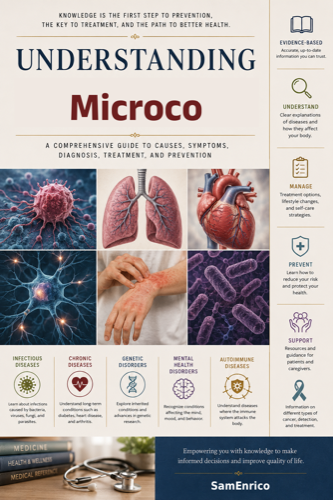
Non-FictionInformativeEducational
Understanding Microco eBook
This disease publication, published by SamEnrico,
by Sales Yu
This disease publication, published by SamEnrico, covers Understanding Microco
Formats
Free sample
Chapter 1: Beyond the Label...--–- Imagine waking up one morning feeling as though your blood has been replaced with lead. You slept eight hours, maybe nine, but your body screams with the exhaustion of having run a marathon. Your fingers tingle with a strange, cool sensation, as if they belong to someone else. You try to stand, and your heart races while your head swims. A doctor later tells you all your tests are normal.
Another suggests you might be depressed. A third, more kindly, admits, “I don’t know what’s wrong with you.”This is not a rare nightmare. For hundreds of thousands of people worldwide, this is a Tuesday.Welcome to the reality of Microco. It is a name you have likely never heard, yet it may be silently shaping your life or the life of someone you love. For decades, this condition has lurked in the shadows of medicine, misdiagnosed as chronic fatigue syndrome, dismissed as fibromyalgia, or outright ignored as a psychosomatic fancy.
But we now stand at a turning point. New research, patient advocacy, and clinical observation are pulling Microco into the light. This chapter is not merely an introduction; it is a declaration. It is the first step in reclaiming your story from a medical system that has often failed you.Before we can fight an enemy, we must name it. Before we can treat a condition, we must define it.
And before we can heal, we must be believed. This chapter provides the foundation for everything that follows: a clear, operational, and compassionate definition of Microco. We will explore what it is, what it is not, and why the distinction matters more than you can imagine.The Birth of a Name: Why “Microco”?Every disease carries a story in its name. “Microco” is a portmanteau derived from two root concepts: microvascular and cognition. The term was first proposed by patient advocacy groups in the early 2010s to capture the dual nature of the illness—a disorder affecting the smallest blood vessels (microvasculature) while simultaneously disrupting higher brain functions.
Prior to this, the condition was referred to by cumbersome clinical descriptors such as “systemic microvascular inflammation syndrome” or “idiopathic endothelial dysfunction with cognitive sequelae.” These names, while accurate, were impractical for everyday use.The choice of “Microco” is intentional and empowering. Unlike vague labels like “medically unexplained symptoms,” it points toward a biological mechanism. It tells the patient and the physician: this is real, this is physical, and this is beginning to be understood. Throughout this book, we will use “Microco” to refer to the entire syndrome, recognizing that it likely represents a final common pathway of several different underlying triggers—much like “anemia” describes low red blood cells regardless of whether the cause is iron deficiency, bone marrow disease, or blood loss.Defining Microco: The Core Diagnostic Framework In 2019, the first International Consensus Conference on Microco (ICCM) convened in Oslo, Norway. Bringing together rheumatologists, neurologists, immunologists, and patient representatives, the ICCM produced a working definition that has since guided research and specialty clinical care.
According to the ICCM, Microco is a chronic, acquired, multi-system disorder characterized by microvascular dysfunction, neurocognitive impairment, and a specific pattern of post-exertional malaise, in the absence of alternative medical or psychiatric explanations.Let us unpack that dense sentence.Chronic: Symptoms persist for at least six months. This distinguishes Microco from acute viral syndromes or temporary stress reactions.Acquired: Patients are not born with Microco. It develops, often after a trigger infection, trauma, or toxic exposure.Multi-system: It is not just a nerve disorder or a muscle disorder or a brain disorder. It touches the cardiovascular system, the nervous system, the immune system, and the gastrointestinal tract.Microvascular dysfunction: The primary biological lesion involves the smallest blood vessels—capillaries and arterioles—which fail to regulate blood flow properly.Neurocognitive impairment: Patients experience measurable difficulties with memory, attention, processing speed, and executive function (planning, organizing, inhibiting).Post-exertional malaise (PEM): This is the hallmark feature. Unlike ordinary fatigue after exercise, PEM is a worsening of all symptoms—often delayed by 12 to 48 hours—following even minor physical, mental, or emotional exertion.
A patient might feel fine immediately after a short walk, only to collapse into a flu-like state the next day.Exclusion of alternatives: This is not a diagnosis of exclusion in the dismissive sense, but a positive diagnosis that requires ruling out other specific conditions (see the differential diagnosis section below).Research Criteria vs. Clinical Reality A critical distinction, often lost in online patient forums, is the difference between research criteria and clinical diagnosis. The ICCM criteria were designed for research trials: they prioritize specificity (ensuring that enrolled patients truly have Microco) even at the cost of sensitivity (excluding some genuine patients whose symptoms are atypical). In a research study, this prevents contamination of the sample. In a doctor’s office, however, rigid application of these criteria would leave many suffering individuals without a label or treatment.Therefore, the research criteria require: (a) at least 3 of 5 major symptoms (fatigue, cognitive fog, microvascular pain, sleep disturbance, orthostatic intolerance), (b) duration of at least 6 months, (c) objective evidence of microvascular dysfunction on at least one test (capillaroscopy, laser Doppler, or endothelial biomarker), and (d) exclusion of all look-alike diseases.In clinical practice, a knowledgeable physician may diagnose Microco even when objective testing is equivocal, provided the symptom pattern and history are highly characteristic.
This is not sloppy medicine; it is the reality of a condition whose biomarkers remain imperfect. As we will see in Chapter 6, the diagnostic journey is often long and frustrating precisely because the research tools have not yet fully translated to the clinic.The Symptom Constellation: Listening to the Body No two patients experience Microco identically, yet certain symptoms appear so consistently that they form the backbone of clinical suspicion. We will devote all of Chapter 5 to early recognition and tracking; here we provide a concise overview to anchor the definition.1. Debilitating Fatigue Unlike the tiredness of a sleepless night, Microco fatigue is a cellular exhaustion. Patients describe it as “a battery that won’t hold a charge,” “walking through wet cement,” or “being unplugged from the wall.” This fatigue does not improve with rest alone; it requires active management of energy envelopes (pacing).2.
Post-Exertional Malaise (PEM)As noted above, PEM is the physiological signature of Microco. It is not a psychological aversion to activity. Functional neuroimaging studies have shown that patients with PEM exhibit abnormal activation patterns in the prefrontal cortex and basal ganglia after exercise, along with elevated inflammatory cytokines (IL-6, IL-1β) that persist for 48 hours. The key feature is delay: the crash comes hours or a day later, misleading patients into thinking they are fine to push further.3. Cognitive Dysfunction (“Brain Fog”)Patients report word-finding difficulties, short-term memory lapses, an inability to multitask, and a feeling of a “cloud” over their thoughts.
Objective testing reveals slowed processing speed and impaired working memory, while basic intelligence remains intact. This is not dementia; it is a reversible (though often persistent) functional impairment linked to cerebral microvascular hypoperfusion.4. Microvascular Pain A distinctive, often overlooked symptom. Unlike the deep ache of fibromyalgia or the sharp, electric shock of neuropathy…
This is the end of the free sample. Get the eBook to keep going. Buy now
About this book
Details
- Author
- Sales Yu
- Publisher
- SamEnrico
- Language
- English
- Genre
- Non-Fiction, Informative, Educational
- Released
- 2026-06-02
- Pages (approx.)
- 152
- Available as
- eBook, Audiobook

Read better in the ZLOADR app
Your eBooks on your phone or tablet. Sign in with your SamEnrico account and start reading.
More by Sales Yu
 Teen Self Esteem Handbook for SchoolsSales Yu$11.99
 MBSR for Empty Nest HandbookSales Yu$11.99
 Child Sleepwalking GuideSales Yu$11.99
 The YouTube Binge Watcher GuideSales Yu$11.99
 Freelance Self Worth GuideSales Yu$11.99
 The Crown’s Digital Throne: How King Charles III Mastered Social MediaSales Yu$11.99
 Marketing Plan Drafting AISales Yu$12.99
 Climate Resilience Investment GuideSales Yu$12.99
 How to Start a Ceramic Ware for Domestic Use Business (Beginners Guide)Sales Yu$11.99
You may also like
 Hong Kong Handover 1997Dunn Johnnie$11.99
 Zumba For Postnatal Recovery CourseNeal Christian$11.99
 Zumba for BeginnersLadner Nikia$11.99
 YouTube Comment Mining GuideHumes Pandora$12.99
 Worry Box MeditationCarlin Rudy$11.99
 Workplace Stress MeditationNguyen Lynn$11.99
 Workplace Stress and Sleep RepairHawley Ivory$11.99
 Workplace Perfectionism CureDelaney Jeffry$11.99
 Workplace Injustice Anger GuideWallen Isabelle$11.99
 Work Addiction and Burnout LinkGreenwood Ester$11.99
 Women in Yoga and WellnessBeattie Galina$11.99
 Women in Stand Up ComedyChun Evangeline$11.99