
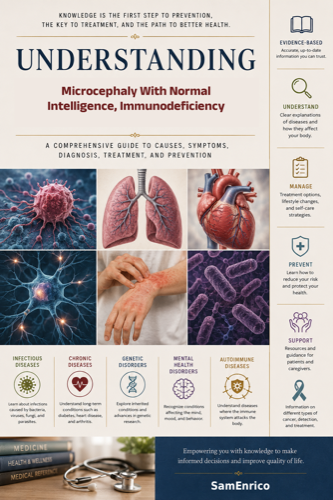
Non-FictionInformativeEducational
Understanding Microcephaly With Normal Intelligence, Immunodeficiency eBook
This disease publication, published by SamEnrico,
by Hooks Ethan
This disease publication, published by SamEnrico, covers Understanding Microcephaly With Normal Intelligence, Immunodeficiency
Formats
Free sample
Chapter 1: Beyond the Measurement...--–- The first lie I was told about my son came from a tape measure. Not from malice, not from ignorance, but from a simple clinical instrument that had been used for over a century to predict futures. The neurologist wrapped the flexible plastic strip around my three-month-old’s head, glanced at the percentile chart, and sighed. “First percentile,” she said, writing it down as if delivering a verdict. “I’m so sorry.” She was apologizing for a brain she assumed was broken.
She was apologizing for a future she thought would be filled with disability, dependency, and despair. What she did not know—what the medical literature at the time could not tell her—was that my son’s head was small not because his brain was damaged, but because his immune system was different. And that difference, while terrifying in its own right, would leave his mind entirely intact.This book exists because that neurologist was not an anomaly. She was the norm. For decades, the word “microcephaly” has been spoken in hushed tones, accompanied by grim prognoses and referrals to disability services.
The medical establishment has treated small head circumference as a proxy for small intellectual potential. And for many children with microcephaly—those whose small heads result from congenital infections like CMV or Zika, or from genetic syndromes that disrupt neuronal migration—that grim prognosis is accurate. But there is a hidden population within the microcephaly spectrum, a group so rarely discussed that even specialists sometimes overlook them: children with microcephaly and normal intelligence. More specifically, this book focuses on those whose microcephaly travels alongside immunodeficiency, a rare genetic syndrome linked to mutations in the NBN gene.If you are reading this, you are likely one of three people. You might be a parent who just received the diagnosis, searching desperately for any story that does not end in tragedy.
You might be a clinician who has encountered a puzzling patient—small head, recurrent infections, but surprisingly bright eyes—and wants to know what you are missing. Or you might be an adult living with this condition, having grown up being told you were “different” without ever understanding why. To all of you: welcome. This chapter will dismantle the most dangerous misconception about microcephaly, redefine what a small head actually means, and give you the tools to advocate for a child whose cognitive potential is not reflected in a percentile chart.The Tyranny of the Percentile The occipitofrontal circumference—the formal name for head circumference measurement—has been a staple of pediatric care since the early twentieth century. It is quick, non-invasive, and remarkably consistent across populations when adjusted for age and sex.
A head circumference below the 2nd or 3rd percentile (different guidelines use different cutoffs) earns the diagnosis of microcephaly. But here is what the percentile chart does not tell you: nothing about the quality of the brain inside. It measures volume, not function. It counts neurons, not connections. It records millimeters, not memories.The link between head size and intelligence is a statistical correlation, not a biological law.
In large populations, people with larger heads do have slightly higher average IQs—by about one to two points per additional centimeter of head circumference. But this correlation is weak, easily overwhelmed by genetics, environment, education, and sheer luck. For every person with a large head and average intelligence, there is someone with a small head doing advanced calculus. The famous physicist Richard Feynman had a head circumference in the 10th percentile—technically not microcephalic but certainly small—and his brain function was, to put it mildly, extraordinary.The problem is that the medical system has conflated correlation with causation. When a child presents with microcephaly, the default assumption is that something went wrong during brain development.
And often, that assumption is correct. But in the specific syndrome this book addresses—microcephaly with normal intelligence and immunodeficiency—the “something went wrong” occurred not in the neurons but in the lymphocytes. The brain developed on schedule, with proper cortical layering, neuronal migration, and synaptogenesis. It just ended up slightly smaller than average. That is not a tragedy.
That is a variation.Two Kinds of Microcephaly: A Critical Distinction To understand why this syndrome is different, you must first understand that “microcephaly” is a description, not a diagnosis. It is like saying “fever” without identifying the infection. There are dozens of causes of microcephaly, and they fall into two broad categories: primary (or congenital) microcephaly and secondary (or postnatal) microcephaly.Primary microcephaly is present at birth. It occurs because something disrupted brain development during pregnancy, typically in the first or second trimester when neurons are being born and migrating to their final positions. The causes include genetic syndromes (like MCPH1, ASPM, or the NBN-related syndrome we will explore), congenital infections (CMV, Zika, toxoplasmosis), maternal exposures (alcohol, certain medications), and chromosomal abnormalities (Down syndrome, Turner syndrome).
In most cases of primary microcephaly, the disruption to brain development is widespread, affecting cortical architecture, neuronal density, and synaptic organization. The result is not just a small brain but a disorganized brain, and with that disorganization comes intellectual disability, motor impairments, seizures, and often a shortened lifespan.Secondary microcephaly is different. The head starts out normal size at birth but then fails to grow appropriately in the first years of life. This indicates a postnatal insult—a brain injury, a metabolic disorder, a neurodegenerative condition, or severe malnutrition. The prognosis for secondary microcephaly depends entirely on the underlying cause.The syndrome we are discussing falls into the primary microcephaly category but with a crucial twist: the brain is small but organized.
Neuroimaging studies (MRI and CT scans) of affected children typically show a structurally normal brain—normal gyral pattern, normal corpus callosum, normal ventricles, normal cerebellar architecture. The only abnormality is overall reduced brain volume, sometimes with a disproportionately small cerebellum. This is not the chaotic, malformed brain seen in many other microcephaly syndromes. This is a brain that developed correctly but stopped growing slightly early, or grew more slowly, or simply ended up smaller for reasons that did not compromise its fundamental wiring.I want you to hold onto that image: a small but perfectly organized brain. That is the neurological reality for the children in this book.
Their heads may be small, but their minds are intact.The Emotional Weight of a Diagnosis Let me pause here to address the parent who just heard the word “microcephaly” from a doctor and felt the floor fall away. I know what you are feeling because I have felt it myself. The word sounds clinical and catastrophic at the same time. You immediately google it—although I advise you to stop googling and read this book instead—and you find stories of children who will never walk, never talk, never recognize their parents’ faces. You find forums filled with despair.
You find statistics about intellectual disability, seizures, and early death.Here is what you will not find in those first few pages of search results: stories of children with microcephaly who graduate high school, attend college, fall in love, and build lives of meaning and joy. Those stories…
This is the end of the free sample. Get the eBook to keep going. Buy now
About this book
Details
- Author
- Hooks Ethan
- Publisher
- SamEnrico
- Language
- English
- Genre
- Non-Fiction, Informative, Educational
- Released
- 2026-05-11
- Pages (approx.)
- 155
- Available as
- eBook, Audiobook

Read better in the ZLOADR app
Your eBooks on your phone or tablet. Sign in with your SamEnrico account and start reading.
More by Hooks Ethan
 Proxemics Personal Space GuideHooks Ethan$11.99
 Mindful Retirement MBSR GuideHooks Ethan$11.99
 Nutrition and Teen Self EsteemHooks Ethan$11.99
 Handling Micromanagement GracefullyHooks Ethan$11.99
 Twitter Compulsive Checking WorkbookHooks Ethan$11.99
 Whispers of the Crystal Forest: The Last Glowworms of WaitomoHooks Ethan$11.99
 How to Start a Building Boards Made of Paper Business (Beginners Guide)Hooks Ethan$11.99
 Influencer Brief GenerationHooks Ethan$12.99
 Perfect Your ProsodyHooks Ethan$11.99
You may also like
 Hong Kong Handover 1997Dunn Johnnie$11.99
 Zumba For Postnatal Recovery CourseNeal Christian$11.99
 Zumba for BeginnersLadner Nikia$11.99
 YouTube Comment Mining GuideHumes Pandora$12.99
 Worry Box MeditationCarlin Rudy$11.99
 Workplace Stress MeditationNguyen Lynn$11.99
 Workplace Stress and Sleep RepairHawley Ivory$11.99
 Workplace Perfectionism CureDelaney Jeffry$11.99
 Workplace Injustice Anger GuideWallen Isabelle$11.99
 Work Addiction and Burnout LinkGreenwood Ester$11.99
 Women in Yoga and WellnessBeattie Galina$11.99
 Women in Stand Up ComedyChun Evangeline$11.99