
Non-FictionInformativeEducational
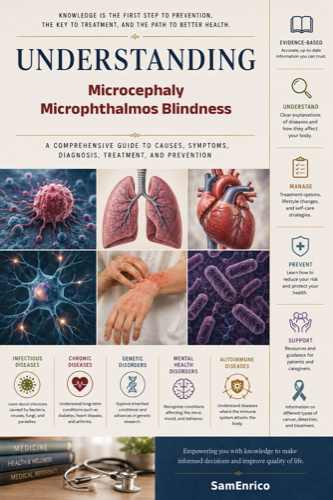
Understanding Microcephaly Microphthalmos Blindness eBook
This disease publication, published by SamEnrico,
This disease publication, published by SamEnrico, covers Understanding Microcephaly Microphthalmos Blindness
Formats
Free sample
Chapter 1: The Silent Hourglass...--The ultrasound technician’s face tightened before she spoke. It was a micro-expression that took less than half a second, but Jessica, twenty-three years old and twenty weeks pregnant with her first child, caught it. The technician had been chatty moments ago—pointing out the flutter of fingers, the curve of the spine, the steady thrum of the heart on the Doppler. Then she paused over the head. Her cursor traced a perimeter, clicked, measured, and went silent.
Jessica looked at her husband Marcus, who was gripping the plastic armrest of the chair beside her. Neither of them knew yet that they had just entered the territory of the rarest of rare diagnoses—a constellation of findings with a name so long it felt like a sentence: microcephaly, microphthalmos, and the looming question of blindness.This chapter is the doorway. It does not begin with medical jargon or statistics. It begins where every journey into rare disease begins: with a moment of stillness, a measurement that falls off a curve, and a creeping awareness that something has gone terribly wrong in the earliest days of life—long before anyone knew to worry. Understanding microcephaly, microphthalmos, and blindness means first understanding the silent, furious pace of development that happens in the first trimester, when the brain and eyes are forged from adjacent sheets of cells no thicker than a strand of hair.
It means learning why an insult during weeks four to seven of gestation often damages both structures at once. And it means facing the hardest truth of all: for many children with this triad, the damage is done before the mother even misses her first period.The Anatomy of a Moment: What the Ultrasound Saw Jessica’s story is not unique; it is archetypal. The routine anatomy scan, performed between eighteen and twenty-two weeks of gestation, is designed to be reassuring. Parents bring printed lists of possible baby names. They have told their families.
They have painted a nursery. The ultrasound is the victory lap. But for the approximately one in thirty-four pregnancies in which a structural anomaly is identified, that room becomes the site of a before-and-after. The technician, following protocol, called for the maternal-fetal medicine specialist. He entered with a neutral expression that Jessica later described as “the face doctors wear when they are about to ruin your life politely.”The specialist measured the fetal head circumference three times.
He measured it again. Then he said the word: microcephaly. He explained that the baby’s head was measuring more than two standard deviations below the mean for gestational age. In plain terms, the head was very small. Then he pointed to the orbits—the bony sockets that hold the eyes.
They, too, were small. This second finding is called microphthalmos. When a specialist sees both microcephaly and microphthalmos on the same ultrasound, the statistical probability of a syndromic diagnosis—a condition affecting multiple organ systems—rises dramatically. The differential diagnosis, the specialist explained, included genetic syndromes, congenital infections such as cytomegalovirus or toxoplasmosis, or environmental exposures during early pregnancy.Jessica asked the question every parent asks: “What does this mean for his vision?” The specialist hesitated. That hesitation was an answer.
He said that with small eyes, vision is often compromised. He said that microphthalmos can range from mildly small but functional eyes to nearly absent eyes. He said they would need fetal MRI to look at the brain in more detail. He did not say the word “blindness.” He did not have to. It hung in the room like a held breath.This chapter is written for every parent who has sat in that chair, for every clinician who has had to deliver that news, and for every trainee who will one day face a similar ultrasound screen.
It is the foundation upon which the rest of this book is built: a clear, empathetic, and clinically precise explanation of what happens during development, how we define these conditions, and why the combination of microcephaly, microphthalmos, and blindness is far more than the sum of its parts.Embryology for the Brave: How the Brain and Eye Grow Together To understand why microcephaly and microphthalmos so often occur together, one must go back to the beginning—not of the universe, but of the fourth week of human gestation. At this stage, the embryo is approximately the size of a poppy seed. It is a flat disc of cells that has already begun to fold into a tube. That tube, called the neural tube, will become the brain and spinal cord. At the same time, two small grooves appear at the front end of the neural tube.
These grooves bulge outward, forming the optic vesicles. The optic vesicles will grow, invaginate, and differentiate into the retina, the lens, the iris, and the optic nerve. The critical point—and it cannot be overstated—is that the developing brain and the developing eyes are not separate projects running in parallel. They are the same project. The eyes are literally an extension of the brain.
The retina is neural tissue. The optic nerve is a tract of the central nervous system. An insult that disrupts neural tube formation will almost invariably disrupt eye formation.This period of vulnerability, from approximately week four to week seven of gestation, is exquisitely sensitive. During these twenty-one days, the basic architecture of the central nervous system is laid down. Neural progenitor cells are dividing at an extraordinary rate—up to two hundred fifty thousand new neurons per minute at peak.
These cells are migrating to their destined locations, forming the layered structure of the cerebral cortex. Simultaneously, the optic vesicles are separating from the forebrain, inducing the overlying surface ectoderm to form the lens, and beginning the complex invagination that creates the double-layered optic cup. Any interference during this window—whether genetic (a mutation in a gene controlling cell division), infectious (maternal cytomegalovirus crossing the placenta), vascular (a disruption in blood flow to the developing forebrain), or environmental (a teratogen such as alcohol or thalidomide)—can damage both structures.The concept of the “developmental field” is useful here. In developmental biology, a field is a group of cells that are programmed to respond to signals as a coordinated unit. The forebrain and eyes constitute a single developmental field.
When a field is disrupted, all structures within it are affected. This explains why children with holoprosencephaly (a failure of the forebrain to divide into two hemispheres) nearly always have eye abnormalities, ranging from cyclopia (a single central eye) to closely spaced eyes to coloboma (a gap in the iris or retina). It also explains why the triad of microcephaly (small brain), microphthalmos (small eyes), and blindness (failure of the visual pathway to develop or function) is so common in syndromic conditions.Defining the Triad: More Than Just Small Precision in language matters. The term “microcephaly” is often thrown around colloquially to mean any small head, but the medical definition is specific and strict. Microcephaly is defined as an occipitofrontal circumference (head circumference) that is more than two standard deviations below the mean for age and sex, measured using standardized growth charts such as those…
This is the end of the free sample. Get the eBook to keep going. Buy now
About this book
Details
- Author
- Griggs Blondell
- Publisher
- SamEnrico
- Language
- English
- Genre
- Non-Fiction, Informative, Educational
- Released
- 2026-05-11
- Pages (approx.)
- 153
- Available as
- eBook, Audiobook

Read better in the ZLOADR app
Your eBooks on your phone or tablet. Sign in with your SamEnrico account and start reading.
More by Griggs Blondell
 Sleep Sack Safety GuideGriggs Blondell$11.99
 MBSR for Medical Students GuideGriggs Blondell$11.99
 Self Harm and Teen EsteemGriggs Blondell$11.99
 Job Loss Self Esteem RepairGriggs Blondell$11.99
 Global Finance Talent Rotation ReportGriggs Blondell$11.99
 The Dragon’s Hoard: A Medieval Obsession with Gold and GreedGriggs Blondell$11.99
 How to Start a Building Boards Made of Asbestos Business (Beginners Guide)Griggs Blondell$11.99
 Build Your Sales MachineGriggs Blondell$11.99
 Impact Measurement ROI GuideGriggs Blondell$12.99
 A B Testing Copy AI GuideGriggs Blondell$12.99
You may also like
 Hong Kong Handover 1997Dunn Johnnie$11.99
 Zumba For Postnatal Recovery CourseNeal Christian$11.99
 Zumba for BeginnersLadner Nikia$11.99
 YouTube Comment Mining GuideHumes Pandora$12.99
 Worry Box MeditationCarlin Rudy$11.99
 Workplace Stress MeditationNguyen Lynn$11.99
 Workplace Stress and Sleep RepairHawley Ivory$11.99
 Workplace Perfectionism CureDelaney Jeffry$11.99
 Workplace Injustice Anger GuideWallen Isabelle$11.99
 Work Addiction and Burnout LinkGreenwood Ester$11.99
 Women in Yoga and WellnessBeattie Galina$11.99
 Women in Stand Up ComedyChun Evangeline$11.99