
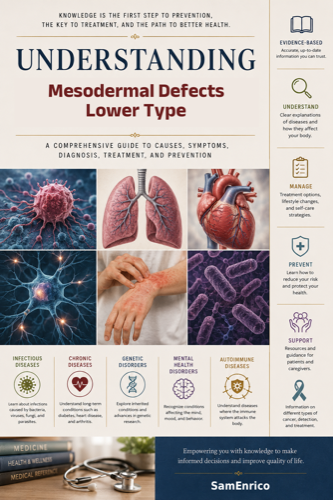
Understanding Mesodermal Defects Lower Type eBook
This disease publication, published by SamEnrico,
This disease publication, published by SamEnrico, covers Understanding Mesodermal Defects Lower Type
Formats
Free sample
Chapter 1: The Vanished Spine--–- The ultrasound tech’s face went pale first. That is the detail Sarah remembers most clearly from December 14th, not the cold gel on her belly or the rhythmic swoosh of the fetal heartbeat, but the way the technician’s practiced smile evaporated like breath on a mirror. She had been chatty for twenty minutes—pointing out femurs, counting fingers, narrating the miracle of her second-trimester anatomy scan with the easy confidence of someone who had done this ten thousand times. Then the probe paused. Then the clicking of measurements stopped.
Then the silence stretched so long that Sarah’s husband, David, stopped holding her hand and started gripping it.“I need to get the doctor,” the tech said, and those six words rewrote every future Sarah had imagined for her unborn daughter.This chapter is not a medical textbook introduction. It is not a dry recitation of incidence rates or a patient satisfaction survey buried in an appendix. This chapter is the story of what happens when a family hears the words “sacral agenesis” for the first time, because before you can understand Lower Mesodermal Defects Sequence (LMDS)—before you can master its embryology, its surgical algorithms, its long-term outcomes—you must understand what it feels like to receive the diagnosis. The science matters deeply. But the science serves the story, and the story begins with a vanishing: the spine that should have been there, isn't.For the clinician reading this book: stay with me.
You have delivered this news. You have watched faces crumple. You have used words like “caudal regression” and “multidisciplinary management” while a mother stopped breathing. This chapter will remind you why precision matters, and why compassion matters more. For the parent reading this book: you are not alone.
What you are feeling has been felt by thousands before you. And what you need—information, hope, a roadmap—is what this entire book was written to provide.Let us begin at the beginning. Not with gastrulation or the primitive streak, but with a question every parent asks: What is happening to my child?THE WEIGHT OF A DIAGNOSISWhen Dr. Martinez, the maternal-fetal medicine specialist, finally came into the ultrasound room, she brought a box of tissues and a small plastic model of a spine. She placed both on the counter before she spoke.
That small act—the tissues first, then the model—told Sarah everything she needed to know about what was coming.“Your baby has a condition called Lower Mesodermal Defects Sequence,” Dr. Martinez said. “Sometimes it’s called caudal regression syndrome. It affects the formation of the lower spine, the kidneys, and sometimes the legs.”Sarah heard the words in fragments, like a radio station fading in and out. Lower.
Spine. Kidneys. Legs. She heard “regression” and thought of a child moving backward, losing skills, deteriorating. She heard “defects” and thought of broken dishes, of things that could not be repaired.“Is she going to die?” Sarah asked.That is the first question.
Always the first question. It comes before “Can she walk?” before “Will she be in pain?” before “Will she know who I am?” The first question is survival, and it deserves a direct answer.Dr. Martinez gave one: “Most babies with LMDS survive. The mortality rate is low unless there are severe kidney anomalies or cardiac defects. But she will need surgery.
She will need specialists. And she will need you to fight for her every step of the way.”Fight. That word landed differently. It was not a medical word. It was a mother’s word.
Sarah grabbed it and held on.What the diagnosis actually means, stripped of jargon and terror, is this: between the third and eighth week of pregnancy, when the embryo is smaller than a grain of rice, the cells that were supposed to form the lower spine, the kidneys, the bladder, and the anus did not complete their work. They started. They migrated to the right places. Then something interrupted them—a genetic hiccup, a blood vessel that failed to form, in some cases high blood sugar from maternal diabetes—and the construction project stopped before the final floors were built.The result is not a single disease but a spectrum. At one end, a child with a slightly shortened sacrum (the triangular bone at the base of the spine) who walks, runs, and plays with no visible difference.
At the other end, a child with no sacrum at all, with a spinal cord that ends high in the lumbar spine, with one kidney, with an anus that never formed, with legs that are short and curved and feet that point inward like a ballerina’s—except there is no grace in it, only constraint.Between these two ends lie thousands of variations. No two children with LMDS are exactly alike, which is both the cruelty and the mercy of the condition. Cruel because no textbook can predict exactly what your child will face. Merciful because there is no single ceiling on what your child can become.THE SPECTRUM OF POSSIBILITYLet me introduce you to three children. You will meet them throughout this book, not as case studies but as companions on the journey.Elena was diagnosed prenatally at twenty-two weeks.
Her ultrasound showed sacral agenesis—Renshaw Type III, meaning her sacrum was completely absent and her iliac bones (the hip bones) articulated directly with her lowest lumbar vertebra. Her kidneys were both present and normal, a gift. Her anus was intact. Her legs were short but symmetrical. Her parents spent the remaining eighteen weeks of her gestation in a state of controlled terror, reading everything they could find (which was not much), joining online support groups (which were half-empty), and preparing for a future they could not visualize.Elena is now seven years old.
She walks with forearm crutches decorated with unicorn stickers. She attends second grade in a mainstream classroom. She does her own intermittent catheterization every four hours, a skill she learned at five. She swims competitively on a local team, where her shortened legs create less drag than her teammates’ longer limbs. Her mother, Sarah, says: “I spent my whole pregnancy mourning the daughter I wouldn’t have.
I missed out on celebrating the daughter I got.”Marcus was not diagnosed prenatally. His birth was unremarkable—seven pounds, three ounces, Apgars of eight and nine—until the pediatrician noticed that his sacrum felt flat, that his anus was positioned too far forward, that his feet were clubbed. An MRI on day two showed a spinal cord that ended at L3 (the third lumbar vertebra) with a fatty filum tethering it to the sacral canal. His kidneys: one normal, one small and dysplastic, likely to fail before adulthood.Marcus is now fourteen. He has had three major surgeries: a tethered cord release at six months, a colostomy at two days (his anus was imperforate), and an ACE (Antegrade Colonic Enema) procedure at seven.
He manages his own bowel program every evening, a twenty-minute ritual that has become as automatic as brushing his teeth. He hates it. He also hates when people assume he is cognitively impaired—he…
This is the end of the free sample. Get the eBook to keep going. Buy now
About this book
Details
- Author
- Marlow Venetta
- Publisher
- SamEnrico
- Language
- English
- Genre
- Non-Fiction, Informative, Educational
- Released
- 2026-05-25
- Pages (approx.)
- 155
- Available as
- eBook, Audiobook

Read better in the ZLOADR app
Your eBooks on your phone or tablet. Sign in with your SamEnrico account and start reading.
More by Marlow Venetta
 Perceived Lack Of Accomplishment GuideMarlow Venetta$11.99
 Stroheim Von RealismMarlow Venetta$11.99
 Cleft Lip Self Esteem GuideMarlow Venetta$11.99
 Twins Sleep Management GuideMarlow Venetta$11.99
 The Difficult Conversation with TeenagersMarlow Venetta$11.99
 Quetzalcoatl’s Flute: The Feathered Serpent’s Divine MelodyMarlow Venetta$11.99
 Japan Metaverse Regulation GuideMarlow Venetta$12.99
 Business Model Canvas PromptsMarlow Venetta$12.99
 Systems Support TechnicianMarlow Venetta$11.99
 How to Become a Kiln PlacerMarlow Venetta$11.99