
Non-FictionInformativeEducational
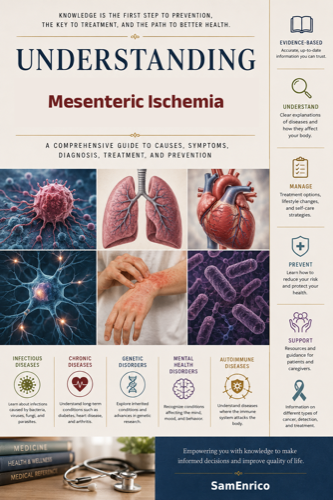
Understanding Mesenteric Ischemia eBook
This disease publication, published by SamEnrico,
This disease publication, published by SamEnrico, covers Understanding Mesenteric Ischemia
Formats
Free sample
Chapter 1: The Silent Highway...--The human gut is a paradox. It is the most intimate border between self and non‑self, a 30‑foot tube lined with living tissue that somehow distinguishes a steak from a pathogen, a vitamin from a virus. Yet this vital organ, the very engine of nutrition and immunity, depends on a vascular supply so delicate and so silent that most physicians never think about it—until it fails catastrophically. When the mesenteric circulation stops, the gut does not scream. It whispers.
And by the time it shouts, the patient is often beyond rescue.This is the central tragedy of mesenteric ischemia: the disease is highly treatable, yet remains one of the most commonly missed diagnoses in acute care medicine. The problem is not a lack of therapeutic tools. The problem is a failure of imagination—a failure to suspect the diagnosis before the bowel has already died. Understanding why this happens, and how to prevent it, requires a journey through the hidden highway of the mesenteric vasculature: its architecture, its ingenious collateral networks, its historical discovery, and the clinical traps that its very design sets for the unwary clinician.This opening chapter establishes the anatomical and historical foundation upon which the entire book rests. Without a map of the mesenteric arteries, the discussions of pathophysiology, diagnosis, and treatment that follow will remain abstract.
With that map, every subsequent chapter gains clarity and clinical relevance.The Historical Shadow: From Death Sentence to Treatable Emergency Before the mid‑20th century, a diagnosis of acute mesenteric ischemia was essentially a death warrant. The condition was described in autopsy series but almost never diagnosed ante‑mortem. When a patient presented with sudden, severe abdominal pain and then died, pathologists would find segments of blackened, necrotic bowel and a thrombus or embolus lodged in the superior mesenteric artery. The clinical dictum was grim: mesenteric vascular occlusion was a surgical disease that surgeons almost never saw in time.The turning point came from an unlikely source: the Korean War. Military surgeons managing traumatic vascular injuries developed techniques for arterial reconstruction that had never been applied to mesenteric vessels.
In 1954, Dr. Clarence Dennis and his team at the State University of New York performed the first successful superior mesenteric artery embolectomy using a Fogarty catheter—a device originally designed for peripheral arteries. The patient survived. The floodgates opened.Over the next two decades, the Mayo Clinic emerged as the epicenter of mesenteric revascularization. Dr.
John H. "Jack" Waugh and later Dr. Peter Gloviczki refined techniques for both acute embolectomy and chronic bypass grafting. They demonstrated that bowel death was not inevitable, that revascularization could salvage intestine thought to be non‑viable, and that a "second look" laparotomy could rescue patients who would otherwise have died. Their work transformed mesenteric ischemia from a pathologic curiosity into a treatable emergency.Yet despite these advances, mortality remained stubbornly high—hovering around 50% even in major centers.
The reason was not technical failure. The reason was diagnostic delay. The average time from symptom onset to operative intervention in the 1970s and 1980s exceeded 24 hours, and by that point, irreversible transmural necrosis had already occurred. The battle was being lost in the emergency department, not the operating room.The 1990s brought two game‑changing innovations: computed tomography angiography and endovascular therapy. For the first time, clinicians could visualize the mesenteric circulation non‑invasively and treat occlusions without opening the abdomen.
Catheter‑directed thrombolysis, aspiration thrombectomy, and stenting offered less invasive options for patients too sick for open surgery. The diagnostic window narrowed from days to hours.But here is the paradox that defines modern mesenteric ischemia: despite all these advances, the disease remains under‑diagnosed. CTA is nearly 100% sensitive for SMA occlusion, but only if the test is ordered. And the test is only ordered if the diagnosis is considered. And the diagnosis is only considered if the clinician remembers that mesenteric ischemia exists.
The greatest barrier to survival is no longer technology. It is awareness.This historical arc—from autopsy curiosity to treatable emergency to under‑diagnosed killer—sets the stage for everything that follows. The reader who finishes this book will never again look at a patient with acute abdominal pain the same way.The Vascular Atlas: Mapping the Mesenteric Highways To understand mesenteric ischemia, one must first understand the three great arteries that supply the gastrointestinal tract. They are not interchangeable. Each has a distinct territory, a distinct embryologic origin, and distinct clinical syndromes when compromised.The Celiac Axis: The Foregut Artery The celiac axis (also called the celiac trunk or celiac artery) is the shortest and widest of the three mesenteric vessels, typically measuring 1-2 centimeters in length before trifurcating into the left gastric, splenic, and common hepatic arteries.
It arises from the anterior aorta at the level of the T12-L1 intervertebral disc, just below the diaphragm's aortic hiatus.The foregut—the territory supplied by the celiac axis—extends from the distal esophagus to the ampulla of Vater (the second part of the duodenum). This includes the stomach, the proximal duodenum, the liver, the gallbladder, the pancreas, and the spleen. The clinical significance is straightforward: celiac artery stenosis produces symptoms in the epigastrium, classically post‑prandial pain that patients describe as "gnawing" or "burning," often mistaken for peptic ulcer disease or gastroesophageal reflux.Because the celiac axis has rich collaterals from the SMA via the pancreaticoduodenal arcades, isolated celiac stenosis is almost always asymptomatic. This is why Median Arcuate Ligament Syndrome (MALS)—compression of the celiac artery by the diaphragmatic crura—remains controversial; many individuals with incidental compression have no symptoms, and the causal link between compression and pain is not always clear.The Superior Mesenteric Artery: The Midgut Artery The superior mesenteric artery (SMA) is the workhorse of the mesenteric circulation. It arises from the anterior aorta at the level of L1, approximately 1-2 centimeters below the celiac axis.
Its origin is protected by a hood of aortic tissue that can be a site of atherosclerotic plaque formation. The SMA passes anterior to the uncinate process of the pancreas and the third part of the duodenum, then enters the root of the small bowel mesentery.The midgut—the SMA territory—extends from the ampulla of Vater to the distal transverse colon. This includes the entire small bowel (duodenum distal to the ampulla, jejunum, and ileum), the cecum, the appendix, the ascending colon, and the proximal two‑thirds of the transverse colon. The SMA also supplies the head of the pancreas via the inferior pancreaticoduodenal artery.The SMA is the most clinically important of the three mesenteric arteries for a simple reason: it is the most common site of both embolic and thrombotic occlusion. An embolus from the heart (typically from atrial fibrillation) lodges at a branching point, often 3-10 centimeters from the SMA origin.
A thrombus forms at the origin itself, superimposed on an atherosclerotic plaque. Both produce the same result: sudden cessation of flow to the entire midgut, leading to rapid ischemia and, without intervention, infarction.Why does SMA occlusion cause such rapid bowel death? The answer lies in the SMA's normal physiology. In the fed state, the small bowel receives 20-30% of…
This is the end of the free sample. Get the eBook to keep going. Buy now
About this book
Details
- Author
- Kunkel Xavier
- Publisher
- SamEnrico
- Language
- English
- Genre
- Non-Fiction, Informative, Educational
- Released
- 2026-06-02
- Pages (approx.)
- 149
- Available as
- eBook, Audiobook

Read better in the ZLOADR app
Your eBooks on your phone or tablet. Sign in with your SamEnrico account and start reading.
More by Kunkel Xavier
 The Difficult Peer Feedback GuideKunkel Xavier$11.99
 Burnout In Nonprofit Sector CourseKunkel Xavier$11.99
 Port Wine Stain Birthmark GuideKunkel Xavier$11.99
 Cukor Women DirectorKunkel Xavier$11.99
 Grandparent Sleep ConsistencyKunkel Xavier$11.99
 The Phantom of Yankee Stadium: The Secret Blueprint That Built a DynastyKunkel Xavier$11.99
 How to Become a Distribution SupervisorKunkel Xavier$11.99
 US Corporate Transparency ActKunkel Xavier$12.99
 SWOT Analysis Prompt EngineeringKunkel Xavier$12.99
 System Automation DeveloperKunkel Xavier$11.99
You may also like
 Hong Kong Handover 1997Dunn Johnnie$11.99
 Zumba For Postnatal Recovery CourseNeal Christian$11.99
 Zumba for BeginnersLadner Nikia$11.99
 YouTube Comment Mining GuideHumes Pandora$12.99
 Worry Box MeditationCarlin Rudy$11.99
 Workplace Stress MeditationNguyen Lynn$11.99
 Workplace Stress and Sleep RepairHawley Ivory$11.99
 Workplace Perfectionism CureDelaney Jeffry$11.99
 Workplace Injustice Anger GuideWallen Isabelle$11.99
 Work Addiction and Burnout LinkGreenwood Ester$11.99
 Women in Yoga and WellnessBeattie Galina$11.99
 Women in Stand Up ComedyChun Evangeline$11.99