
Non-FictionInformativeEducational
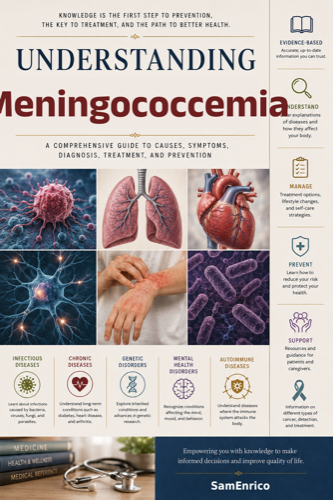
Understanding Meningococcemia eBook
This disease publication, published by SamEnrico,
by Oldham Alla
This disease publication, published by SamEnrico, covers Understanding Meningococcemia
Formats
Free sample
Chapter 1: The Twelve-Hour Killer...--It begins like a hundred other illnesses. A headache that could be from staying up too late studying. A low-grade fever that might be the start of the flu going around the dormitory. Muscle aches that feel exactly like the ones you get after a hard workout. Maybe a touch of nausea.
Nothing specific. Nothing that screams "medical emergency." Nothing that would make a reasonable person rush to the emergency department in the middle of the night.This is what makes Neisseria meningitidis one of the most terrifying pathogens in human medicine. Not its complexity. Not its resistance to antibiotics. Not some exotic mechanism that defies modern science.
No, what makes this bacterium a perfect killer is its disguise. It wears the mask of a dozen benign illnesses just long enough to establish a foothold. And by the time the mask slips—by the time the real face of the disease reveals itself—the clock is already ticking toward a countdown measured not in days but in hours.This is a book about that countdown. It is a book about the bacterium that kills with terrifying speed, the immune system that sometimes becomes its own worst enemy, the families who watch helplessly as a healthy child becomes a critically ill patient in a single afternoon, and the public health systems that work—often invisibly and thanklessly—to prevent the next case. But most of all, this is a book about what you need to know before the countdown begins.
Because once it starts, there is no time to learn.The Historical Shadow of Meningococcal Disease To understand why this disease remains so feared, we must first understand its track record. The history of meningococcal disease is written in epidemics that have terrorized communities, collapsed military units, and disrupted mass gatherings for over a century.The first definitive description of epidemic cerebrospinal meningitis—as it was then called—came from Geneva in 1805, when an outbreak struck with such ferocity that local physicians documented every detail in what would become the first modern account of the disease. But outbreaks had almost certainly occurred long before. Some historians speculate that the "plague" described by Thucydides in ancient Athens during the Peloponnesian War (430-426 BCE) had features consistent with meningococcal disease: sudden onset, high fever, a rash that darkened the skin, and death within days of symptom onset.The modern era of understanding began in 1887, when Austrian pathologist Anton Weichselbaum isolated the bacterium from the cerebrospinal fluid of patients who had died from what was then called "spotted fever." He named it Diplococcus intracellularis meningitidis—a name that reflected its appearance as paired cells (diplococcus) found inside cells (intracellularis) and associated with the meninges (meningitidis). Later reclassified as Neisseria meningitidis, the bacterium joined the Neisseria genus alongside its less dangerous cousin, Neisseria gonorrhoeae.The early twentieth century brought devastating epidemics.
During World War I, military camps became breeding grounds for the disease. Crowded barracks, the stress of training, and concurrent respiratory infections created the perfect conditions for both carriage and invasion. Among US Army recruits in 1917-1918, the incidence of meningococcal disease reached 50 cases per 100,000 personnel—fifty times higher than the civilian rate in peacetime. Case fatality rates exceeded 70% because no effective treatment existed. A soldier who developed a fever and rash on Monday might be dead by Wednesday, before his family even received the telegram notifying them of his illness.The interwar period brought the first glimmer of hope.
In the 1930s, researchers developed a serum therapy derived from horses immunized against the bacterium. The results were modest at best and dangerous at worst—serum sickness was common, anaphylaxis occurred, and the therapy did little once septic shock had set in. But it was the first attempt at a targeted treatment, and it established the principle that the immune system could be harnessed against the invader.The real breakthrough came with the introduction of sulfonamide antibiotics in the 1940s. For the first time, physicians had a pill that could kill Neisseria meningitidis. Mortality rates plummeted from 70% to below 20% within a decade.
But the victory was short-lived. By the 1960s, sulfonamide resistance had spread globally, driven by the bacterium's remarkable ability to acquire and share resistance genes. The wonder drug of the 1940s was useless by the 1970s.This pattern—discovery of a new weapon, followed by the bacterium's eventual adaptation—would repeat itself. Penicillin, introduced in the 1940s for other infections, became the mainstay of meningococcal treatment by the 1950s. And while full-blown penicillin resistance remains rare (less than 1% of isolates globally), intermediate resistance—strains that require higher doses or alternative drugs—has emerged in several countries.
The bacterium learns. It adapts. It survives.The Meningitis Belt: A Geographic Tragedy If meningococcal disease had spread evenly across the globe, it would still be a feared pathogen. But it does not spread evenly. It concentrates in one region with such intensity that the region has earned its own name: the African Meningitis Belt.The Belt stretches across sub-Saharan Africa from Senegal and The Gambia in the west to Ethiopia in the east, encompassing 26 countries and approximately 400 million people.
It is not a belt in the sense of a continuous band of equal risk; rather, it is a region defined by ecological and climatic conditions that promote both bacterial transmission and human susceptibility. The key factor is the dry season—typically December through June—when harmattan winds blow dust from the Sahara across the region. The dust damages respiratory mucosa, creating micro-abrasions that allow N. meningitidis to invade from the nasopharynx into the bloodstream. Dry air also desiccates mucosal surfaces, further compromising the body's first line of defense.During epidemic years, incidence rates in the Belt can reach 1,000 cases per 100,000 population.
To put that number in perspective, consider that in the United States or Western Europe, the annual incidence of meningococcal disease is approximately 0.3 to 1.0 cases per 100,000. A rate of 1,000 per 100,000 is not one thousand times higher—it is three thousand times higher. A disease that is vanishingly rare in Boston or London becomes an ever-present threat in Ouagadougou or Niamey.The largest recorded epidemic in the Belt occurred in 1996-1997, when serogroup A swept across the region. Over two years, more than 250,000 cases were reported. More than 25,000 people died.
And those statistics almost certainly underestimate the true toll, because surveillance in many Belt countries is incomplete. A child who dies in a remote village hours from the nearest clinic may never be counted.The devastation wrought by meningococcal disease in the Belt is not merely a matter of incidence rates. It is a matter of resources. In wealthy countries, a patient with fulminant meningococcemia receives intensive care: mechanical ventilation, vasopressor support, renal replacement therapy if needed, and all the technological infrastructure of a modern hospital. In much of the Belt, such resources are scarce or nonexistent.
A patient may present to a rural clinic staffed by a single nurse with no intravenous antibiotics, no oxygen, no ability to transfer to a higher level of care. The case fatality rate in such settings is not 10-15%—it is 50-70%. The same disease that kills one in ten in a London teaching hospital…
This is the end of the free sample. Get the eBook to keep going. Buy now
About this book
Details
- Author
- Oldham Alla
- Publisher
- SamEnrico
- Language
- English
- Genre
- Non-Fiction, Informative, Educational
- Released
- 2026-05-11
- Pages (approx.)
- 159
- Available as
- eBook, Audiobook

Read better in the ZLOADR app
Your eBooks on your phone or tablet. Sign in with your SamEnrico account and start reading.
More by Oldham Alla
 Uber Driver Airport Queue StrategyOldham Alla$11.99
 The Connector PersonalityOldham Alla$11.99
 Event Planning Priority GuideOldham Alla$11.99
 Clash of Clans Notification FixOldham Alla$11.99
 Nutritional Hair Loss GuideOldham Alla$11.99
 Project Management For StudentsOldham Alla$12.99
 Resilience Adaptability Skills GuideOldham Alla$12.99
 Rf TestingOldham Alla$11.99Rf TestingOldham Alla$11.99Rf TestingOldham Alla$11.99
 How to Become a Splitter OperatorOldham Alla$11.99
You may also like
 Hong Kong Handover 1997Dunn Johnnie$11.99
 Zumba For Postnatal Recovery CourseNeal Christian$11.99
 Zumba for BeginnersLadner Nikia$11.99
 YouTube Comment Mining GuideHumes Pandora$12.99
 Worry Box MeditationCarlin Rudy$11.99
 Workplace Stress MeditationNguyen Lynn$11.99
 Workplace Stress and Sleep RepairHawley Ivory$11.99
 Workplace Perfectionism CureDelaney Jeffry$11.99
 Workplace Injustice Anger GuideWallen Isabelle$11.99
 Work Addiction and Burnout LinkGreenwood Ester$11.99
 Women in Yoga and WellnessBeattie Galina$11.99
 Women in Stand Up ComedyChun Evangeline$11.99