
Non-FictionInformativeEducational
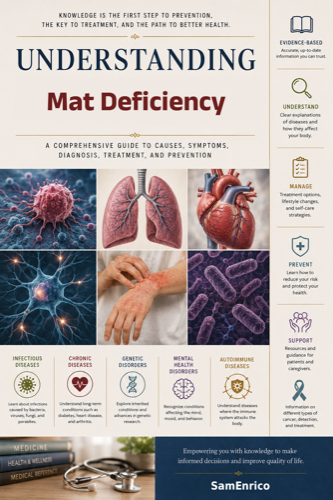
Understanding Mat Deficiency eBook
This disease publication, published by SamEnrico,
This disease publication, published by SamEnrico, covers Understanding Mat Deficiency
Formats
Free sample
Chapter 1: The Toll Booth Inside You--The phone rang at 4:47 PM on a Tuesday. The caller ID read “State Health Department.” Not the pediatrician’s office. Not the hospital. The health department. For the parents who will open this book in the middle of a sleepless night, that phone call is still echoing in their ears.
The voice on the other end said something about a heel-prick blood spot taken forty-eight hours after birth. Something about an amino acid called methionine. Something about a result that was “out of range.” And then, the words that change everything: “We need you to see a geneticist.”If you are reading this chapter because you just received that phone call, stop and take a breath. You are not alone. You are not the first family to walk this path.
And by the time you finish this chapter—this single chapter—you will understand more about what is happening inside your child’s body than most general practitioners learn in medical school. More importantly, you will understand why most people with this condition live completely normal, healthy, happy lives.This book is not a textbook. It is a lifeline. It is written by a team of metabolic geneticists, nutritionists, genetic counselors, and—most importantly—parents who have sat exactly where you are sitting now. The science is real.
The accuracy is rigorous. But the voice is human. Because a rare diagnosis is not a mathematical problem. It is a human experience.So let us begin at the beginning. Not with the genetic mutation.
Not with the newborn screening algorithm. But with a question that every family asks in those first terrifying days: What is actually wrong?The One-Sentence Answer Here is the single most important sentence in this entire book, and you should memorize it now: In MAT deficiency, the body’s ability to convert a common amino acid called methionine into a critical molecule called SAM is partially broken, causing methionine to build up in the blood while SAM levels may drop.That is the entire condition in one sentence. Everything else in this book—the monitoring schedules, the dietary guidelines, the pregnancy considerations, the research on future therapies—is just an expansion of that one sentence.But a single sentence, no matter how accurate, does not calm a terrified parent at 2:00 AM. So let us unpack that sentence piece by piece, using stories, analogies, and plain language. By the end of this chapter, you will not need a medical degree.
You will need only what you already have: love for your child and the willingness to learn.The Building Blocks of Life: A Very Short Story About Protein Every living thing on this planet—every human, every whale, every oak tree, every bacterium—is built from tiny molecular building blocks called amino acids. Think of amino acids as LEGO bricks. There are twenty different types of these bricks, and your body arranges them in countless combinations to build everything from your fingernails to your brain cells to the enzymes that digest your food.Most of these twenty amino acids your body can manufacture on its own, using raw materials from the food you eat. But nine of them—just nine—your body cannot make. These nine must come directly from the protein you consume.
They are called essential amino acids, not because they are more important than the others (all amino acids are essential for life), but because you must eat them. Your body has no factory to produce them from scratch.Methionine is one of these nine essential amino acids.This means that every human being on earth—every newborn, every grandparent, every Olympic athlete, every person reading this sentence—must consume methionine in their diet. There is no alternative. There is no workaround. Methionine is not optional.
It is as essential as oxygen and water, though thankfully we need far less of it.Where does methionine come from? The answer is simple: protein. Animal proteins—meat, poultry, fish, eggs, dairy—are particularly rich in methionine. Plant proteins—beans, lentils, nuts, seeds, soy—contain methionine as well, though typically in smaller amounts. Grains and vegetables contain trace amounts.
Fruits contain very little.So every time you eat a piece of chicken, every time you drink a glass of milk, every time you crack an egg into a frying pan, you are consuming methionine. Your body absorbs it from your digestive tract, transports it through your bloodstream, and delivers it to your cells, where the real work begins.The Toll Booth: How Methionine Becomes SAMNow we arrive at the heart of the matter. When methionine enters a cell—whether a liver cell, a brain cell, or any of the trillions of other cells in your body—it does not just sit there. It is not a storage molecule. Methionine has a job to do.
But before it can do that job, it must be transformed.Enter the enzyme.An enzyme is a biological machine. It is a protein—remember those LEGO bricks?—that has been folded into a specific three-dimensional shape that allows it to grab onto one molecule and convert it into another molecule. Enzymes are the workers of your body. They do not think. They do not rest.
They simply exist, waiting for the right molecule to come along so they can do their job.The enzyme responsible for transforming methionine is called MAT. That stands for Methionine Adenosyltransferase. Do not worry about the long name. The only thing you need to remember is that MAT is the worker that picks up methionine, attaches a small chemical group to it (an adenosyl group, if you are curious), and turns it into a new molecule called SAM.SAM stands for S-Adenosylmethionine. Again, the name does not matter.
What matters is what SAM does.SAM is one of the most versatile and important molecules in the human body. It is often called the body’s primary methyl donor. That phrase—methyl donor—sounds technical, but the concept is simple. A methyl group is a tiny cluster of one carbon atom and three hydrogen atoms. Think of it as a single LEGO brick.
SAM carries this methyl brick and donates it to other molecules—to DNA, to proteins, to fats, to neurotransmitters—to tell them what to do.When SAM donates a methyl group to a piece of DNA, it can turn a gene on or off. When SAM donates a methyl group to a neurotransmitter, it can change how your brain cells communicate. When SAM donates a methyl group to a toxin, it can make that toxin easier for your body to eliminate. SAM is involved in more than two hundred different chemical reactions in your body. It regulates your mood.
It supports your immune system. It helps repair your cells. It is, in a very real sense, a superhero molecule.So here is the flow: Methionine (from food) enters the cell. MAT (the enzyme) grabs the methionine and converts it into SAM (the superhero). SAM then goes off to perform hundreds of essential tasks.In a healthy person with a functioning MAT enzyme, this process happens seamlessly.
Methionine levels stay within a normal range because methionine is constantly being converted into SAM. SAM levels stay within a…
This is the end of the free sample. Get the eBook to keep going. Buy now
About this book
Details
- Author
- Marchand Mammie
- Publisher
- SamEnrico
- Language
- English
- Genre
- Non-Fiction, Informative, Educational
- Released
- 2026-06-02
- Pages (approx.)
- 145
- Available as
- eBook, Audiobook

Read better in the ZLOADR app
Your eBooks on your phone or tablet. Sign in with your SamEnrico account and start reading.
More by Marchand Mammie
 LGBTQ Conversion Therapy Attempt SurvivorMarchand Mammie$11.99
 Nuclear War Fear Simulation FactMarchand Mammie$11.99
 Norwegian Fishermen Mine SweepersMarchand Mammie$11.99
 Twitch Streaming Addiction GuideMarchand Mammie$11.99
 The Chronic Stress Menopause SeverityMarchand Mammie$11.99
 The Last Stand of the Turtle King: A Forgotten Warrior's RiseMarchand Mammie$11.99
 PaperhangerMarchand Mammie$11.99
 Remote Review Stakeholder AlignmentMarchand Mammie$12.99
 Executive Decision Blocking GuideMarchand Mammie$12.99
 How to Become a DiverMarchand Mammie$11.99
You may also like
 Hong Kong Handover 1997Dunn Johnnie$11.99
 Zumba For Postnatal Recovery CourseNeal Christian$11.99
 Zumba for BeginnersLadner Nikia$11.99
 YouTube Comment Mining GuideHumes Pandora$12.99
 Worry Box MeditationCarlin Rudy$11.99
 Workplace Stress MeditationNguyen Lynn$11.99
 Workplace Stress and Sleep RepairHawley Ivory$11.99
 Workplace Perfectionism CureDelaney Jeffry$11.99
 Workplace Injustice Anger GuideWallen Isabelle$11.99
 Work Addiction and Burnout LinkGreenwood Ester$11.99
 Women in Yoga and WellnessBeattie Galina$11.99
 Women in Stand Up ComedyChun Evangeline$11.99