
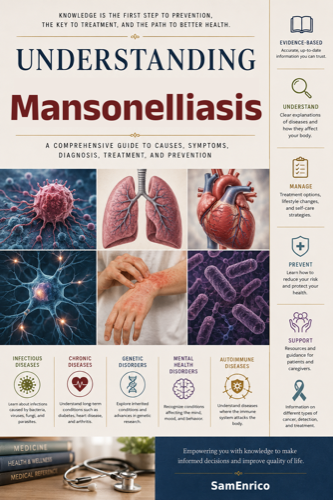
Understanding Mansonelliasis
This disease publication, published by SamEnrico,
This disease publication, published by SamEnrico, covers Understanding Mansonelliasis
Formats
About this book
Free sample
Chapter 1: The Invisible Epidemic...--–- The patient arrived at the teaching hospital in Yaoundé, Cameroon, on a humid Tuesday morning in July. She was thirty-four years old, a mother of three, and had spent the last eighteen months visiting seven different doctors. Her chief complaint was simple: itching. Not the casual itch of dry skin or an allergic reaction to mosquito bites, but a deep, relentless, bone-level pruritus that had stripped the skin from her forearms and shins. She had been diagnosed with eczema, then scabies, then a psychosomatic disorder.
One well-meaning dermatologist had prescribed an antidepressant. Another had suggested she was "scratching for attention." Her blood work showed eosinophilia – a elevated count of a certain white blood cell – but no one had connected that clue to her suffering. She had been told, more than once, that nothing was wrong with her.The problem was not that she was imagining her symptoms. The problem was that the medical establishment, from her local clinic to the regional hospital, was not looking for the right thing. She had mansonelliasis, a parasitic infection caused by filarial worms of the genus Mansonella.
The microfilariae – the larval stage of the parasite – were circulating in her blood and residing in her skin, triggering an immune response that manifested as intractable itching. But because mansonelliasis is rarely taught in medical schools, rarely tested for in diagnostic labs, and rarely mentioned in clinical guidelines, she had suffered in silence for eighteen months. Her case was not unusual. It was, in fact, tragically ordinary.The Scope of the Invisible Mansonelliasis is one of the most common parasitic infections you have never heard of. Current estimates suggest that at least 114 million people across sub-Saharan Africa, Central and South America, and the Caribbean carry one of the three Mansonella species that infect humans: Mansonella perstans, Mansonella ozzardi, or Mansonella streptocerca.
To put that number in perspective, it is roughly equivalent to the entire population of the Philippines, or Germany, or Vietnam. It is more people than live in all of Australia and New Zealand combined. And yet, if you were…
This is the end of the free sample. Get the eBook to keep going. Buy now
Contents
- Chapter 1
- Chapter 2
- Chapter 3
- Chapter 4
- Chapter 5
- Chapter 6
- Chapter 7
- Chapter 8
- Chapter 9
- Chapter 10
- Chapter 11
- Chapter 12
Details
- Author
- Pederson Adelaide
- Publisher
- SamEnrico
- Language
- English
- Genre
- Non-Fiction, Informative, Educational
- Released
- 2026-05-08
- Pages (approx.)
- 138
- Available as
- eBook, Audiobook

Read better in the ZLOADR app
Your eBooks on your phone or tablet. Sign in with your SamEnrico account and start reading.
More by Pederson Adelaide
 Emotional Intelligence for Foster ParentsPederson Adelaide$11.99
 Eczema Skin Self Esteem GuidePederson Adelaide$11.99
 EQ For Social WorkersPederson Adelaide$11.99
 Senior Telehealth Self Esteem HandbookPederson Adelaide$11.99
 1031 Exchange Partnership InterestPederson Adelaide$11.99
 Blood and Gold in the Andes: Pizarro's Gambit at Cajamarca (1532)Pederson Adelaide$11.99
 How to Start a Penholder Business (Beginners Guide)Pederson Adelaide$11.99
 Member Experience RepresentativePederson Adelaide$11.99
 Procurement Continuous Improvement GuidePederson Adelaide$12.99
 Strategy Meeting For StartupsPederson Adelaide$12.99