
Non-FictionInformativeEducational
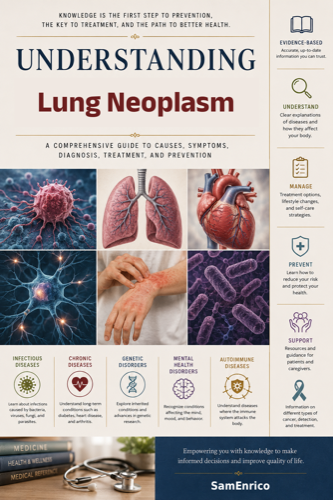
Understanding Lung Neoplasm eBook
This disease publication, published by SamEnrico,
by Ali Joline
This disease publication, published by SamEnrico, covers Understanding Lung Neoplasm
Formats
Free sample
Chapter 1: The Unspoken Diagnosis...--–- The phone rings on a Tuesday afternoon. You recognize the hospital's number. Your heart accelerates before your mind has time to form a single coherent thought. The voice on the other end is kind, professional, and measured. "We have your biopsy results," they say.
"There is a malignancy. You have lung cancer."In that single moment, everything changes. The world does not stop spinning, but for you, it might as well have. You hear words that follow — "nodule," "stage," "oncology referral," "treatment options" — but they seem to drift past you, muffled, as if you are underwater. You hang up the phone.
You look around your living room, your kitchen, your office, and you wonder how the rest of the world continues moving when yours has just shattered.This book exists because of that moment.The chapters that follow are designed to be your companion, your translator, and your guide through the landscape of lung neoplasm — a term that simply means abnormal growth in the lung, but that carries with it a weight that feels unbearable at first. Before we dive into the biology of cancer cells, the intricacies of staging systems, or the alphabet soup of targeted therapies (EGFR, ALK, ROS1 — terms that will soon become familiar to you), we must begin with a different foundation. We must understand not just what lung cancer does to the body, but what the diagnosis does to a person.And we must address, directly and without flinching, the single most destructive, isolating, and unnecessary burden that lung cancer patients carry: stigma.The Weight of a Diagnosis: Why Lung Cancer Is Different Let us be honest with each other from the very first pages of this book. A breast cancer patient is surrounded by pink ribbons, charity walks, and public sympathy. A colon cancer patient receives cards, casseroles, and expressions of gentle concern.
A lung cancer patient, too often, receives a different response. Sometimes it is overt: a relative who says, "Well, you smoked, so what did you expect?" Sometimes it is subtle: a momentary silence, an averted gaze, a question that goes unasked. Sometimes it is internalized: the voice in your own head whispering, "I did this to myself."This is stigma. And it is, by every measure, a public health crisis layered on top of a medical one.Lung cancer is the leading cause of cancer-related death worldwide, responsible for approximately 1.8 million deaths annually — more than breast, prostate, and colon cancers combined. In the United States alone, more people die from lung cancer than from breast, prostate, colorectal, and pancreatic cancers put together.
These are not abstract statistics. These are mothers and fathers, teachers and truck drivers, never-smokers and former smokers and current smokers, people in their thirties and people in their eighties. And yet, despite its staggering toll, lung cancer receives less research funding per death than almost any other major cancer, largely because of the perception — false and cruel — that patients somehow "deserved" their illness.The first and most important truth of this book is this: No one deserves cancer. Lung cancer is a disease of cells, not a punishment for behavior. The biology of malignant transformation does not consult a patient's moral record.
The stigma surrounding lung cancer is not just unfair; it is dangerous. It delays diagnosis, as patients avoid screening because they fear judgment. It undermines treatment, as patients hide their diagnosis from family and friends, depriving themselves of crucial emotional support. It distorts research, as funding lags behind need because of public perceptions that lung cancer is "self-inflicted" and therefore less worthy of attention.We will not perpetuate that injustice in these pages. You are here because you or someone you love has been diagnosed with a serious illness, and you deserve accurate information, compassionate guidance, and practical tools.
That begins with understanding the full picture of lung neoplasm — including who gets it, why, and what we can do about it.The Global Landscape: Who Gets Lung Cancer and Why Let us start with the numbers, because numbers tell a story that stigma tries to erase.Worldwide, lung cancer is diagnosed in approximately 2.2 million people each year. It is the most common cancer in men and the second most common in women. The highest incidence rates are found in North America, Europe, and East Asia, though the disease occurs in every country, in every population, across every socioeconomic stratum.The single most important risk factor for lung cancer is tobacco smoking, responsible for approximately 85-90% of all cases in the United States. A person who smokes has roughly 15 to 30 times higher risk of developing or dying from lung cancer than a person who has never smoked. This is not a matter of opinion; it is one of the most robust, replicated findings in all of epidemiology, supported by decades of research across multiple continents and populations.But here is where the story becomes more complex, and more important, for you to understand.
Fifteen percent of lung cancers occur in people who have never smoked in their lives. Among never-smokers, lung cancer is the seventh most common cause of cancer death worldwide. In some parts of the world — particularly East Asia — the proportion of lung cancers among never-smokers is even higher, reaching 30-40% in some populations. If never-smoker lung cancer were its own category, it would rank among the top ten deadliest cancers on its own.This means two things simultaneously. First, tobacco control remains an urgent public health priority.
Smoking is the leading preventable cause of death in the world, and the single most effective way to reduce lung cancer mortality is to prevent people from starting to smoke and to help those who smoke to quit. Second — and equally important — lung cancer is not exclusively a smoker's disease. The never-smoker with lung cancer is not a rare exception; they represent hundreds of thousands of people every year. And even among those who do smoke, addiction is a neurobiological condition, not a character flaw. Nicotine is extraordinarily addictive — as addictive as heroin or cocaine, by some measures.
Many people who smoke began as adolescents, before their brains had fully developed, in an environment saturated with billions of dollars of tobacco marketing.We make these distinctions not to excuse or to blame, but to understand. Understanding risk is the foundation of prevention. Understanding causation is the foundation of medical progress. And understanding the full spectrum of who gets lung cancer is the foundation of compassion.Beyond Tobacco: The Other Causes of Lung Neoplasm While tobacco is the dominant cause, it is far from the only cause. A complete understanding of lung neoplasm requires acknowledging the full range of risk factors, because each one represents an opportunity for prevention and each one challenges the simplistic narrative of blame.Radon gas is the second leading cause of lung cancer overall and the leading cause among never-smokers.
Radon is a naturally occurring radioactive gas produced by the decay of uranium in soil and rock. It is invisible, odorless, and tasteless. It seeps into homes through cracks in foundations, gaps around pipes, and sump pumps. The Environmental Protection Agency estimates that radon causes approximately 21,000…
This is the end of the free sample. Get the eBook to keep going. Buy now
About this book
Details
- Author
- Ali Joline
- Publisher
- SamEnrico
- Language
- English
- Genre
- Non-Fiction, Informative, Educational
- Released
- 2026-05-09
- Pages (approx.)
- 160
- Available as
- eBook, Audiobook

Read better in the ZLOADR app
Your eBooks on your phone or tablet. Sign in with your SamEnrico account and start reading.
More by Ali Joline
 Narcissistic Parent Self Worth WorkbookAli Joline$11.99
 Upwork Hourly vs FixedAli Joline$11.99
 Breath Awareness for VeteransAli Joline$11.99
 The Cambodia Digital Nomad GuideAli Joline$11.99
 Agreeing with Truth De escalationAli Joline$11.99
 The Silla-Goryeo Clash: The Battle of Gwangju that Shaped KoreaAli Joline$11.99
 Ecommerce Logistics LatAm GuideAli Joline$12.99
 Executive Summary Financial SectionAli Joline$12.99
 How to Become a Drawing-in-machine TenderAli Joline$11.99
 Gwim Credit ManagerAli Joline$11.99
You may also like
 Hong Kong Handover 1997Dunn Johnnie$11.99
 Zumba For Postnatal Recovery CourseNeal Christian$11.99
 Zumba for BeginnersLadner Nikia$11.99
 YouTube Comment Mining GuideHumes Pandora$12.99
 Worry Box MeditationCarlin Rudy$11.99
 Workplace Stress MeditationNguyen Lynn$11.99
 Workplace Stress and Sleep RepairHawley Ivory$11.99
 Workplace Perfectionism CureDelaney Jeffry$11.99
 Workplace Injustice Anger GuideWallen Isabelle$11.99
 Work Addiction and Burnout LinkGreenwood Ester$11.99
 Women in Yoga and WellnessBeattie Galina$11.99
 Women in Stand Up ComedyChun Evangeline$11.99