

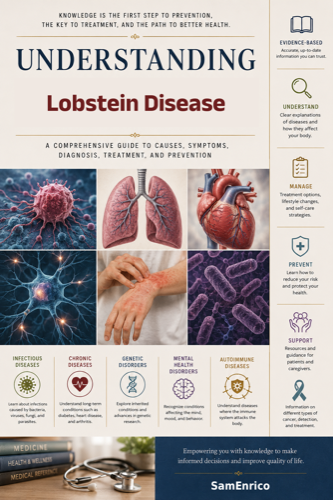
Non-FictionInformativeEducational
Understanding Lobstein Disease eBook
This disease publication, published by SamEnrico,
by Ayres Herb
This disease publication, published by SamEnrico, covers Understanding Lobstein Disease
Formats
Free sample
Chapter 1: The Silence Before...--There is a particular kind of silence that exists in a hospital room at three in the morning. It is not the absence of sound. The machines hum. The air vents hiss. The fluorescent lights buzz with a frequency that seems to vibrate in your teeth.
Nurses walk the hallways in soft-soled shoes, their footsteps a gentle shush-shush-shush. A baby cries somewhere down the corridor, and a mother’s voice answers, low and soothing, singing a lullaby that you cannot quite recognize. The silence I am talking about is not outside. It is inside. It is the hollow space that opens up in your chest when you are holding your child’s hand—so small, so pale, so impossibly fragile—and you realize that you have no idea what comes next.
You have no map. No guide. No guarantee. You have only the silence, and the beeping of the monitors, and the slow, steady rhythm of your child’s breathing.I have sat in that silence. I have felt it press against my ribs like a living thing.
I have watched the clock tick past midnight, past one, past two, while my son Liam slept in a hospital crib with a cast on his leg and an IV in his arm. I have counted his breaths—twenty-eight per minute, regular, shallow—and I have wondered if each one would be his last. I have stared at the ceiling and replayed the moment of his first fracture over and over, searching for a mistake I could correct, a warning sign I could have seen, a different choice that would have led to a different life. I have found nothing. The silence gave me no answers.
It only gave me more questions, more fear, more of that hollow ache that feels like grief but has not yet earned the name.That was four years ago. Liam is now a preschooler with a gap-toothed smile and a stubborn streak that could move mountains. He has had ninety-four fractures, eleven surgeries, and more X-rays than I can count. He uses a power wheelchair to get around the neighborhood, a walker to take wobbly steps across the living room, and a pair of forearm crutches that he calls his “robot arms” because he thinks they make him look like a superhero. He is the bravest person I have ever met, and he has no idea.
He thinks everyone lives like this. He thinks all children wake up some mornings with a new bruise and no memory of how it got there. He thinks it is normal to have a favorite orthopedist, to know the names of all the bones in the body, to ask a nurse for “the pink cast” because pink is his favorite color and if he has to be broken, he might as well be stylish about it.He is wrong, of course. This is not normal. This is Osteogenesis Imperfecta—Lobstein Disease, as it was once called—and it is the reason I am writing this book.
Not because I am a doctor. Not because I am a scientist. I am neither. I am a mother who spent four months in diagnostic limbo, eighteen months fighting an insurance company for a wheelchair, and three years learning to hear the whispers of my son’s body before they became screams. I am a mother who has held her child through seizures caused by medication, through the terror of a basilar invagination diagnosis, through the slow, grinding recovery of a spinal fusion.
I am a mother who has wept in parking lots, shouted at insurance adjusters, and fallen asleep in more hospital waiting rooms than I can count. I am also a mother who has laughed until she cried watching her son try to do a wheelie in his power chair, who has cheered louder at a single step with a walker than most parents cheer at a soccer goal, who has learned that joy is not the opposite of suffering but its companion.I am writing this book because when I sat in that hospital room at three in the morning, I had nothing to read. There were medical textbooks, dense and impenetrable, written for doctors who already knew the language. There were academic papers, locked behind paywalls, filled with statistics that meant nothing to a terrified parent. There were online forums, chaotic and contradictory, where one parent swore by a treatment that another parent called dangerous.
There were blogs and vlogs and social media posts, each one offering a piece of the puzzle but never the whole picture. What I needed was a book that sat beside me in the silence—a book that understood the fear but did not let it take over, a book that gave me facts without jargon, hope without false promises, and the quiet, steady presence of someone who had walked this path before. I needed this book. So I wrote it.The Anatomy of a Fracture: What Happens Inside the Bone Before we go any further, I need you to understand something about bones. Most people think of bones as dry, dead structures—like the skeletons you see hanging in science classrooms, bleached white and brittle as chalk.
That is not what living bone looks like. Living bone is pink and wet and teeming with life. It is filled with blood vessels, nerve endings, and two types of cells that are constantly at war: osteoblasts, which build bone, and osteoclasts, which break it down. In a healthy person, this war is a careful dance. The osteoblasts lay down new bone tissue, and the osteoclasts clear away old, damaged bone to make room for the new.
Every ten years or so, your entire skeleton is replaced. You are literally not the same person you were a decade ago, at least not in your bones.In a person with Osteogenesis Imperfecta, this dance becomes a catastrophe. The problem starts with collagen, the protein that gives bone its flexibility and resilience. Collagen is made up of three polypeptide chains twisted together like a triple-stranded rope. In most forms of OI, mutations in the COL1A1 or COL1A2 genes cause this rope to be defective.
Instead of a strong, flexible cord, you get a frayed, knotted mess. The osteoblasts try their best. They lay down collagen, and then they lay down minerals on top of that collagen—calcium and phosphate, the concrete to the collagen’s rebar. But if the rebar is defective, the concrete does not matter. The structure will crack under stress.
It will crack under normal stress. It will crack under no stress at all.This is why children with OI fracture so easily. Their bones are not “soft,” as some people assume. Soft bones would bend without breaking—like the bones of a child with rickets, which curve and bow but rarely snap. OI bones are brittle.
They are hard, but they lack the flexibility to absorb energy. Imagine dropping a ceramic plate versus dropping a rubber mat. The rubber mat bends and springs back. The ceramic plate shatters. That is the difference between a normal bone and an OI…
This is the end of the free sample. Get the eBook to keep going. Buy now
About this book
Details
- Author
- Ayres Herb
- Publisher
- SamEnrico
- Language
- English
- Genre
- Non-Fiction, Informative, Educational
- Released
- 2026-06-02
- Pages (approx.)
- 154
- Available as
- eBook, Audiobook

Read better in the ZLOADR app
Your eBooks on your phone or tablet. Sign in with your SamEnrico account and start reading.
More by Ayres Herb
 Subscription Service AdoptionAyres Herb$12.99
 Steve Jobs Calligraphy InfluenceAyres Herb$11.99
 Child Star Body Image TraumaAyres Herb$11.99
 Bullying At School Self Worth HandbookAyres Herb$11.99
 PNE for Tension HeadachesAyres Herb$11.99
 The Newlywed Stress Management GuideAyres Herb$11.99
 The Sultan's Vineyard: The Ottoman Empire's Great Wine FraudAyres Herb$11.99
 Extraction TechnicianAyres Herb$11.99
 How to Become a Last Putter-awayAyres Herb$11.99Subscription Service AdoptionAyres Herb$12.99
 Online Business LLC For Non ResidentsAyres Herb$12.99
You may also like
 Hong Kong Handover 1997Dunn Johnnie$11.99
 Zumba For Postnatal Recovery CourseNeal Christian$11.99
 Zumba for BeginnersLadner Nikia$11.99
 YouTube Comment Mining GuideHumes Pandora$12.99
 Worry Box MeditationCarlin Rudy$11.99
 Workplace Stress MeditationNguyen Lynn$11.99
 Workplace Stress and Sleep RepairHawley Ivory$11.99
 Workplace Perfectionism CureDelaney Jeffry$11.99
 Workplace Injustice Anger GuideWallen Isabelle$11.99
 Work Addiction and Burnout LinkGreenwood Ester$11.99
 Women in Yoga and WellnessBeattie Galina$11.99
 Women in Stand Up ComedyChun Evangeline$11.99