
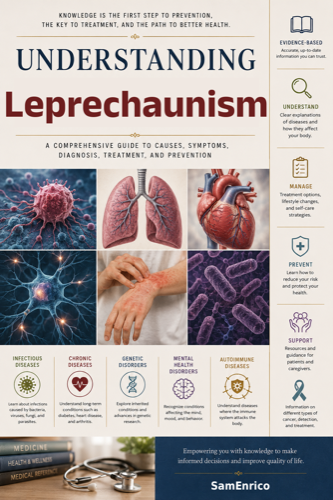
Understanding Leprechaunism
This disease publication, published by SamEnrico,
This disease publication, published by SamEnrico, covers Understanding Leprechaunism
Formats
About this book
Free sample
Chapter 1: The Elfin Child...--When Dr. William Donohue walked into the autopsy suite at the Hospital for Sick Children in Toronto in the winter of 1948, he expected to find answers to a medical mystery that had haunted his colleagues for months. The infant boy had been born at term, weighing barely four pounds, with eyes that seemed too large for his face and skin that hung in loose folds. The nurses had called him "different." The mother had called him beautiful. Neither knew that this child would become the first documented case of one of the rarest and most devastating genetic disorders known to medicine—a disease that would eventually bear Donohue's name, but which the world would come to know by a different, more whimsical, and ultimately more problematic moniker: Leprechaunism.The year 1948 marked a turning point in pediatric endocrinology.
Insulin had been discovered just twenty-seven years earlier, revolutionizing the treatment of diabetes. The medical community was still learning that hormones could go not only too low but also too high, and that sometimes the problem was not the quantity of a hormone but the body's ability to respond to it. Donohue was a pathologist, not an endocrinologist, but he had a detective's eye for patterns that others missed. As he examined the infant's tissues under the microscope, he noted something peculiar: the pancreas was enlarged, packed with beta cells that appeared hyperactive, yet the child had died emaciated, as if starved despite adequate nutrition. The liver showed no glycogen storage.
The thymus was atrophied. It was as if the child's body had been screaming for something that never arrived.What Donohue could not know in 1948 was that he was looking at the consequences of a completely dysfunctional insulin receptor. The gene that encodes this receptor, INSR, would not be mapped until 1985. The concept of insulin resistance as a primary genetic disorder was still decades away. But Donohue did something remarkable: he published his findings, describing two siblings with identical features, and suggested that this was a new, likely genetic, syndrome.
His original paper, "Leprechaunism: A Euphemism for a Rare Familial Disorder," appeared in the Journal of Pediatrics in 1954, coining…
This is the end of the free sample. Get the eBook to keep going. Buy now
Contents
- Chapter 1
- Chapter 2
- Chapter 3
- Chapter 4
- Chapter 5
- Chapter 6
- Chapter 7
- Chapter 8
- Chapter 9
- Chapter 10
- Chapter 11
- Chapter 12
Details
- Author
- Wimberly Randell
- Publisher
- SamEnrico
- Language
- English
- Genre
- Non-Fiction, Informative, Educational
- Released
- 2026-06-02
- Pages (approx.)
- 160
- Available as
- eBook, Audiobook

Read better in the ZLOADR app
Your eBooks on your phone or tablet. Sign in with your SamEnrico account and start reading.
More by Wimberly Randell
 Gardening for LongevityWimberly Randell$11.99
 The House of David EscapeWimberly Randell$11.99
 Social Anxiety FAQ GuideWimberly Randell$11.99
 Latin America Talent Exodus PatternsWimberly Randell$11.99
 Work Addiction Among Journalists GuideWimberly Randell$11.99
 Anansi's Lyrical Web: The Trickster’s Musical DeceptionWimberly Randell$11.99
 How to Start a Chains Made of Plastic Business (Beginners Guide)Wimberly Randell$11.99
 One Page Channel Strategy HandbookWimberly Randell$12.99
 Real Estate Climate Risk GuideWimberly Randell$12.99
 Construction Lead HandWimberly Randell$11.99